INFJ: The Advocate. They seek the deeper meaning of things.
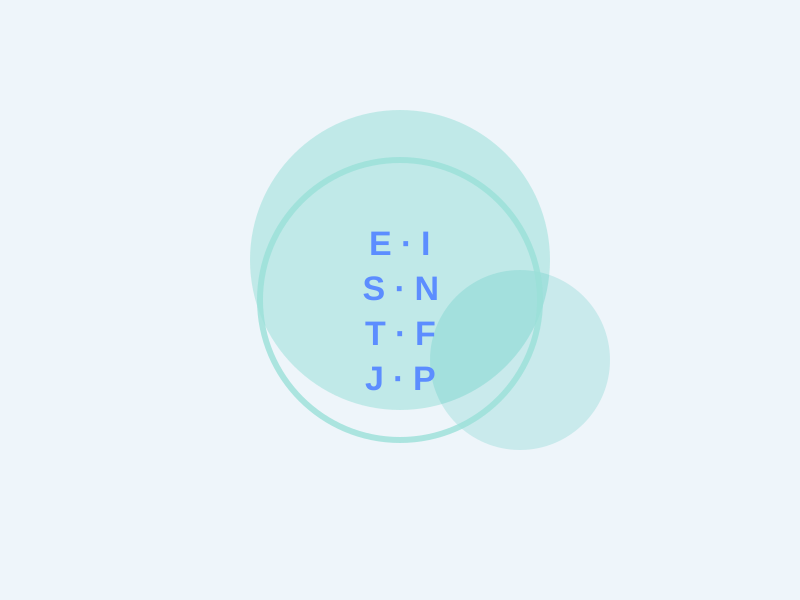
The INFJ profile is one of the sixteen types of the Myers-Briggs Type Indicator (MBTI), a questionnaire that sorts people according to four pairs of psychological preferences, such as introversion versus extraversion.
The nickname “Advocate” doesn’t come from the official MBTI but from the 16Personalities website, which uses its own names for each type. In David Keirsey’s temperament classification (1998), the same code is called the Counselor.
It’s a small group: in the US national sample reported in the MBTI manual (Myers, McCaulley, Quenk and Hammer, 1998; N = 3,009), it makes up 1.5% of the population, with 1.6% among women and 1.3% among men. If you gathered a hundred people at random from that population, you’d expect to find one or two. These figures describe that US sample, not the general population of other countries.
These people process what they live through by looking for the deeper meaning of things. Staying on the surface isn’t enough: they need to understand the why.
They’re guided by an inner intuition that picks up connections and nuances that aren’t obvious, and by an empathy that goes beyond feeling with others and aims to change the reality around them.
Understanding this pattern is useful for several practical reasons: it helps make sense of their high self-demand, the isolation they sometimes fall into when they feel nobody fully understands them, and the exhaustion that comes from giving themselves tirelessly to causes that pursue other people’s wellbeing.
The INFJ function hierarchy
In Myers’s theory, each type ranks four mental functions from most to least developed. According to the most widely used hierarchy model, for the INFJ they are:
- Dominant: Introverted Intuition (Ni). It quietly synthesizes impressions and patterns into a big-picture vision, often before being able to explain how it got there.
- Auxiliary: Extraverted Feeling (Fe). It carries that vision toward people: it pays attention to group harmony and to what others need.
- Tertiary: Introverted Thinking (Ti). It adds internal logical analysis, more present with maturity.
- Inferior: Extraverted Sensing (Se). Contact with immediate physical detail, the least comfortable function and the one that surfaces under stress.
The Advocate’s moral engine and core traits
The INFJ character doesn’t settle for drifting along with inertia. They feel a need to step up when things get difficult, even when looking the other way would be easier, and they measure success by consistency with what they truly value and by the common good, more than by money or status.
- A search for purpose: they’re driven to discover their life’s mission and act in tune with it. In practice, this can mean changing jobs or direction several times until they find work aligned with their values, even if it costs them some stability.
- Intuitive wisdom: they steer by a very clear framework of principles that works as their compass, often setting themselves apart from social expectations. They may turn down a promotion if they feel it doesn’t fit with what they consider right.
- Active idealism: they aren’t passive dreamers. They have concrete goals and tend to get directly involved, for example by organizing a community initiative in their neighborhood instead of just talking about it.
Distinctive strengths in everyday practice
- Psychological insight: they quickly pick up on what goes unsaid and on people’s underlying intentions. They often sense that something is off in a conversation before the other person puts it into words.
- Creativity and imagination: they use their sensitivity and their vision of the future to come up with original solutions to complex human problems, such as an unconventional way of mediating in a family conflict.
- Leadership by inspiration: they prefer to lead by example and through voluntary cooperation around a shared ideal. It’s a leadership that persuades more than it commands.
- Written eloquence: they often express their inner world more fluently in writing, warmly and precisely. It’s not unusual for them to feel more comfortable drafting a thoughtful letter than defending their position out loud in an argument.
Behavior patterns and relationship dynamics
Despite their outward warmth, an INFJ’s social behavior tends to be reserved. Because they carry such a rich inner life, it’s common for them to feel different from most people, which sometimes makes it hard to fit into conventional circles.
- A rejection of superficiality: they avoid filler small talk and prioritize conversations with real meaning.
- Authentic bonds: they prefer a few close friendships, where they enjoy knowing and being known, over many superficial relationships.
- Weighing their impact: they calmly consider how their actions will affect other people’s feelings before deciding, even on small matters.
- Sensitivity to criticism: they can take negative comments very personally and keep turning them over for longer than the comment deserved.
The risk of excessive altruism and the impact of stress
Their dedication to fixing injustices and speaking up for the disadvantaged can become a source of wear when the INFJ puts their own care on the back burner and fatigue piles up without them paying attention to it.
- Conflict avoidance: they feel a deep aversion to direct confrontation and sometimes leave problems unresolved in the hope that they’ll fade on their own.
- Firmness on principles: if they sense that a basic moral principle is being violated, they drop their usual flexibility and defend their position with a rigidity that surprises people who only know their conciliatory side.
- Tension that reaches the body: because they hold tension in instead of expressing it, they often notice it as fatigue or muscle tension.
Psychologist Naomi Quenk (2002) described how, under intense stress, the inferior function “takes over” in a crude way. In types with dominant Introverted Intuition, like the INFJ, this state shows up in two signs: an excess of sensory activities (compulsive eating, cleaning or tidying) and an obsessive focus on external facts and details, such as rereading a message over and over in search of a hidden meaning that probably isn’t there. Quenk presents it as a passing, recognizable episode, not as a trait of the type.
How to read this portrait
Like the rest of the MBTI types, this profile describes preferences with more popular tradition than psychometric backing at the level of the Big Five, the model with the most research support. It’s useful as a map for understanding yourself, not as a diagnosis.
If you saw yourself in this portrait, you can explore it with our 16 personalities test.
The INFP profile shares that same inner world of values, although it prefers to keep options open rather than settle and decide: that’s the difference between the J and the P.
Sources
- Keirsey, D. (1998). Please Understand Me II: Temperament, Character, Intelligence. Prometheus Nemesis.
- Myers, I. B., McCaulley, M. H., Quenk, N. L. and Hammer, A. L. (1998). MBTI Manual: A guide to the development and use of the Myers-Briggs Type Indicator (3rd ed.). Consulting Psychologists Press.
- Quenk, N. L. (2002). Was That Really Me? How Everyday Stress Brings Out Our Hidden Personality. Davies-Black.
Want to know more about yourself?
Discover your result with one of our related tests.
Frequently asked questions
What does it mean to be an INFJ?
A profile led by Introverted Intuition, with Extraverted Feeling as its auxiliary function: people who search for the deeper meaning of things and are guided by strong empathy.
Why is the INFJ the rarest MBTI type?
In the US national sample published in the MBTI manual (1998), it accounts for 1.5% of the population (1.3% of men and 1.6% of women), the lowest figure of the 16 types. Popular type literature often links this to the uncommon pairing of abstract intuition with a need for structure (Judging), although the data describe frequency, not its cause.
What's the biggest risk for an INFJ?
Burnout from excessive altruism: because they focus so heavily on outward ideals, they tend to put self-care on hold and build up stress until they notice it in their body.