What's the Rarest Personality Type?
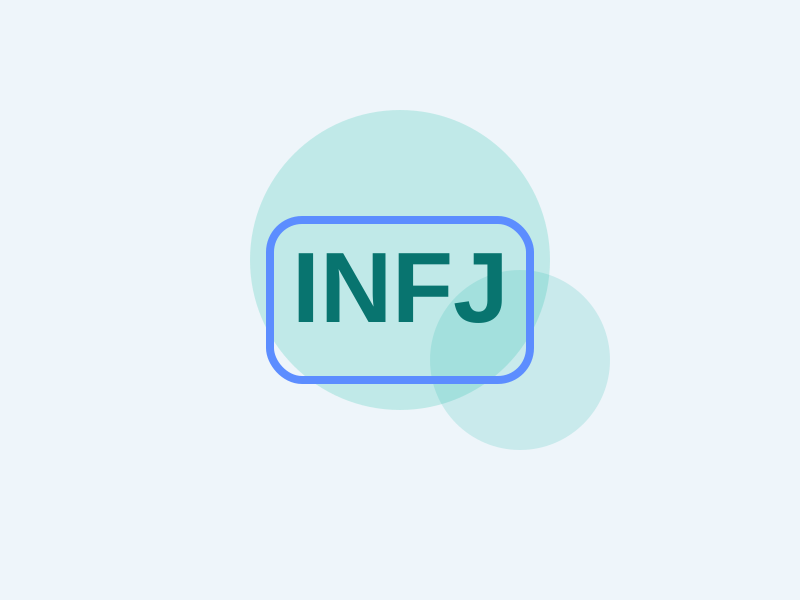
The Myers-Briggs Type Indicator (MBTI) sorts personality into 16 types that combine four preferences. Of all the combinations, the INFJ (Introversion, Intuition, Feeling, and Judging) is the least frequent in the instrument’s reference sample.
In popular writing it goes by different nicknames depending on the school: David Keirsey called it the Counselor within his Idealist temperament (Keirsey, 1998), and the 16personalities site calls it the Advocate. Neither name belongs to the official MBTI, which uses only the letters.
If you’re curious whether your own result lands near this extreme or the most common one, you can check with our 16 personalities test.
The numbers: where the 1.5% comes from
- Overall percentage: the INFJ makes up around 1.5% of the US national sample published in the 1998 manual (Myers, McCaulley, Quenk, & Hammer, 1998; N = 3,009), the lowest figure of the sixteen profiles.
- By sex: it sits at about 1.3% among men and 1.6% among women. It is one of the few types that is almost equally scarce in both sexes.
- For comparison: the most common profile among women is the ISFJ (19.4%), and among men, the ISTJ (16.4%).
One nuance changes the answer depending on how the question is asked. Split by sex, there are even scarcer groups: INTJ women are about 0.8% of the female population and ENTJ women 0.9%. The INFJ is the rarest type overall; the INTJ woman is the rarest subgroup.
It also helps to remember what that sample is: an estimate for the United States in the late 1990s. Figures from other countries, or from online tests with self-selected participants, may come out differently. The full table is in the article on population percentages by type.
Why it comes out so low: a simple calculation
If the four preferences were independent, multiplying their percentages would be enough. With the manual’s data (50.7% Introversion, 26.7% Intuition, 59.8% Feeling, and 54.1% Judging), the INFJ should come in around 4.4%. It comes in at 1.5%, about three times lower.
The gap shows that the preferences are not distributed at random: Intuition appears more often alongside Perceiving than alongside Judging. The four NJ types (INFJ, INTJ, ENFJ, and ENTJ) add up to less than 8% of the sample, when simple multiplication says they should exceed 14%.
Research on the Big Five model offers a framework for reading this. McCrae and Costa (1989) found that the MBTI’s S-N scale corresponds mainly to openness to experience (a correlation of 0.72 with Intuition) and the J-P scale to conscientiousness (the Judging pole, the more organized one). In those terms, the INFJ describes someone with a lot of openness and, at the same time, a clear preference for order: a possible and valuable mix, but one that shows up in the data less often than probability predicts.
How the INFJ works from the inside
According to the model’s hierarchy of functions (Myers & McCaulley, 1985), the INFJ is ordered like this:
- Dominant, Introverted Intuition: processes information internally, looking for patterns and meanings rather than isolated data.
- Auxiliary, Extraverted Feeling: takes its decisions outward, attending to values and to harmony between people.
- Tertiary, Thinking: logical analysis that is available, but less comfortable.
- Inferior, Extraverted Sensing: attention to the concrete details of the surroundings. Quenk (2002) describes how, under stress or fatigue, this function can appear in an exaggerated form, for example as unusual attention to sensory details or impulsive behavior that is out of character for the type.
What sets it apart is the mix of a very inward perception with a closure-oriented way of deciding. Most introverted intuitive profiles, like the INFP or the INTP, prefer Perceiving and leave conclusions open for longer. The INFJ, by contrast, tends to turn its intuitions into plans and to see them through with perseverance.
What rarity does not mean
Being uncommon in a sample does not make a type better, deeper, or smarter. Nor does it explain on its own how someone feels: the sense of “being different” often attributed to INFJs is an idea from popular writing, not a research finding.
The figure also inherits the limitations of the instrument itself. A considerable share of people get a different type when they retake the questionnaire a few weeks later, especially if one scale sits close to the cutoff point (Pittenger, 2005), and that affects types with small percentages more. Type descriptions reflect general orientations of normal personality and do not replace a professional psychological assessment.
Sources
- Keirsey, D. (1998). Please Understand Me II: Temperament, Character, Intelligence. Prometheus Nemesis.
- McCrae, R. R., & Costa, P. T. (1989). Reinterpreting the Myers-Briggs Type Indicator from the perspective of the five-factor model of personality. Journal of Personality, 57(1), 17-40.
- Myers, I. B., & McCaulley, M. H. (1985). Manual: A guide to the development and use of the Myers-Briggs Type Indicator. Consulting Psychologists Press.
- Myers, I. B., McCaulley, M. H., Quenk, N. L., & Hammer, A. L. (1998). MBTI Manual: A guide to the development and use of the Myers-Briggs Type Indicator (3rd ed.). Consulting Psychologists Press.
- Pittenger, D. J. (2005). Cautionary comments regarding the Myers-Briggs Type Indicator. Consulting Psychology Journal: Practice and Research, 57(3), 210-221.
- Quenk, N. L. (2002). Was That Really Me? How Everyday Stress Brings Out Our Hidden Personality. Davies-Black.
Want to know more about yourself?
Discover your result with one of our related tests.
Frequently asked questions
What's the rarest MBTI type?
The INFJ, which makes up around 1.5% of the US national sample in the MBTI manual (1998). Keirsey calls it the Counselor and the 16personalities site the Advocate; neither nickname belongs to the official MBTI.
Why is the INFJ so uncommon?
The data describe its frequency, not its cause. What can be observed is that Intuition (N) shows up more often alongside Perceiving (P) than alongside Judging (J): the four NJ types together make up less than 8% of the sample.
How is the INFJ different from other intuitive types like the INFP or INTP?
Those types prefer Perceiving, which makes them fluid and in no rush to conclude anything; the INFJ, by contrast, applies almost stubborn tenacity and perseverance to make their visions real.
Is there any group even rarer than the INFJ?
Yes, if you split by sex. In the same sample, INTJ women are about 0.8% of the female population and ENTJ women 0.9%, below the INFJ's 1.5% of the total.