What Is Myers-Briggs Theory?
Myers-Briggs psychological type theory is a model of personality that explains differences in behavior through a small number of preferences that, according to the theory, each person is born with.
It builds on Carl Jung’s psychological types (Jung, 1921) and was turned into a practical questionnaire by Katharine Briggs and Isabel Briggs Myers (Myers and McCaulley, 1985). Its central idea is that differences in behavior aren’t random but come from different ways people direct their energy, process information and make decisions.
The model’s goal is to sort those inclinations into 16 qualitative personality types. It’s a framework for general understanding and self-knowledge, not a diagnostic tool.
Types versus traits: what sets this model apart
Personality psychology describes people in two ways: by types (qualitative, discrete categories, like this one) or by traits (continuous dimensions, like the Big Five).
Myers-Briggs assigns each person one of 16 fixed profiles; the Big Five, by contrast, places each person at a point on a continuous spectrum for each trait.
The difference isn’t just one of format. A type model is easier to remember (“I’m an INFJ” says more at a glance than five scores), but it forces people who sit near the midpoint of a dimension to pick a pole, something a continuous model doesn’t do.
That’s one of the reasons the scientific backing for the MBTI is weaker than for the Big Five. McCrae and Costa (1989) showed that the four MBTI scales correspond to four of the five major factors (extraversion, openness, agreeableness and conscientiousness), but that they behave like continuous dimensions rather than separate types. Pittenger (1993; 2005) also reviewed studies in which a considerable share of people got a different type when retaking the questionnaire a short time later, especially those who scored near the center of a scale.
The four dimensions of personality
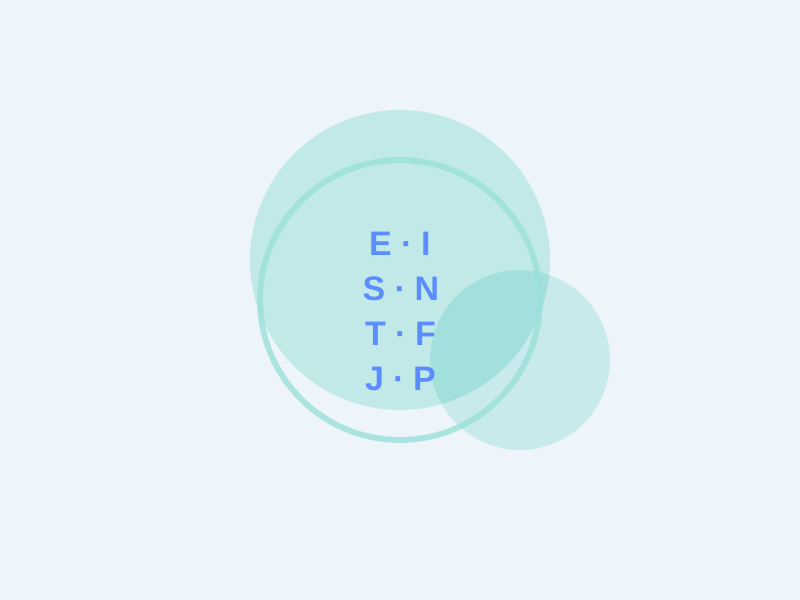
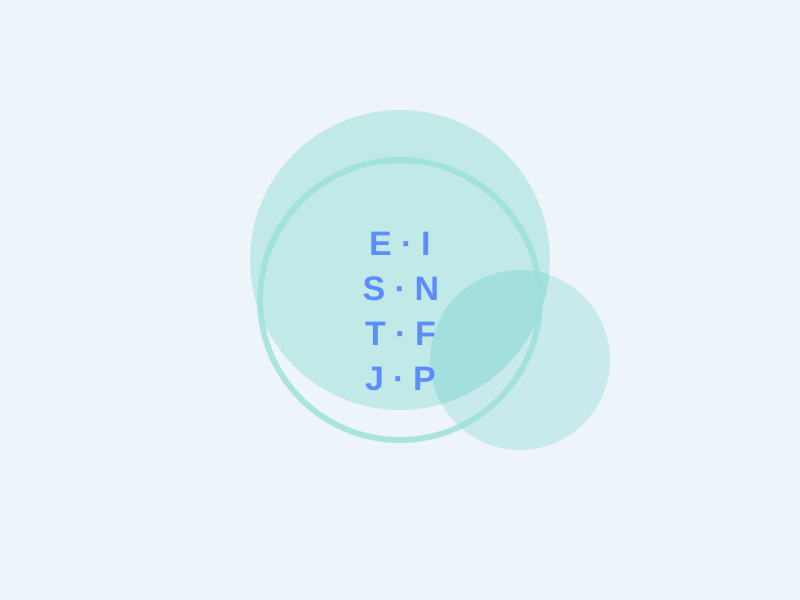
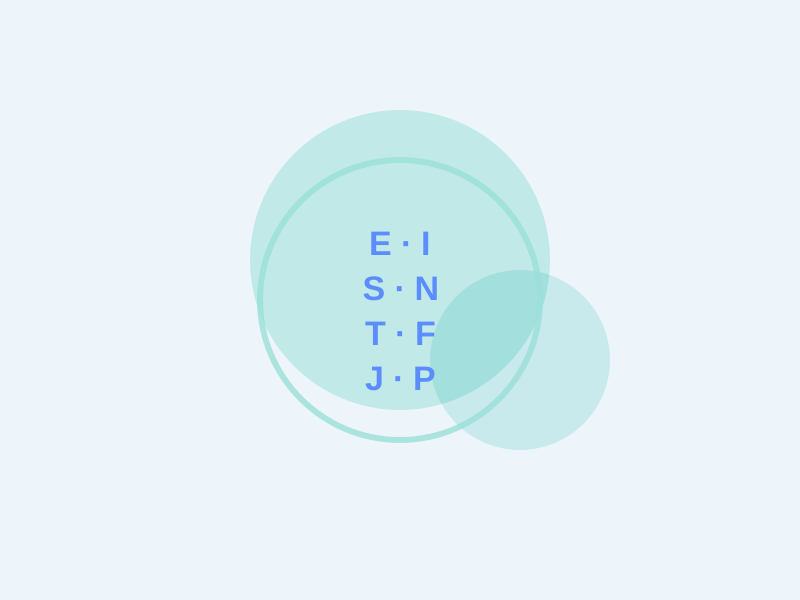
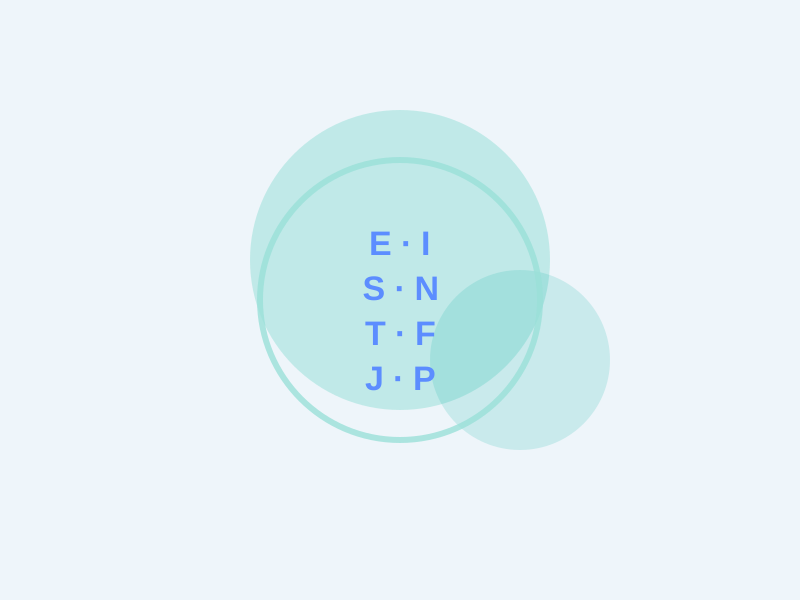
The model is organized around four dichotomies. According to the theory, each person leans toward one pole of each pair.
- Extraversion (E) - Introversion (I): where energy is directed. An extraverted person is oriented toward the outer world of people and action; an introverted person, toward the inner world of concepts and ideas.
- Sensing (S) - Intuition (N): how information is gathered. The sensing pole trusts tangible facts and the present; the intuitive pole looks for patterns, meanings and future possibilities.
- Thinking (T) - Feeling (F): what criteria are used to decide. Someone who prefers thinking analyzes logical, impersonal consequences; someone who prefers feeling evaluates according to personal or social values.
- Judging (J) - Perceiving (P): how one deals with the outside world. A preference for Judging seeks planning and closure; Perceiving prioritizes flexibility and keeping options open.
The dynamics and hierarchy of functions
Combining the four letters produces a code (for example, INTJ or ENFP). But the theory isn’t a simple sum of letters: within each type there’s a hierarchy of mental functions.
The dominant function carries the most weight in a person’s character and sets its main direction. The auxiliary complements it: if the dominant is oriented toward the inner world, the auxiliary handles the outer one, and vice versa. Below them come a tertiary function and an inferior one, the least developed.
The inferior function has a role of its own in the theory. Psychologist Naomi Quenk (2002) described how, under intense stress, that little-trained function can take over in a crude way, which explains why a person can behave “not like themselves” at moments of great pressure.
MBTI and 16personalities: two different tests
Many people who search for a “16 personalities test” actually land on 16personalities.com, which isn’t the MBTI. That website, run by the company NERIS Analytics, borrows the four-letter format but:
- Is based on traits: it reworks Big Five dimensions instead of Jung’s preferences, and the site itself explains that it doesn’t use cognitive functions.
- Adds a fifth letter: Assertive (-A) or Turbulent (-T), a scale related to stress sensitivity that the MBTI doesn’t have.
- Uses its own nicknames: names like “Architect,” “Advocate” or “Mediator” belong to that website, not to the official MBTI.
The official MBTI is published by The Myers-Briggs Company (formerly CPP, Consulting Psychologists Press) and is paid. Our test is yet another questionnaire, inspired by the four-axis model.
Applications and limitations of the model
The typology is used mainly in personal development, career guidance, communication and conflict management at work: it helps people see that many disagreements stem from different styles of processing information, not from bad intentions.
Despite its practical usefulness, the indicator measures preferences, not abilities or levels of intelligence. It doesn’t determine success in a profession and shouldn’t be used to limit anyone’s possibilities. It’s a reference point for getting to know yourself, and the human psyche will always be more complex than any classification.
If you’d like to see this theory applied to your own case, you can take our 16 personalities test and get your four-letter code in a few minutes.
Sources
- Jung, C. G. (1921). Psychologische Typen. Rascher.
- McCrae, R. R. and Costa, P. T. (1989). Reinterpreting the Myers-Briggs Type Indicator from the perspective of the five-factor model of personality. Journal of Personality, 57(1), 17-40.
- Myers, I. B. and McCaulley, M. H. (1985). Manual: A guide to the development and use of the Myers-Briggs Type Indicator. Consulting Psychologists Press.
- NERIS Analytics (n.d.). Our Theory. 16Personalities. Theory page
- Pittenger, D. J. (1993). The utility of the Myers-Briggs Type Indicator. Review of Educational Research, 63(4), 467-488.
- Pittenger, D. J. (2005). Cautionary comments regarding the Myers-Briggs Type Indicator. Consulting Psychology Journal: Practice and Research, 57(3), 210-221.
- Quenk, N. L. (2002). Was That Really Me? How Everyday Stress Brings Out Our Hidden Personality. Davies-Black.
Want to know more about yourself?
Discover your result with one of our related tests.
Frequently asked questions
What is Myers-Briggs theory?
A personality assessment model that sorts a person's natural preferences into 16 qualitative types, based on how they direct their energy, process information and make decisions.
Who created this theory?
It's based on Carl Jung's psychological types (1921) and was developed into a practical questionnaire by Katharine C. Briggs and Isabel Briggs Myers.
What are the model's four dimensions?
Extraversion-Introversion, Sensing-Intuition, Thinking-Feeling and Judging-Perceiving.
Is the MBTI the same as the 16personalities.com test?
No. The MBTI is Briggs and Myers's official questionnaire, published today by The Myers-Briggs Company. 16personalities.com is a different test, from the company NERIS Analytics, that borrows the four letters but is based on Big Five-style traits, adds a fifth letter (-A or -T) and doesn't use Jung's functions.