Who Created the 16 Personalities Test?
The type indicator now popularly known as the “16 personalities test,” or the MBTI (Myers-Briggs Type Indicator), was created by two women with no academic training in psychology: a mother and her daughter, who worked on it from home for more than two decades.
Their story is well documented in two biographies: Frances Wright Saunders’s (1991), written with access to the family papers, and Merve Emre’s (2018), more critical, which also reconstructs how the questionnaire became a business.
A mother who was cataloguing personalities before she knew Jung
Katharine Cook Briggs (1875-1968) began observing and classifying differences in temperament before she read Jung.
According to her biographers, the starting point was Clarence “Chief” Myers, her daughter Isabel’s boyfriend and later husband: his way of being was so different from the Briggs family’s that Katharine set out to understand where those differences came from. She began collecting biographies and sketching her own classification of characters.
When the English translation of Carl Jung’s Psychological Types (1921) came out in 1923, Briggs found in the book a theoretical framework that matched years of homemade observation, and she dropped her own system to adopt Jung’s. In 1926 she published a popular article in The New Republic inviting readers to identify their own type.
Isabel Briggs Myers: from mystery novelist to test author
Her daughter, Isabel Briggs Myers (1897-1980), studied political science at Swarthmore College and had no training in psychology or statistics. Before devoting herself to the questionnaire, she had won a literary contest with her detective novel Murder Yet to Come (1930), followed by a second one, Give Me Death (1934).
In the early 1940s she began designing questions, trying them out on acquaintances and refining the questionnaire by hand, teaching herself the basics of test construction.
During World War II, with much of the workforce mobilized and a need to assign each person a job in industry, mother and daughter saw a practical application for their instrument. The first paper versions circulated around 1943.
From home project to published instrument
For years the indicator remained a project sustained almost single-handedly by Isabel, who gave it to thousands of medical and nursing students to accumulate data.
The breakthrough came in 1962, when the Educational Testing Service (ETS), the organization that runs major standardized exams in the United States, published a research version of the indicator with its first manual. The relationship wasn’t easy: Emre (2018) documents the reservations several of the organization’s psychometricians had about the questionnaire’s foundations.
The following decades consolidated the instrument:
- 1969: Isabel begins working with psychologist Mary McCaulley in a typology lab at the University of Florida.
- 1975: Consulting Psychologists Press (now The Myers-Briggs Company) becomes the MBTI’s publisher, and Myers and McCaulley found the Center for Applications of Psychological Type (CAPT), devoted to research and training.
- 1980: Isabel Briggs Myers dies, the same year her book Gifts Differing is published.
- 1985 and 1998: the second and third editions of the manual appear (Myers and McCaulley, 1985; Myers, McCaulley, Quenk and Hammer, 1998), with reliability data and a national reference sample.
How the four dimensions work
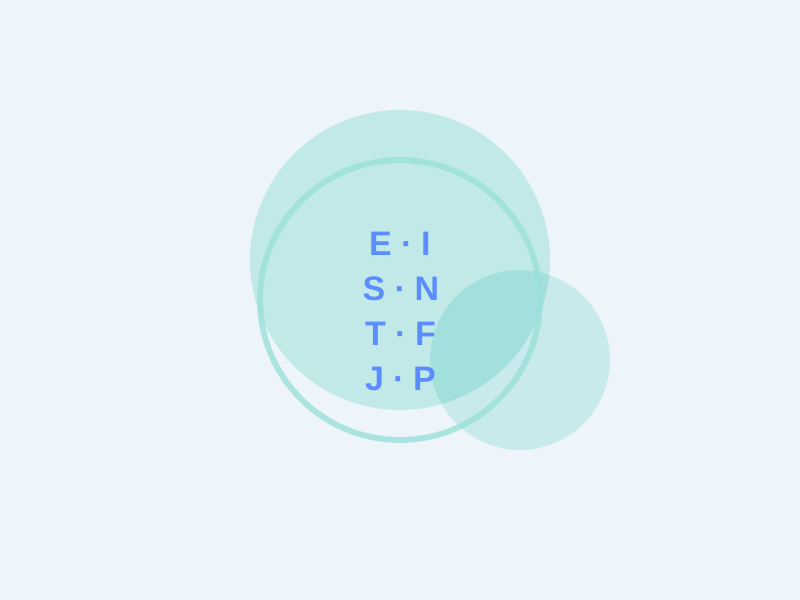
The indicator was built on four bipolar scales, combining Jung’s ideas with Briggs and Myers’s own contributions:
- Energy orientation: Extraversion (E) versus Introversion (I). Whether the focus is directed toward the outer world or the inner world of ideas.
- Taking in information: Sensing (S) versus Intuition (N). Literal recording through the senses versus picking up patterns and possibilities.
- Decision-making: Thinking (T) versus Feeling (F). Logical, impersonal analysis versus values-based evaluation.
- Outward style: Judging (J) versus Perceiving (P). A preference for a structured environment or for a flexible approach.
The fourth scale is Briggs and Myers’s major original contribution: Jung didn’t formulate it as a separate dimension. They used it to work out which function is dominant in each type.
Crossing these variables produces a four-letter code (such as INFJ or ESTP) that describes one of the 16 types, although they don’t all appear with the same frequency in the population.
What about 16personalities.com?
The website that shows up first today when you search for “16 personalities test” isn’t Briggs and Myers’s work. 16personalities.com belongs to the company NERIS Analytics and was launched in the 2010s. It borrows the four-letter format, but its model is based on Big Five-style traits, adds a fifth letter (Assertive, -A, or Turbulent, -T) and, as the site itself explains, doesn’t use Jung’s functions. The nicknames for each type, such as “Architect” or “Mediator,” are also its own.
So the question of who created “the 16 personalities test” has two answers: Briggs and Myers created the MBTI and the 16 types; NERIS Analytics created the online test that bears that name today.
Evolution and impact
What began as a family observation project became a published instrument from 1962 on and one of the most widely used personality questionnaires in the world for career guidance and team building.
Its popularity doesn’t amount to scientific backing: research has questioned how stable the types are when the test is retaken and whether they work as closed categories, as explained in what Myers-Briggs theory is. Its value today is mainly educational: it translates complex ideas about individual differences into a clear, easy-to-remember map.
You can try a digital version of a questionnaire inspired by that model in our 16 personalities test.
Note: this self-reported typology is general-interest material for self-knowledge. It doesn’t measure pathologies or intellectual aptitudes and doesn’t replace an assessment by a qualified professional.
Sources
- Emre, M. (2018). The Personality Brokers: The Strange History of Myers-Briggs and the Birth of Personality Testing. Doubleday.
- Jung, C. G. (1921). Psychologische Typen. Rascher.
- Myers, I. B. and McCaulley, M. H. (1985). Manual: A guide to the development and use of the Myers-Briggs Type Indicator. Consulting Psychologists Press.
- Myers, I. B., McCaulley, M. H., Quenk, N. L. and Hammer, A. L. (1998). MBTI Manual: A guide to the development and use of the Myers-Briggs Type Indicator (3rd ed.). Consulting Psychologists Press.
- NERIS Analytics (n.d.). Our Theory. 16Personalities. Theory page
- Saunders, F. W. (1991). Katharine and Isabel: Mother’s Light, Daughter’s Journey. Consulting Psychologists Press.
Want to know more about yourself?
Discover your result with one of our related tests.
Frequently asked questions
Who created the 16 personalities test?
Katharine Cook Briggs and her daughter Isabel Briggs Myers, building on Carl Jung's theory of psychological types, published in 1921. Note: the 16personalities.com website is a different test, created by the company NERIS Analytics in the 2010s.
When was the first questionnaire created?
The first paper versions were put together during World War II, around 1943; the Educational Testing Service published a research version of the indicator, with its first manual, in 1962.
Why was this test created?
To help people identify their natural inclinations and find jobs suited to their profile, especially in the context of a wartime crisis that demanded assigning tasks quickly.