Is the 16 Personalities Test Based on Carl Jung's Theory?
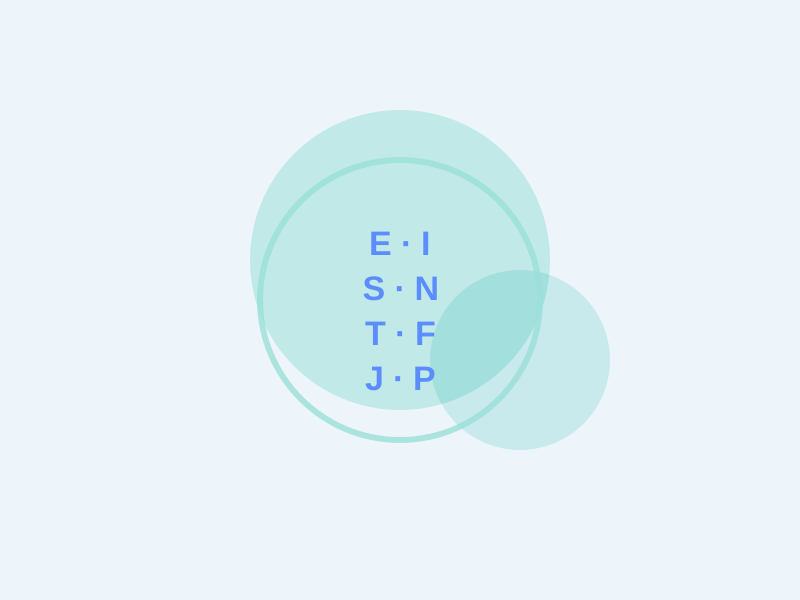
The Myers-Briggs Type Indicator (MBTI) has its roots directly in the theory of psychological types put forward by the Swiss psychiatrist Carl Gustav Jung in 1921 (Jung, 1921). It isn’t a literal copy of his work, though: it’s a practical adaptation and extension developed decades later by Katharine Cook Briggs and Isabel Briggs Myers (Myers & McCaulley, 1985), with at least two fundamental differences from the original Jung that rarely get explained.
Jung’s legacy: functions and attitudes
Carl Jung argued that human consciousness orients itself through two attitudes toward energy (Extraversion and Introversion) and four basic mental functions, split into two core processes:
Perceiving processes (how we gather information)
- Sensing (S): a direct focus on observable facts through the five senses, realism, and the present.
- Intuition (N): a focus on relationships, hidden meanings, patterns, and future possibilities.
Judging processes (how we make decisions)
- Thinking (T): conclusions based on logical analysis, cause and effect, and impersonal objectivity.
- Feeling (F): conclusions based on weighing personal values, social values, and relational harmony.
Jung grouped them into two irrational, or perceiving, functions (Sensing and Intuition) and two rational, or judging, functions (Thinking and Feeling), and combined each one with the two attitudes (Jung, 1921).
Myers-Briggs’s contribution: everyday structure
Decades later, Briggs and Myers translated these complex conceptual dynamics into a practical model.
Their main methodological contribution was making explicit a dimension that stayed implicit in Jung’s work: the Judging (J) - Perceiving (P) dichotomy.
- Judging (J): describes people who prefer to interact with the outside world in an organized, planned way, seeking closure or a quick decision.
- Perceiving (P): describes those who prefer an open, flexible, spontaneous attitude, oriented toward gathering more information before deciding.
This fourth scale made it possible to systematize the formula for identifying which mental processes are dominant and which are auxiliary in each person’s inner and outer world.
Two fundamental differences between Jung and the MBTI
Beyond adding the Judging-Perceiving scale, Briggs and Myers departed from Jung on two decisions that considerably change what the test measures in practice:
- Jung described the functions as something dynamic over a lifetime, not as a fixed snapshot: for him, a person could develop different functions depending on their life stage or context, and “individuation” was precisely the process of integrating one’s less developed functions over time. The MBTI, by contrast, assigns a type based on a single questionnaire and treats it as relatively stable, a necessary simplification to make the indicator practical, but one that moves away from Jung himself.
- Jung never proposed a closed list of 16 combinations. He wrote about eight types (crossing the two attitudes with the four functions), not sixteen (Jung, 1921). The jump from 8 to 16 types, with the J-P scale as a fourth independent axis, is a later construction by Myers (Myers & McCaulley, 1985), not a literal reading of Psychological Types.
Jung held that although we all use the four functions daily, each individual develops a dominant function (the personality’s “captain”) and an auxiliary function that complements it. That inner hierarchy is the part of the model the MBTI keeps most faithful to the original Jung, more so than the final number of types.
The result is a useful tool for self-knowledge, but it is a pedagogical, simplified reading of Jung, not a direct transcription of his work. A second gap adds to that one: many tests that circulate with the same four letters, such as the one at 16personalities.com (NERIS Analytics, with its -A/-T suffix), no longer start from Jung at all but from trait scales inspired by the Big Five.
You can see how this theory translates into a concrete result with our 16 personalities test, which is meant for general interest and does not replace a professional assessment.
Sources
- Jung, C. G. (1921). Psychologische Typen. Rascher.
- Myers, I. B., & McCaulley, M. H. (1985). Manual: A guide to the development and use of the Myers-Briggs Type Indicator. Consulting Psychologists Press.
Want to know more about yourself?
Discover your result with one of our related tests.
Frequently asked questions
Is the MBTI a copy of Jung's theory?
Not exactly. It's directly based on his psychological types (1921), but Briggs and Myers adapted and expanded it decades later, adding the Judging-Perceiving dimension that stayed implicit in Jung's work.
What are the dominant and auxiliary functions, according to Jung?
The dominant function is a person's leading mental process (the 'captain' of their personality); the auxiliary function complements it, helping balance the inner and outer worlds.
Does the MBTI measure the amount of a trait?
No. Unlike other psychological tests, it measures dichotomies (qualitative preferences), not quantities: no pole is better, worse, or healthier than its opposite.