What Each Letter of the Personality Code Means
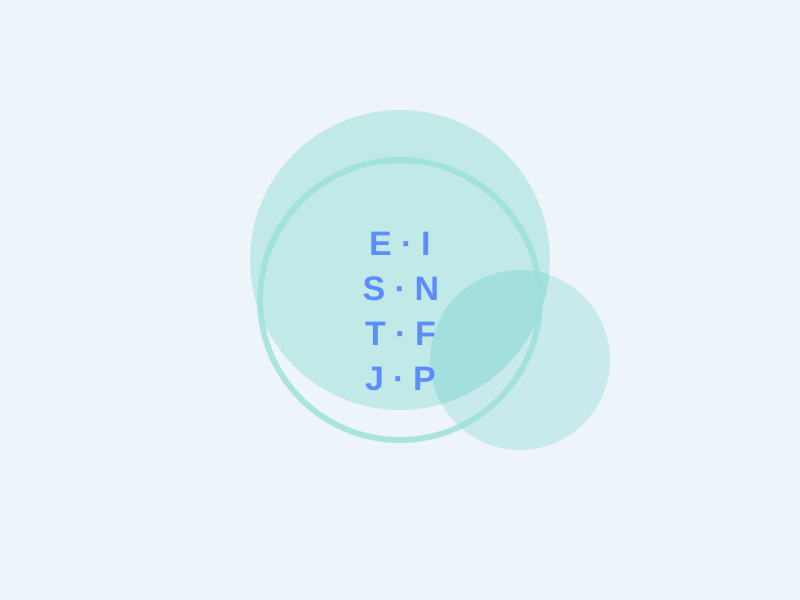
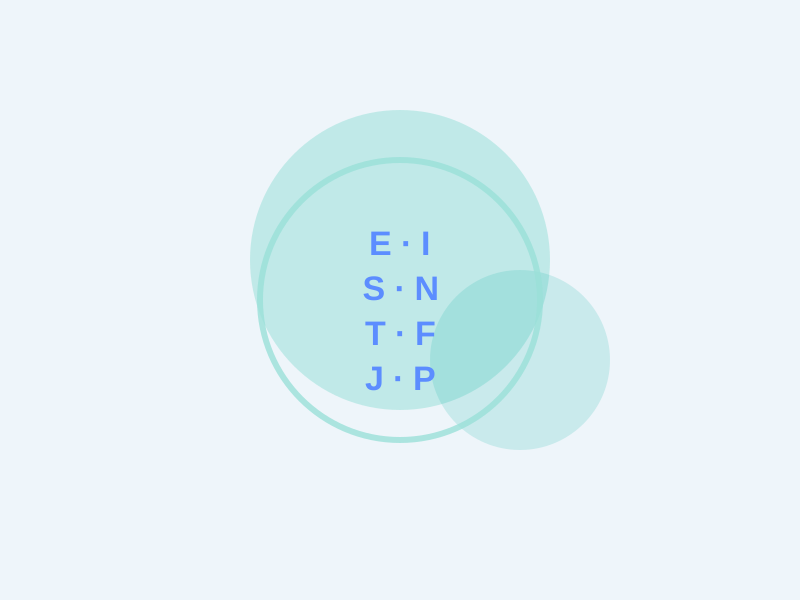
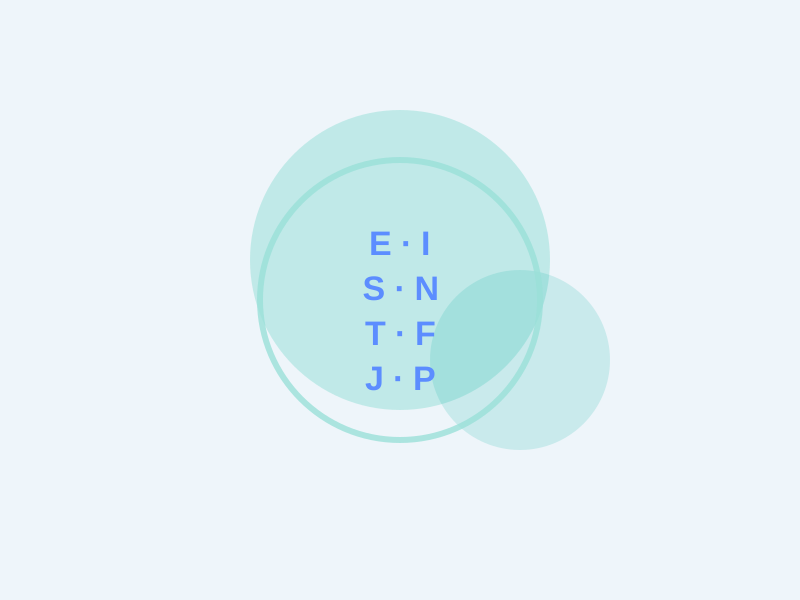
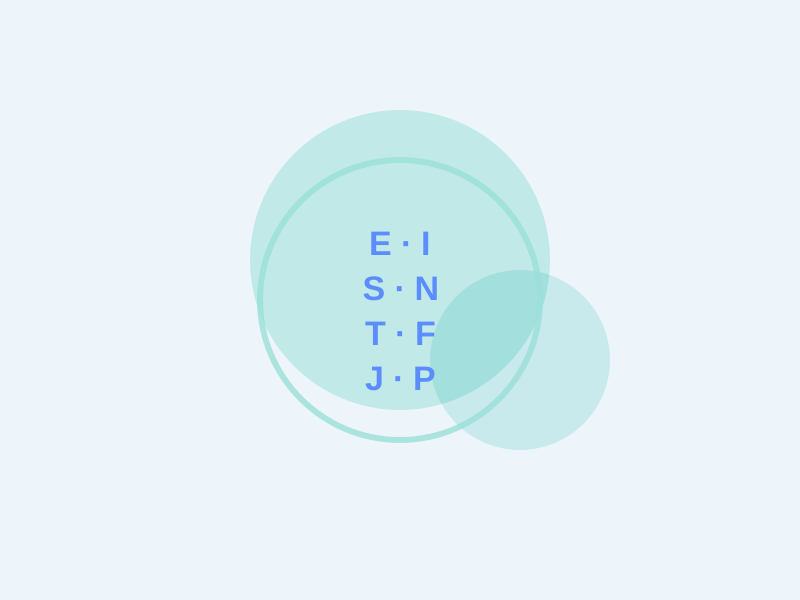
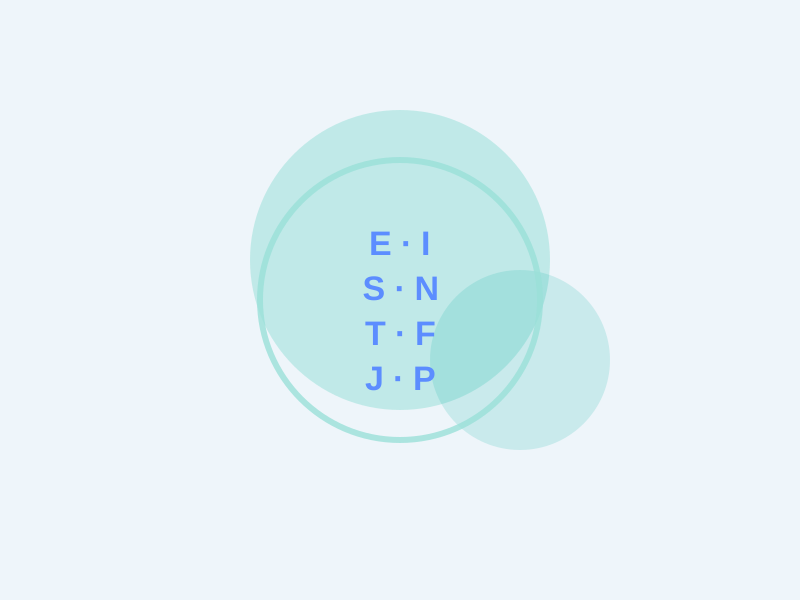
The four-letter code of the Myers-Briggs Type Indicator (MBTI) is built by choosing one preference from each of four pairs. Each letter sums up a specific idea from Carl Jung’s theory, and each one also carries a common misunderstanding that is best cleared up before reading a result.
1. Energy orientation: Extraversion (E) or Introversion (I)
This first dimension describes where attention goes and where energy comes from.
- Extraversion (E): people who prefer it recharge through contact with the outside world, with people and activity. They tend to think out loud and prefer action over long deliberation.
- Introversion (I): people who prefer it direct their energy toward their inner world of ideas, memories, and reflections, and need time alone to restore their strength.
The misunderstanding: confusing introversion with shyness or weak social skills. In the MBTI the letter is about where energy is recharged, not about ease in conversation: there are introverts who are very skilled in public and who simply come out of a long meeting drained.
2. Taking in information: Sensing (S) or Intuition (N)
This pair defines what kind of information a person naturally picks up and prioritizes.
- Sensing (S): attention to concrete facts, details, the present, and whatever can be checked with the senses.
- Intuition (N): attention to possibilities, abstract relationships, patterns, and what has not happened yet.
Intuition is written with N because the I is already taken by Introversion.
The misunderstanding: believing that N means “smarter” or “more creative.” The preference describes where attention goes, not ability. It is also the most lopsided axis in the model: in the US national sample published in the 1998 manual, 73.3% preferred Sensing (Myers, McCaulley, Quenk, & Hammer, 1998), a figure covered in detail in the article on population percentages by type.
3. Making decisions: Thinking (T) or Feeling (F)
This scale describes the standard a person trusts most when reaching a conclusion.
- Thinking (T): deciding on the basis of logic, impersonal analysis, and cause and effect.
- Feeling (F): deciding on the basis of personal values, empathy, and the effect of the decision on the people involved.
The misunderstanding: reading F as “emotional” and T as “cold.” Jung called these two functions rational precisely because both are ways of judging by an ordered standard (Jung, 1921): Thinking judges by logical consistency and Feeling by value. An F can be very calm and a T very passionate. This is also the axis with the largest sex difference in the manual’s data, with most women in F and most men in T.
4. Relating to the outer world: Judging (J) or Perceiving (P)
This last pair, made explicit by Briggs and Myers (Myers & McCaulley, 1985) on the basis of Jung’s original theory (Jung, 1921), describes how everyday life is organized in relation to the outside world.
- Judging (J): a preference for a planned, structured life, for settling decisions and meeting deadlines.
- Perceiving (P): a preference for a more flexible, adaptable style that keeps options open while new information comes in.
The misunderstanding: reading J as “someone who judges others” and P as “a perceptive person” or, worse, a messy one. Judging and Perceiving are technical names: J means the decision function (T or F) is the one shown outwardly, and P means the perceiving function (S or N) is. That is the key to the next section.
The dynamics of type: more than the sum of its parts
Reading the four letters as separate traits is the most common mistake. MBTI theory is dynamic: the letters form a hierarchy of four functions, an idea inherited from Jung (Jung, 1921).
- Dominant: the most developed and conscious process, the one that sets the tone of the type.
- Auxiliary: the one that balances it; if the dominant is a perceiving function, the auxiliary is a judging one, and vice versa.
- Tertiary: the opposite of the auxiliary, less developed.
- Inferior: the opposite of the dominant. According to Quenk (2002), it is the one that surfaces in a clumsy or exaggerated way under fatigue or stress, in those moments when someone says “that wasn’t like me.”
The J/P rule for finding the dominant
The four letters are enough to work out the hierarchy in two steps:
- The last letter tells you which function faces outward. With J the judging function (the T or F in the code) is extraverted; with P, the perceiving function (the S or N).
- The first letter tells you whether that extraverted function leads or supports. In an E type, the extraverted function is the dominant. In an I type, it is the auxiliary, and the dominant is the other middle function, lived inwardly.
Two examples. In the INFJ, the J shows that Feeling (F) faces outward; since the type is introverted, that Extraverted Feeling is the auxiliary and the dominant is Introverted Intuition (Myers & McCaulley, 1985). In the ENTP, the P shows that Intuition faces outward; since the type is extraverted, Extraverted Intuition is the dominant and Introverted Thinking the auxiliary. Its inferior function, the opposite of the dominant, is Sensing.
The same letters in other tests
Many four-letter results in circulation do not come from the official MBTI. The free questionnaire at 16personalities.com, from the company NERIS Analytics, uses the same letters but measures continuous traits in the style of the Big Five model, calls the P Prospecting instead of Perceiving, and adds a fifth suffix, -A or -T (Assertive or Turbulent), which the MBTI does not have. Its nicknames (Advocate, Protagonist, Campaigner…) are also specific to that site. So the same code can describe somewhat different things depending on which test produced it.
What the letters do not say
The MBTI sorts preferences, not amounts of a trait: a very clear score on E does not mean “more extraverted,” but more clarity in the choice. Nor does it measure abilities, intelligence, or mental health, and no type is better than its opposite.
Its main technical limitation is stability. Pittenger (2005) reviews studies in which a considerable share of people get a different type when they retake the questionnaire a few weeks later, especially when one of their scales sits close to the cutoff point. That is why the letters work better as a starting point for reflection than as a fixed label.
If you want to know your four letters, you can find them with our 16 personalities test, which is meant for general interest and does not replace a professional assessment.
Sources
- Jung, C. G. (1921). Psychologische Typen. Rascher.
- Myers, I. B., & McCaulley, M. H. (1985). Manual: A guide to the development and use of the Myers-Briggs Type Indicator. Consulting Psychologists Press.
- Myers, I. B., McCaulley, M. H., Quenk, N. L., & Hammer, A. L. (1998). MBTI Manual: A guide to the development and use of the Myers-Briggs Type Indicator (3rd ed.). Consulting Psychologists Press.
- Pittenger, D. J. (2005). Cautionary comments regarding the Myers-Briggs Type Indicator. Consulting Psychology Journal: Practice and Research, 57(3), 210-221.
- Quenk, N. L. (2002). Was That Really Me? How Everyday Stress Brings Out Our Hidden Personality. Davies-Black.
Want to know more about yourself?
Discover your result with one of our related tests.
Frequently asked questions
What do the four MBTI letters mean?
Each letter represents one pole of a dichotomy: Extraversion/Introversion, Sensing/Intuition, Thinking/Feeling, and Judging/Perceiving.
Is one type better than its opposite?
No. No personality type is better or worse than another; the letters reflect natural preferences, not abilities, intelligence levels, or mental health status.
What are the dominant and auxiliary functions?
The dominant function is the mental process the model considers most developed and conscious in a type; the auxiliary balances it. In the INFJ, for example, the dominant is Introverted Intuition and the auxiliary is Extraverted Feeling.
How can you tell the dominant function from the four letters?
The last letter shows which function faces outward: with J it is the judging function (T or F), with P the perceiving function (S or N). In extraverts that extraverted function is the dominant; in introverts it is the auxiliary, and the dominant is the other middle-letter function, in its introverted form.
Do the letters on 16personalities.com mean the same as in the MBTI?
They are similar but not the same. 16personalities.com is a different questionnaire, by NERIS Analytics, that measures traits on a continuum in the style of the Big Five, calls the P Prospecting, and adds a fifth suffix, -A (Assertive) or -T (Turbulent), which does not exist in the MBTI.