How to Find Out Your Personality Type
The Myers-Briggs Type Indicator (MBTI) is a self-exploration questionnaire that sorts a person’s preferences on four scales and sums them up in one of 16 four-letter codes.
Finding out your type isn’t about boxing yourself in. It’s about drawing a map of your usual preferences: how you recharge, what information you notice first, how you decide and how you organize yourself.
If you’d rather jump straight into it, you can take our 16 personalities test and come back to this guide afterward to make better sense of your code.
Note: this article is for information only. A personality test doesn’t replace an assessment by a psychology or counseling professional.
1. The starting point: the four dimensions
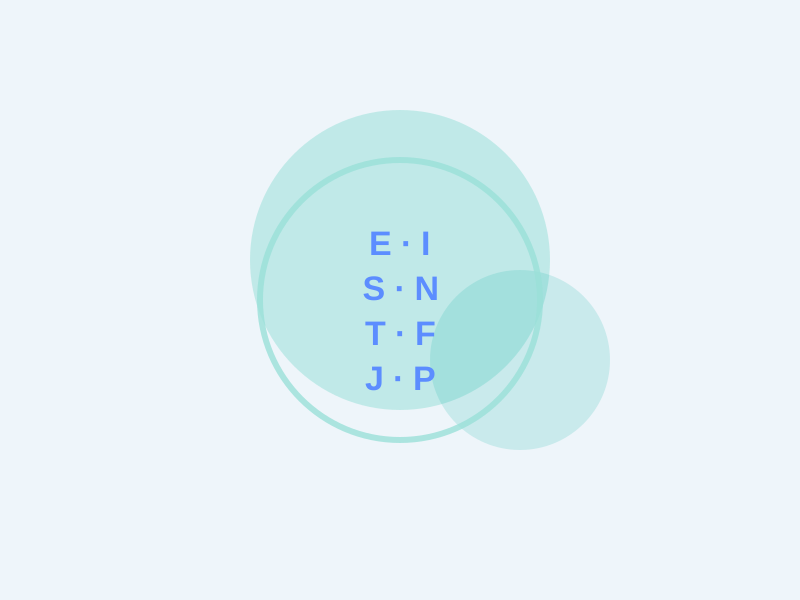
The code is built from four independent scales. On each one, a person leans toward one pole:
- Energy orientation: Extraversion (E) versus Introversion (I). Whether you recharge through interaction with the outside world or in your inner world of ideas.
- Gathering information: Sensing (S) versus Intuition (N). Whether you notice concrete facts first or patterns and possibilities.
- Making decisions: Thinking (T) versus Feeling (F). Whether logical analysis weighs more, or values and the effect on people.
- Dealing with the outer world: Judging (J) versus Perceiving (P). Whether you prefer to settle things and plan, or to keep your options open.
What each letter means, and the most common misunderstandings about them, is explained in what each letter of the personality code means.
2. Which test are you taking? Three different instruments
Much of the confusion about “my type” comes from the fact that very different questionnaires circulate under the same four-letter code.
- The official MBTI. It’s published by The Myers-Briggs Company and administered by certified practitioners. It uses forced-choice items between two options and, according to its manual (Myers, McCaulley, Quenk and Hammer, 1998), the result should be checked in a feedback interview where the person confirms their “best-fit type”. The questionnaire is the starting point, not the final word.
- The 16personalities.com test. It was created by the company NERIS Analytics and is the most widespread online, but it isn’t the MBTI. Its own site explains that it reworked dimensions inspired by the Big Five personality traits, that it shows percentages on each scale and that it adds a fifth letter, -A (Assertive) or -T (Turbulent). Its nicknames, such as Architect, Protagonist or Campaigner, are its own too.
- Tests inspired by the model, like ours. They use the same four dichotomies without reproducing the official instrument or its scoring algorithm.
Three different results on three websites don’t necessarily mean something is wrong: they may be three instruments measuring similar things with different methods.
3. How our test works
Our test comes in three versions: quick (16 statements), standard (40) and full (80). Each statement is rated on a five-point agreement scale, from “Strongly disagree” to “Strongly agree”, and each one scores one of the eight poles (E, I, S, N, T, F, J or P).
The code is worked out axis by axis: the points for each pole are added up and the higher one wins. The full version also includes control questions that rephrase a preference already asked about; if the answers contradict each other too much, the test tells you instead of hiding it.
The more statements behind each letter, the more stable the result. That’s why, if you’re unsure about a letter, the full version gives a more reliable reading than the quick one.
4. How to answer so the result looks like you
A few guidelines help, whatever the questionnaire:
- Answer as you usually are, when there’s no work or social pressure, not as you’d like to be.
- Don’t overanalyze: spontaneous answers tend to reflect your underlying preference better than heavily reasoned ones.
- Accept the dilemma: it’s common to think “I do both.” The useful question is which of the two comes to you with less effort.
Two examples of how the questions work
T/F scale: in a conflict with a colleague, what convinces you more? An argument with firm logic (T), or an explanation that takes into account the values and needs of the people involved (F).
J/P scale: with an important deadline ahead, how do you prefer to work? With a schedule, wrapping up stages ahead of time (J), or moving forward flexibly and concentrating your effort close to the deadline (P).
5. Reading the result: how clear each letter is
The 16 types aren’t spread evenly across the population (Myers, McCaulley, Quenk and Hammer, 1998). If your result feels unusual, it helps to know which types are actually the most common before giving that impression too much weight.
The MBTI manual pairs each letter with a preference clarity index, which shows how consistently a pole was chosen:
- Slight: both poles carry similar weight.
- Moderate: there’s a clear lean, though the person also uses behaviors from the opposite pole.
- Clear or very clear: the answers point consistently to the same side.
This index doesn’t measure how much of a trait you “have” or whether you use it well. It measures how sure your choice was on the questionnaire.
6. Why your result can change when you retake the test
This is one of the most frequently cited criticisms of the model. Pittenger (2005) reviews studies in which a sizable share of people change at least one letter when retaking the MBTI a few weeks later. It happens mostly on the scales where the person sits near the midpoint: a couple of different answers are enough to cross the line.
The underlying reason is that most personality traits are distributed continuously, with many people in the middle range, and the type format forces them onto one side or the other. If you want to see how a trait model handles this, the comparison is in MBTI vs. Big Five: which is better?.
7. What to do with your code
The result is a preliminary hypothesis. It’s usually refined in three ways:
- Read the full profile for your type, which offers more nuance than the four letters.
- Compare adjacent profiles: if you’re unsure about a letter, read the profile that changes only that letter and keep the one that better describes your usual behavior.
- Look at the dominant function: in Myers’s theory, the last letter shows which function faces the outer world. In an extravert, a J signals that the dominant function is a judging one (T or F); in an introvert, the J shows that the function visible on the outside is the auxiliary. Reading the description of the dominant function sometimes settles doubts that the individual letters don’t.
Used this way, the information works as a starting point for understanding your differences with other people, rather than as a closed label.
Sources
- Myers, I. B., McCaulley, M. H., Quenk, N. L., & Hammer, A. L. (1998). MBTI Manual: A guide to the development and use of the Myers-Briggs Type Indicator (3rd ed.). Consulting Psychologists Press.
- NERIS Analytics. (n.d.). Our Theory. 16Personalities. https://www.16personalities.com/articles/our-theory
- Pittenger, D. J. (2005). Cautionary comments regarding the Myers-Briggs Type Indicator. Consulting Psychology Journal: Practice and Research, 57(3), 210-221.
Want to know more about yourself?
Discover your result with one of our related tests.
Frequently asked questions
How can I find out my MBTI type?
By answering a questionnaire that measures your preferences across four dimensions, responding as you usually are and without overanalyzing each question. The official MBTI uses forced-choice items and is followed by a feedback interview; free online tests, ours included, usually use agreement scales.
What should I do if I'm torn between two letters?
A common way to settle the doubt is to compare the adjacent profile that changes just that one letter (for example, INFJ and INFP) and see which one more accurately describes your usual pattern. If your score on that scale sits near the midpoint, it's normal for the result to change when you retake the test.
Is the test result final?
It's a preliminary hypothesis, not a closed diagnosis. The full profile offers a more detailed description that's usually weighed against your own experience to judge how accurate it is.
Is the 16personalities.com test the MBTI?
No. It's a different questionnaire, created by NERIS Analytics, that borrows the four letters but measures five trait-style scales and adds a fifth letter, -A (Assertive) or -T (Turbulent), which doesn't exist in the MBTI.