How Many Questions Does the 16 Personalities Test Have?
Questions on the official MBTI test (Form G and Form M)
The official Myers-Briggs Type Indicator (MBTI) has gone through several versions over the course of its history and psychometric development (Myers, McCaulley, Quenk & Hammer, 1998).
Depending on the standard form used, the exact number of questions varies:
- MBTI Form M (current standard): made up of 93 questions. It has been the standard version since 1998. Every question is scored to determine the four preference scales.
- MBTI Form G: the version that came before Form M, with 126 questions.
- MBTI Form F: an older version that included 166 questions.
- MBTI Form Q (Step II): made up of 144 questions. This advanced tool assesses the four basic scales and also breaks them down into 20 personality facets (five per dimension).
Why forced choice, and what bias it introduces
The forced-choice format (picking between two options, with no room to say “both equally” or “neither”) isn’t a minor technical detail: it’s a methodological decision with a real cost.
It was chosen because it cuts down on the tendency to answer in a “socially desirable” way (always picking the option that sounds better) and because it simplified hand scoring of the four dichotomies, something that mattered a great deal when Briggs and Myers designed the questionnaire by hand (Myers & McCaulley, 1985), decades before accessible statistical software existed.
The cost is that each answer describes a relative preference: you choose one pole over its opposite within the same scale, rather than measuring how much of each pole the person has. In psychometrics, this kind of format is associated with ipsative scores, although in the MBTI the effect is limited, because the two options in each item belong to the same scale and different scales aren’t pitted against each other. What does get lost is intensity: choosing E enthusiastically or by a hair counts the same.
Someone who’s actually very close to the midpoint between extraversion and introversion is still forced to lean one way on every question, and the final result can convey a sharpness of type (“you’re an E” or “you’re an I”) that the real person doesn’t feel that clearly, one of the methodological limitations Pittenger (1993) points out. It’s the same tension between discrete types and continuous traits that sets the MBTI apart from the Big Five.
The four dimensions assessed
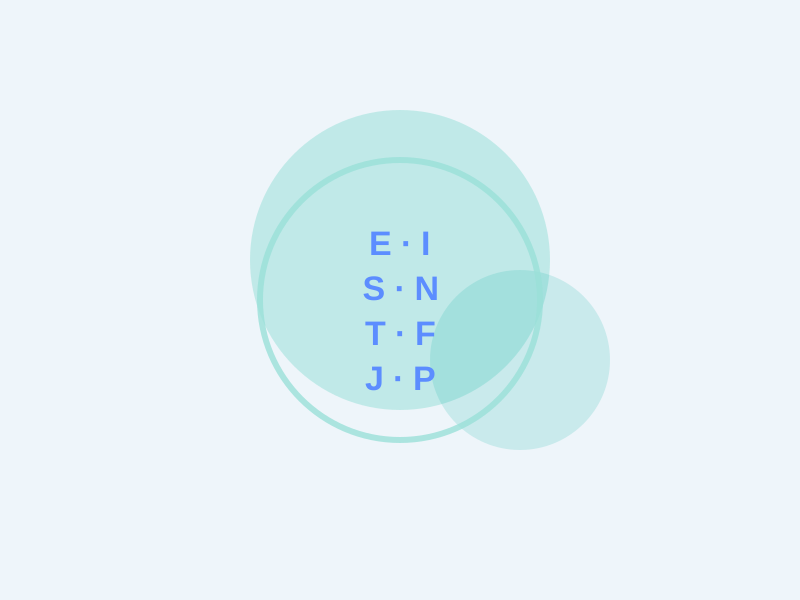
The questionnaire distributes its questions to score four bipolar scales independently:
- Extraversion (E) - Introversion (I): measures where energy is directed.
- Sensing (S) - Intuition (N): assesses the preferred way of perceiving reality.
- Thinking (T) - Feeling (F): looks at the criterion used to make decisions.
- Judging (J) - Perceiving (P): describes lifestyle and interaction with the outer world.
Scoring mechanism
The questionnaire doesn’t assess aptitude or levels of intelligence. Its computerized formats use Item Response Theory (IRT) methods to place the person on one side of the dichotomy, a statistical refinement introduced with Form M (Myers, McCaulley, Quenk & Hammer, 1998).
The numeric results it produces (like the preference clarity index) don’t mean greater maturity or skill. They only reflect the level of consistency and certainty with which the user picked one preference over the other while taking the test.
What about the 16personalities.com test?
The most visited site for “taking the 16 personalities test” isn’t the MBTI. 16Personalities is a proprietary questionnaire from the company NERIS Analytics that borrows the four-letter code but, as its website explains, reworks dimensions inspired by the Big Five personality traits. It’s answered on an agreement scale instead of forced choice, shows a percentage on each scale and adds a fifth letter, -A (Assertive) or -T (Turbulent), which doesn’t exist in the MBTI. That’s why its number of questions and its results aren’t comparable with those of Form M.
How many questions our test has
Our 16 personalities test isn’t the official instrument either, and it doesn’t use forced choice. It comes in three versions: quick, with 16 statements; standard, with 40; and full, with 80. Each statement is rated on a five-point agreement scale and adds to one of the eight poles, with the same number of items for each (two, five or ten).
The code is decided axis by axis, keeping the pole with the higher score. The full version includes control questions that rephrase a preference already asked about and flags it if the answers contradict each other too much. With more items per letter, the result is more stable, especially for people near the midpoint of a scale.
This test, like any self-report inventory of preferences, is meant for self-knowledge. It isn’t a diagnostic assessment and doesn’t replace an evaluation by a mental health professional.
Sources
- Myers, I. B., & McCaulley, M. H. (1985). Manual: A guide to the development and use of the Myers-Briggs Type Indicator. Consulting Psychologists Press.
- Myers, I. B., McCaulley, M. H., Quenk, N. L., & Hammer, A. L. (1998). MBTI Manual: A guide to the development and use of the Myers-Briggs Type Indicator (3rd ed.). Consulting Psychologists Press.
- NERIS Analytics. (n.d.). Our Theory. 16Personalities. https://www.16personalities.com/articles/our-theory
- Pittenger, D. J. (1993). The utility of the Myers-Briggs Type Indicator. Review of Educational Research, 63(4), 467-488.
Want to know more about yourself?
Discover your result with one of our related tests.
Frequently asked questions
How many questions does the current official MBTI have?
Form M, the current standard since 1998, has 93 questions.
Are there other versions with more or fewer questions?
Yes: Form G (the one before Form M) had 126 questions, the older Form F had 166, and Form Q (Step II) has 144 and adds 20 personality facets.
How is the questionnaire scored?
Through forced choice: the user picks between psychologically equivalent options, and the system uses Item Response Theory to place them on one side of each dichotomy.