16 Personalities Test
16 personalities test in three versions (16, 40 or 80 questions): find your four-letter code based on your energy, how you decide and your lifestyle.
16 personalities test in three versions (16, 40 or 80 questions): find your four-letter code based on your energy, how you decide and your lifestyle.
The 16 personalities test, also known as the MBTI (Myers-Briggs Type Indicator), is one of the most widely used personality frameworks in the world.
It builds on Carl Jung's theory of psychological types and was turned into a practical questionnaire by Katharine Cook Briggs and Isabel Briggs Myers.
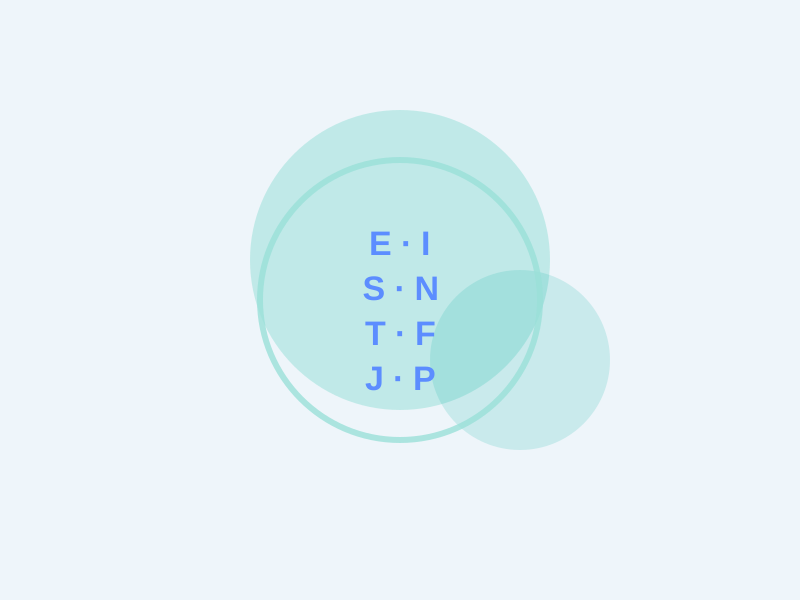
It organizes personality into four independent dimensions:
Combining these preferences produces a four-letter code, such as INFJ or ESTP, corresponding to one of the 16 possible types.
Unlike the Big Five, it sorts people into qualitative types rather than placing them on a continuous spectrum: that makes it intuitive and memorable, but its scientific standing has been debated for decades.
The most frequently cited academic critique is David Pittenger's (1993), published in the Journal of Career Planning and Employment: he reviewed the MBTI's statistical structure and concluded that it falls short of several basic standards expected of a psychological test, including predictive validity.
One clear contrast with the Big Five: the latter has robust, widely replicated meta-analyses supporting its predictive validity at work (Barrick and Mount, 1991), while the MBTI lacks an equivalent body of evidence on that front.
Here you'll find its origin, the four dimensions explained, and a breakdown of each type. None of this content replaces a professional psychological evaluation or the official MBTI® assessment.
It's a personality indicator (also called the MBTI) that sorts people into 16 types by combining four dimensions: Extraversion/Introversion, Sensing/Intuition, Thinking/Feeling, and Judging/Perceiving.
It's based on Carl Jung's theory of psychological types (1921) and was turned into a practical questionnaire by Katharine Cook Briggs and Isabel Briggs Myers.
It's very popular as a self-discovery tool, but it has less empirical support than the Big Five: its test-retest reliability is lower, and it sorts people into fixed types instead of continuous spectrums.
The most common tends to be ISFJ (around 13.8% of the population), and the rarest is INFJ (around 1.5%).
Lower than most users assume: research such as McCarley and Carskadon (1983) found that a notable share of people get a different type when they retake the test weeks later, especially on dichotomies where the original score landed close to the midpoint. That doesn't invalidate the model as a reflection tool, but it does temper the idea that your resulting type is fixed and unchanging.
Discover your DISC style: the four behavior colors (Dominance, Influence, Steadiness, Conscientiousness) and what it says about how you act.
1 testDiscover your attachment style: how the way you bond with others shapes your romantic relationships, family ties, and friendships.
4 testsDiscover your love language: how you prefer to give and receive affection in your close relationships.
3 tests
The MyersBriggs Type Indicator (MBTI) is a selfexploration questionnaire that sorts a person's preferences on four scales and sums them up…
Questions on the official MBTI test (Form G and Form M) The official MyersBriggs Type Indicator (MBTI) has gone through several versions ov…
The statistical snapshot: how the 16 types are distributed The distribution of MBTI profiles in the population isn't symmetrical. The data…