What's My Attachment Style?
Attachment style test: 20 questions to find out whether your emotional bond is secure, anxious, avoidant, or disorganized.
Attachment style test: 20 questions to find out whether your emotional bond is secure, anxious, avoidant, or disorganized.
Toxic relationship quiz: 15 questions on patterns like exhaustion, guilt, isolation or cycles of tension and making up. Guidance only, not a diagnosis.
Am I over my ex? A 25-question quiz on which pattern dominates your breakup grief: resisting the pain, rumination, rebound, anger or fear it will last.
Short 15-question test on whether your wellbeing and identity revolve excessively around your romantic relationship: low, moderate, or high.
The attachment theory, developed by British psychiatrist John Bowlby from his clinical work with children after World War II and later expanded by psychologist Mary Ainsworth, explains how the bonds we form in childhood shape the way we relate to others as adults: how much closeness we seek, how we handle the fear of being left, and how comfortable we feel depending on another person.
Bowlby argued something that was controversial at the time: that this bond is a primary need in its own right, as biological as hunger, not a simple side effect of being fed.
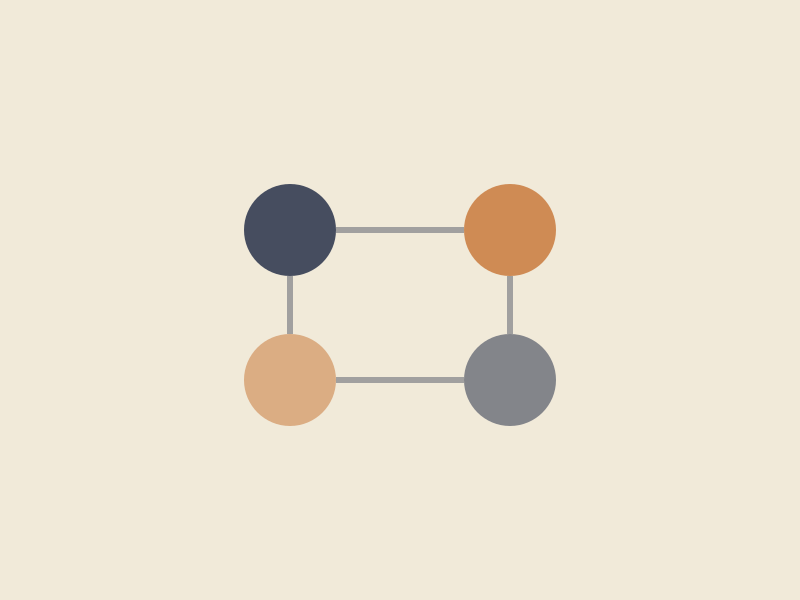
The model describes attachment along two independent axes: anxiety (how much you worry about being unloved or abandoned) and avoidance (how much discomfort closeness and emotional dependence bring up in you).
Combining both axes produces four styles:
The way attachment is measured has evolved alongside the model itself. In 1978, Ainsworth designed the "Strange Situation": an experiment with just eight brief episodes (a mother and child in a room full of toys, the appearance of a stranger, two short separations, and their reunions) that let researchers classify one-year-olds by how they reacted to seeing their mother again.
For adults, Canadian psychologist Kim Bartholomew proposed, together with Leonard Horowitz in 1991, a model far easier to apply outside a lab: cross two questions, do I deserve love and attention? (model of self) and can I trust that others will be there for me? (model of others).
The same four styles emerge from combining positive and negative answers to those two questions. That's exactly the logic our test follows: it places your result on a two-axis map, not in a contest between four closed labels.
The clinical gold standard remains the Adult Attachment Interview (AAI, Main, Kaplan, and George, 1985), which a trained professional scores less on what you say about your childhood than on how coherently you say it. Self-report questionnaires like ours are much simpler, but line up reasonably well with its results.
No style is fixed or final: research on so-called "earned security" shows that attachment patterns can shift with self-awareness, relationships that offer a secure base and, when needed, therapy.
Our test is a popular-science, informational take inspired by this model. It doesn't replace a professional psychological assessment or the Adult Attachment Interview.
Psychologists Phillip Shaver and Mario Mikulincer, authors of the reference book on adult attachment Attachment in Adulthood, describe anxiety and avoidance as two secondary strategies for regulating emotion when an attachment figure isn't always available: hyperactivation (keeping the attachment system constantly on alert, pushing until attention is secured) and deactivation (what Bowlby called "compulsive self-reliance": suppressing the search for closeness and managing distress alone).
The most widely used self-report instrument in research for measuring both is the 36-item ECR scale (Brennan, Clark, and Shaver, 1998), the direct precursor to the questionnaire our test is based on. Recent research mostly relies on its revised version, the ECR-R (Fraley, Waller, and Brennan, 2000), which sharpens the psychometrics of those same two axes.
The evidence isn't limited to self-report: an fMRI study by Coan, Schaefer, and Davidson (2006) found that holding a partner's hand under the threat of an electric shock reduced the brain's stress response, and other work on physical touch in couples, such as Grewen et al. (2003), recorded lower blood pressure during interaction with a partner than alone: the biological signature of what the theory calls a "secure base."
It's the pattern you tend to follow when bonding emotionally with other people, formed in childhood and later reinforced (or corrected) by adult relationships. It shapes how much closeness you seek and how you handle trust.
The most widely used adult model describes four: secure, anxious, avoidant, and disorganized, produced by combining two independent axes (anxiety and avoidance).
Yes. It's called earned security: with self-awareness, stable relationships, and sometimes therapy, it's possible to develop more secure patterns even if your starting point wasn't secure.
The anxious style seeks closeness and fears abandonment; the avoidant style prioritizes independence and feels uneasy depending on others. They sit at nearly opposite ends of how people handle intimacy.
No. It's an informational, orientation-only approximation. If attachment is significantly affecting your relationships, the recommended step is to see a licensed mental health professional.
A laboratory experiment designed in 1978 by Mary Ainsworth: it observes how a one-year-old reacts to two brief separations from their mother and the reunions that follow, in order to classify their attachment based on those reactions.
Because it follows Kim Bartholomew's 1991 model: it crosses your level of anxiety (model of self) with your level of avoidance (model of others). The four styles emerge from combining high or low values on both axes, not from competing closed categories.
Discover your love language: how you prefer to give and receive affection in your close relationships.
3 testsDiscover your emotional intelligence profile: how you manage your own emotions, other people's, and your relationships.
3 testsDiscover your main character strengths: which virtues you lead with, according to positive psychology.
3 tests
Attachment in Relationships: The Pattern Doesn't Look the Same Once You're in a Stable Bond Knowing your attachment style is the first step…
Attachment Style Compatibility: Ten Different Ways of Bonding as a Couple Each attachment style (secure, anxious, avoidant, and disorganize…

"I don't talk to people, they talk to me and I ignore them, I laugh to myself, I never look up. I'm worried, what do you think I have?" a p…