Avoidant Attachment: Independence as a Way to Stay Protected
Avoidant Attachment: When Independence Protects Against Closeness
Avoidant attachment describes people who prioritize self-sufficiency and feel uncomfortable with emotional dependence, their own or anyone else’s.
It isn’t coldness: it’s a learned strategy for not relying on something that, at some point, wasn’t reliably there.
People with this style tend to function very well on their own and value their space highly, even inside relationships that genuinely matter to them.
Where it comes from: learning not to ask
In Ainsworth’s “Strange Situation,” these babies gave a striking impression of independence: they explored the room without using their mother as a base, didn’t seem too bothered by her absence, and on her return, ignored her or avoided contact.
It isn’t that they felt nothing; they had learned not to show it. Their bodies did react: Sroufe and Waters (1977) recorded infants’ heart rates in the Strange Situation and found signs of arousal in avoidant babies even though they looked calm on the outside. Spangler and Grossmann (1993) confirmed that their heart rate during separation resembled that of secure babies and that, after the procedure, their cortisol, a stress hormone, rose more.
That learning tends to trace back to a caregiving pattern where caregivers respond rigidly to the baby’s expressed needs, with some aversion to emotional contact or outright rejection when the child cries or asks for something.
The implicit message the child receives is that expressing a need doesn’t get it met, it pushes the caregiver further away; the only way to keep any closeness is to not ask, not depend, not show. Over time, that strategy stops feeling like a strategy and becomes the “natural” way of being in a relationship.
How it shows up in relationships
- Preference for solving things alone: faced with a problem, the first instinct is to handle it individually rather than ask for support.
- Discomfort with vulnerability: sharing emotions in depth can feel exposing or unnecessary, even with people you trust.
- Need for space after closeness: moments of real intimacy tend to be followed by an urge to create distance, almost as a way of rebalancing.
- A more reserved communication style: some studies link this style with less open communication about emotional topics, including a couple’s sex life.
Two ways of avoiding closeness
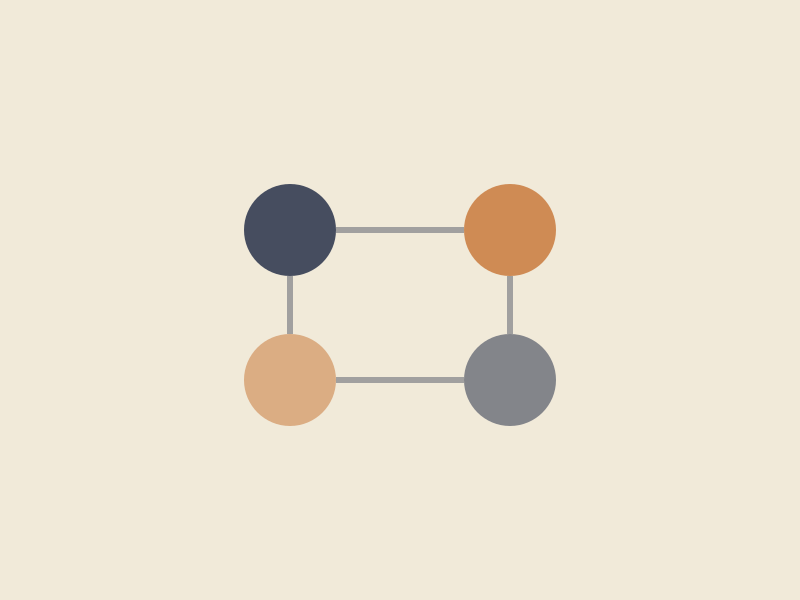
Kim Bartholomew and Leonard Horowitz’s model (1991) distinguishes two styles with high avoidance, based on how the person sees themselves:
- Dismissing: combines a positive self-image with a negative image of others. This person has managed to “deactivate” their attachment system by focusing on individual achievement; they value autonomy above almost everything and, generally, don’t experience this as a problem. This is the profile that this article and our test call avoidant attachment.
- Fearful-avoidant: combines a negative image of self and of others. They do want closeness, but distrust both whether they deserve it and whether the other person will respond well if they show vulnerability. Because it adds high anxiety to high avoidance, it is the rough adult equivalent of disorganized attachment, which is why we cover it in that article.
Both share avoidance as a strategy, but the dismissing type tends to feel comfortable with their independence, while the fearful type experiences it with more internal conflict.
If you recognize yourself in most of this list, our avoidant attachment test measures the intensity of this pattern in more detail.
Compatibility as a couple
According to several studies on marital satisfaction, this is the style most associated with low levels of intimacy and commitment, especially when both partners share it or when it’s paired with an anxious style (one of the combinations generally considered hardest, which we cover in a dedicated article on that dynamic).
With a securely attached partner, on the other hand, the avoidant person has more room to gradually tolerate closeness without it being demanded all at once, which makes for more sustainable relationships.
It’s worth clarifying that avoidance doesn’t equal an inability to love: several studies show these people do get involved and do care for their partner, it’s just that they show it less through words and vulnerability, and more through actions and respecting the other person’s space.
A technical name for this strategy: deactivation
Researchers Phillip Shaver and Mario Mikulincer call this pattern deactivation of the attachment system: instead of seeking closeness in distress, that search gets inhibited and thoughts related to needing support get suppressed.
John Bowlby, the theory’s creator, had already named this same strategy: “compulsive self-reliance,” an independence that doesn’t come from free choice, but from a learned need to not depend on anyone.
What the research suggests about tolerating closeness
Different approaches link several factors to greater tolerance for closeness in this pattern, always as part of a gradual process rather than a single formula:
- Asking for help with small things, as a progressive way of getting used to the feeling of depending on someone.
- Communicating the need for space instead of pulling away without explanation: research links this with the other person reading it less as rejection, a nuance we cover in our article on communication by attachment style.
- The distinction between intimacy and losing autonomy: emotional closeness doesn’t equal giving up independence, even if it can feel that way at first.
- The specific variant may matter: when avoidance also comes with a negative self-image (the fearful style described above), self-esteem is usually part of the work, alongside independence.
This article is for general information and does not replace a professional assessment. As with the other attachment patterns, a licensed mental health professional can guide this process with tools beyond self-knowledge alone.
Sources
- Ainsworth, M. D. S., Blehar, M. C., Waters, E. and Wall, S. (1978). Patterns of Attachment: A Psychological Study of the Strange Situation. Lawrence Erlbaum.
- Bartholomew, K. and Horowitz, L. M. (1991). Attachment styles among young adults: A test of a four-category model. Journal of Personality and Social Psychology, 61(2), 226-244.
- Bowlby, J. (1969). Attachment and Loss, Vol. 1: Attachment. Basic Books.
- Mikulincer, M. and Shaver, P. R. (2007). Attachment in Adulthood: Structure, Dynamics, and Change. Guilford Press.
- Spangler, G. and Grossmann, K. E. (1993). Biobehavioral organization in securely and insecurely attached infants. Child Development, 64(5), 1439-1450.
- Sroufe, L. A. and Waters, E. (1977). Heart rate as a convergent measure in clinical and developmental research. Merrill-Palmer Quarterly, 23(1), 3-27.
Want to know more about yourself?
Discover your result with one of our related tests.
Frequently asked questions
What is avoidant attachment?
The attachment style marked by high avoidance (discomfort with closeness and dependence) and low fear of abandonment: self-sufficiency is prioritized over intimacy.
Does avoidant attachment mean I don't love anyone?
No. It means emotional closeness brings up discomfort or a sense of lost autonomy, not an absence of affection. The care is there, it's just expressed with more distance.
Can someone with avoidant attachment have a stable relationship?
Yes. Research links greater stability with a partner who understands that the need for space isn't the same as rejection, and with a gradual, often supported, tolerance for closeness.
Are all avoidant people the same?
No. Bartholomew and Horowitz's model (1991) distinguishes the dismissing style (positive self-image, comfortable with distance) from the fearful-avoidant style (negative self-image too, wants closeness but doesn't trust it). The fearful style combines high avoidance and high anxiety and is the rough adult equivalent of disorganized attachment.