Enneagram Type 6: The Loyalist
Enneagram Type 6 describes a personality pattern focused on anticipating risks and seeking security and support in their surroundings.
In Riso and Hudson’s RHETI it is called “the Loyalist.” It’s a way of living in which the mind stays one step ahead, trying to guess what could go wrong before it happens.
According to the model, it is lived by loyal, hardworking people who live with a background doubt and a state of alertness to possible threats. A common example: rereading an email several times before sending it, not out of perfectionism, but out of a worry that something will go wrong if it isn’t checked enough.
This text is educational material about a personality model; it is not a diagnosis and does not replace an assessment by a psychology professional.
The fear of being left without support
Riso and Hudson place the 6’s basic fear in being left without support or guidance, and their basic desire in having security and backing. To compensate, the person looks for certainties and leans on rules, groups or authority figures that ease the unease.
The passion the Ichazo and Naranjo tradition assigns to this profile is fear, often rendered as cowardice. It doesn’t mean a lack of physical courage but an almost permanent anxious tension. Naranjo associated it with the paranoid character described by the psychiatry of his time, in the sense of a suspicious style, not a disorder.
The mind works like a surveillance system that scans future scenarios to avoid danger. The conflict appears when that natural caution turns into constant suspicion and an excessive attachment to their own beliefs, which makes it hard to relax.
What the model proposes about its origins
The enneagram’s explanations about childhood are hypotheses of the model, not findings from developmental research. With that caveat, the usual reading suggests that the 6 learned it was risky to trust their own judgment, and sought shelter in external systems: a group, an authority, a clear set of rules.
The “lost childhood message” that Riso and Hudson put forward for this type would be “you are safe.”
Phobic and counterphobic: two faces of the same fear
One of the 6’s particularities is that their fear can be expressed in opposite ways. Enneagram literature distinguishes between the phobic six, who seeks protection by obeying, consulting and avoiding risks, and the counterphobic six, who faces danger head on, challenges authority they don’t trust and can seem reckless.
Although the two reactions look opposite, both stem from the same concern about being left without support. Most people of this type combine both depending on the context.
Wings and instinctual subtypes
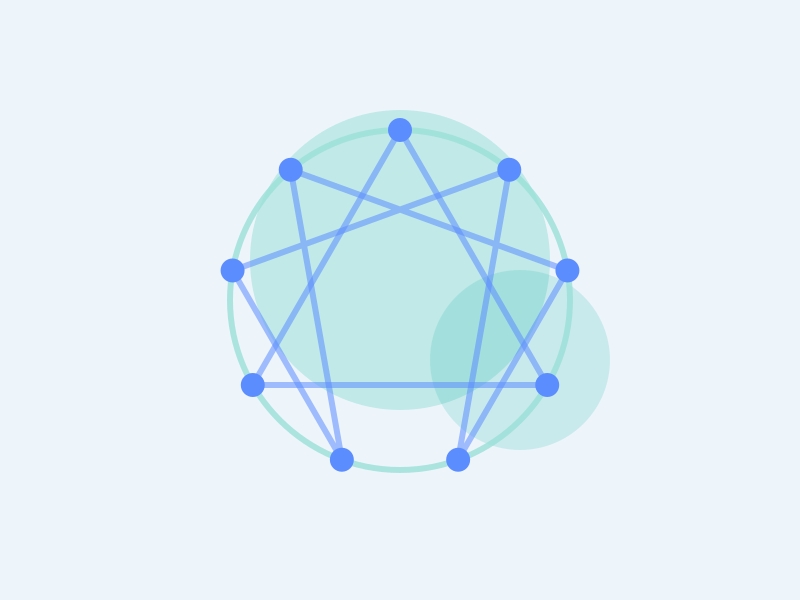
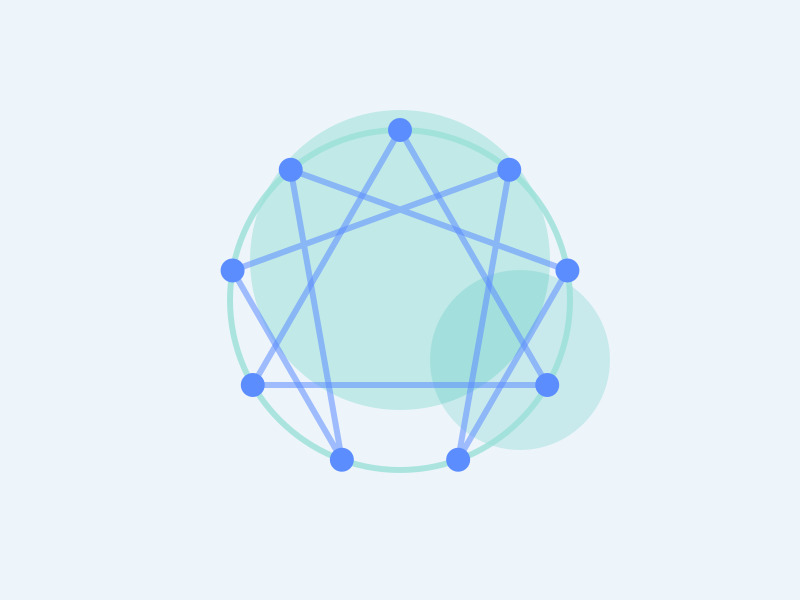
The wings are the two neighboring numbers in the symbol, which shade the type without changing it. For the 6, they are the 5 and the 7.
- Six with a 5 wing: more independent, serious and analytical; they seek security in knowledge and reliable systems.
- Six with a 7 wing: more sociable, fun-loving and outgoing; they seek security in relationships and the group.
The theory adds the dominant instinct, which Naranjo developed in his 27 subtypes and Riso and Hudson call “instinctual variants.” In self-preservation, security is sought in affection and close protection; in the social variant, in duty and the group’s rules; in the one-to-one variant, in appearing strong, a trait many authors link to the counterphobic variant.
Strengths and reactions under pressure
In their balanced form, 6s show very valuable capacities for commitment and collaboration:
- A firm loyalty to the people, ideals and institutions they trust.
- An analytical ability to spot problems before they happen and propose realistic solutions.
- Remarkable courage in standing up for those who are more vulnerable.
- A sense of responsibility that makes them a pillar of families and teams.
Under pressure, the need for certainty can become paralyzing: the person questions their own choices, asks for guarantees before taking a step and puts off action for fear of getting it wrong. In conflicts they need others to share their concern; if they sense indifference, the anxiety can turn into suspicion.
In the model’s stress direction, the 6 moves toward traits of Type 3 in their less healthy form: they try to hide their fear by becoming competitive and highly focused on their image of efficiency.
Toward inner calm
In the growth direction, the model places the 6 alongside a balanced Type 9: less mental noise and more serenity. The underlying idea is to accept that you’ll never have a one hundred percent guarantee before acting, and to trust your own judgment more.
What research says about the enneagram
The systematic review by Hook and colleagues (2021), covering 104 samples, found mixed evidence for the enneagram’s reliability and validity: consistent relationships with the Big Five, but fewer than nine factors in the analyses and little support for the wings or the stress and growth arrows. It’s a useful language for self-observation, not an instrument with the psychometric backing of the Big Five.
Do you see yourself in this profile? Explore it with our enneagram test.
Sources
- Riso, D. R. and Hudson, R. (1999). The Wisdom of the Enneagram. New York: Bantam.
- Naranjo, C. (1994). Character and Neurosis: An Integrative View. Nevada City: Gateways/IDHHB.
- Hook, J. N., Hall, T. W., Davis, D. E., Van Tongeren, D. R. and Conner, M. (2021). The Enneagram: A systematic review of the literature and directions for future research. Journal of Clinical Psychology, 77(4), 865-883. https://doi.org/10.1002/jclp.23097
Want to know more about yourself?
Discover your result with one of our related tests.
Frequently asked questions
What is cowardice as this type's dominant passion?
It doesn't refer to a lack of physical courage (the article itself notes this profile can show great courage defending others) but to a state of chronic anxiety and constant anticipation of danger.
Why can this profile be both submissive and rebellious?
Under this model, both are responses to the same basic fear of being left without support: sometimes protection is sought by obeying, other times by defying an authority perceived as unreliable. Enneagram literature describes these as the phobic and counterphobic variants of the same type.
What happens under a lot of stress?
The article describes a possible shift toward Type 3 traits: more competitiveness and concern with one's own image of efficiency.