What Are the 9 Enneagram Personality Types?

The Enneagram is a personality model that describes nine types, each organized around an underlying fear and desire. It’s used mainly in personal development, coaching and spirituality; it isn’t part of mainstream academic psychology or the diagnostic manuals.
According to the model, those fears and desires steer our automatic everyday reactions, the ones that happen almost without thinking. Knowing them is presented as a way to look at your own defense mechanisms from a little more distance, without being a promise of change or a substitute for a professional’s guidance.
The nine types at a glance
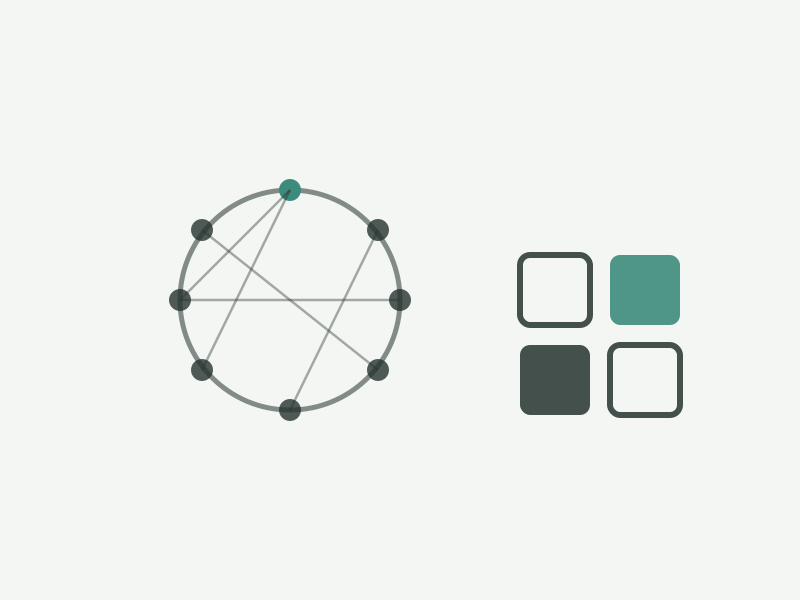
The table summarizes the nine types using the names of the Riso and Hudson school, the most widespread today, and the passions described by Ichazo and Naranjo. According to Riso and Hudson, the arrows show the type each one would move toward under stress and in growth.
| Type | Name | Basic fear | Basic desire | Passion | Under stress | In growth |
|---|---|---|---|---|---|---|
| 1 | Reformer | Being bad, defective or corrupt | Being good, having integrity, being right | Anger | 4 | 7 |
| 2 | Helper | Being unloved | Feeling loved | Pride | 8 | 4 |
| 3 | Achiever | Being worthless | Feeling valuable | Vanity | 9 | 6 |
| 4 | Individualist | Having no identity or personal significance | Finding themselves | Envy | 2 | 1 |
| 5 | Investigator | Being useless or incapable | Being capable and competent | Avarice | 7 | 8 |
| 6 | Loyalist | Being without support or guidance | Having security and support | Fear | 3 | 9 |
| 7 | Enthusiast | Being deprived or in pain | Being satisfied and fulfilled | Gluttony | 1 | 5 |
| 8 | Challenger | Being harmed or controlled by others | Protecting themselves and running their own life | Lust (intensity) | 5 | 2 |
| 9 | Peacemaker | Loss and separation | Inner peace and stability | Sloth | 6 | 3 |
The types are also grouped into three centers: instinctive (8, 9 and 1), feeling (2, 3 and 4) and thinking (5, 6 and 7). Each type has two “wings”, its neighboring numbers on the circle, which according to the model shade the way it expresses itself; a 9 with an 8 wing would be firmer, and one with a 1 wing more orderly.
Where the nine stances come from, according to the model
The Enneagram tradition proposes that each type begins as a strategy of emotional protection in childhood. Faced with a sense of vulnerability, the child would develop a way of presenting itself to the world that keeps it safe: what the model calls “ego” or “personality”, as opposed to “essence”.
That defensive identity would be built on a particular basic fear, and from there strategies would develop to obtain security, attention or autonomy. For example, a child who feels they receive affection mainly when they help might end up, as an adult, putting other people’s needs ahead of their own, the Type 2 pattern.
This is a hypothesis of the model, not a finding: no studies show that Enneagram types form this way.
The nine types, one by one
- Type 1, the Reformer: strives to do things right to make up for the fear of being defective. Demanding of itself and its surroundings, as if carrying a magnifying glass that spots whatever is wrong. The model links its development with turning held-in anger into serenity and accepting reality without demanding that it be perfect.
- Type 2, the Helper: feels that tending to other people’s needs is the path to receiving affection. Tends to forget its own needs and make itself indispensable. The model suggests its development involves recognizing its own needs, what the tradition calls turning pride into humility, and learning to take care of itself.
- Type 3, the Achiever: ties its worth to its achievements and the image it projects. Adapts easily to whatever its environment rewards. Growth is linked with replacing vanity with authenticity, with being who it is rather than who it pays to seem.
- Type 4, the Individualist: seeks an identity of its own, distinct from others, and often feels it lacks something essential to be happy. Tends to experience its emotions intensely. Balance, according to the model, comes from cultivating equanimity and also looking outward.
- Type 5, the Investigator: protects its energy and space and prefers understanding things to living them fully. Accumulates knowledge as a way to feel capable. The model links its development with connecting thought with experience and feelings.
- Type 6, the Loyalist: stays alert to risks for fear of being left without support. Doubts its own decisions and looks for trustworthy reference points. The model distinguishes a phobic 6, more cautious, and a counterphobic one, who faces fear head-on. Its evolution is described as turning anxiety into inner confidence.
- Type 7, the Enthusiast: keeps many options open and seeks stimulating experiences, partly so as not to dwell on discomfort. Jumps easily from one plan to the next. According to the model, calm comes from learning to stay in the present and tolerate boredom.
- Type 8, the Challenger: protects itself with armor of strength for fear of being harmed or controlled. Tends to take charge and confront head-on whatever it perceives as a threat. The model links its maturity with letting go of control and accepting its own vulnerability.
- Type 9, the Peacemaker: sets its opinions aside to avoid friction and keep things calm around it. Can slip into a kind of autopilot and play down what troubles it. The model links its development with asserting its own presence and opinion.
What research says
The systematic review by Hook and colleagues (2021), which gathered 104 samples, found mixed evidence on the reliability and validity of Enneagram questionnaires. The type scales relate to the Big Five in ways consistent with the theory, but statistical analyses usually find fewer than nine factors, and no study has recovered the nine types by grouping people based on their answers.
In other words: the nine types work as a descriptive language that many people find useful, but they haven’t been shown to be nine natural categories of people. That’s why the result of any Enneagram test is best read as a hypothesis, as we explain in how to find out your Enneagram type.
From type to self-observation
Within this model, identifying your type is a first step in self-observation: recognizing the moment you react automatically and telling that learned pattern apart from your own identity.
The approach links well-being with gradually replacing those automatic responses with freer choices, although each person’s process is different and, in the face of significant distress, the right step is a professional’s guidance.
Want to know which of the nine fits you? Our Enneagram test is an orientative way to explore it.
Sources
- Hook, J. N., Hall, T. W., Davis, D. E., Van Tongeren, D. R., and Conner, M. (2021). The Enneagram: A systematic review of the literature and directions for future research. Journal of Clinical Psychology, 77(4), 865-883. doi:10.1002/jclp.23097
- Naranjo, C. (1994). Character and Neurosis: An Integrative View. Gateways/IDHHB.
- Riso, D. R., and Hudson, R. (1999). The Wisdom of the Enneagram. Bantam.
Want to know more about yourself?
Discover your result with one of our related tests.
Frequently asked questions
How is this roundup different from the articles dedicated to each type?
Here all nine are compared at a glance, with their basic fear, basic desire, passion and arrows; each type also has its own article with more depth and nuance.
Is one Enneagram type better than the others?
No. According to the model, all nine are equally understandable strategies at their origin, none is superior and each has its own development challenge.
How is each type's growth direction decided?
The model traces those directions using the inner lines of the geometric symbol, which join the points in a fixed sequence (1-7-5-8-2-4-1 and the 3-6-9 triangle). They're part of the system's theory, not a result of empirical research.
What is each type's "passion"?
It's the term Óscar Ichazo and Claudio Naranjo used for each type's dominant emotion, inspired by the classic list of deadly sins, to which they added fear and vanity (or deceit): anger, pride, vanity, envy, avarice, fear, gluttony, lust and sloth. In the Enneagram they carry no moral meaning, only a descriptive one.