Enneagram vs. 16 Personalities: Two Different Ways of Typing Yourself
The Enneagram and 16 Personalities look like cousins because both sort people into named categories, but they answer different questions: one describes what drives you internally, the other describes how you process the world.
What each model measures
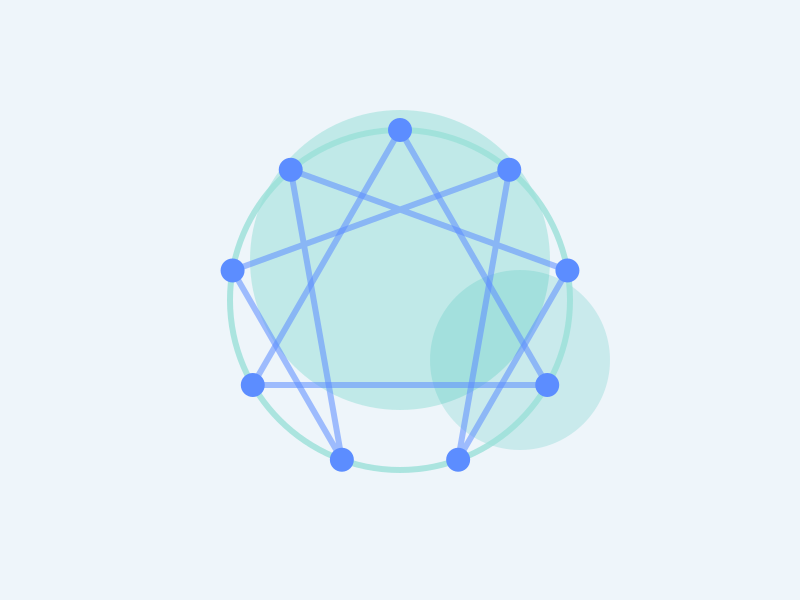
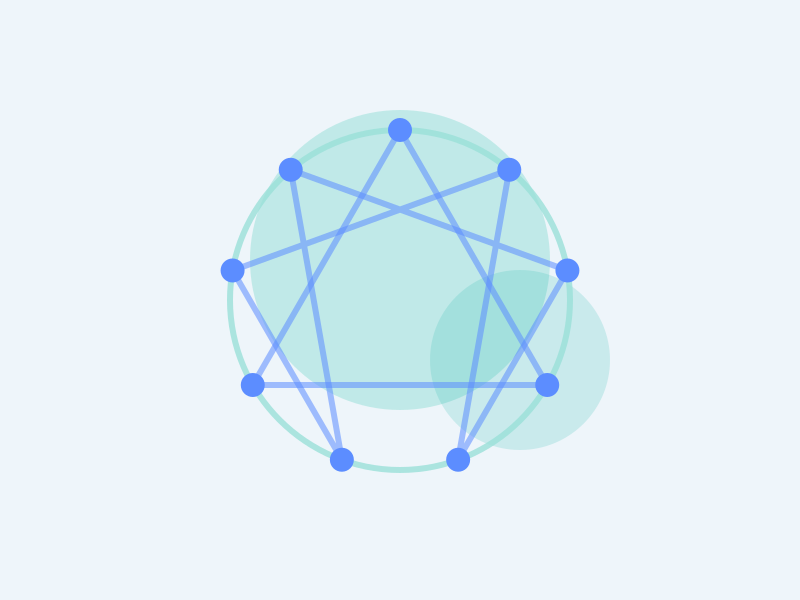
The Enneagram organizes personality around nine core motivations and fears: the fear of being worthless (type 3), say, or the fear of being unloved (type 2).
It asks less about how you act and more about why you act that way, what underlying need your behavior is trying to satisfy.
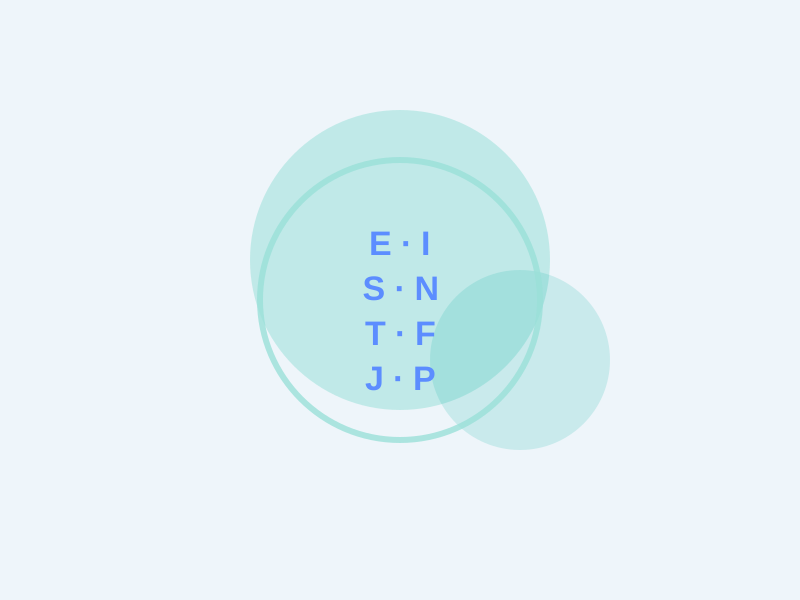
16 Personalities inherits the typological tradition of Carl Jung, later systematized by Katharine Cook Briggs and Isabel Briggs Myers: it describes how you prefer to get energy (introversion/extraversion), process information, decide, and organize.
It’s a model about cognitive style, not deep motivation. One useful nuance: 16personalities.com, the most visited site under that name, is a different test from the MBTI, based on Big Five-style traits; we explain this in what is Myers-Briggs theory.
Origin and scientific backing
This is where the two models diverge most clearly.
The Enneagram, in its modern form, was systematized in the 20th century by Oscar Ichazo and later Claudio Naranjo, drawing on earlier philosophical and spiritual traditions; its development has been mostly clinical and intuitive, not psychometric.
There’s considerably less academic literature confirming its nine types as discrete categories through factor analysis (Sutton, 2012), the kind of evidence that does back, with caveats, dimensional models like Big Five. The systematic review by Hook and colleagues (2021), covering 104 samples, found mixed evidence of reliability and validity, and factor analyses that usually yield fewer than nine factors.
16 Personalities, a direct descendant of the MBTI, does have a longer history of formal psychometric study (Pittenger, 1993), though that same research has flagged its main weakness: low test-retest reliability. Pittenger (2005) notes that up to half of people get a different code when they retake the test weeks later, especially those who score near the midpoint of a scale.
Neither model reaches the empirical validation level of a purely dimensional model, but for different reasons: the Enneagram due to a shortage of rigorous studies, 16 Personalities due to the results of those very studies questioning its stability.
What each one is better for
The Enneagram tends to be more useful when the goal is emotional understanding:
- why you keep repeating a certain pattern
- what fear sits behind a disproportionate reaction
- what you actually need when you ask for something else
It’s a language that lends itself well to therapeutic work or deep self-reflection, though it’s worth holding with the humility of knowing its empirical base is limited.
16 Personalities performs better as a quick snapshot of style:
- how you work best
- how you make decisions
- how you recharge
It’s more useful in practical and team settings, precisely because it describes observable behavior rather than hidden motivation.
Do you have to pick one?
No.
They’re two different questions about the same person, and plenty of people find value in crossing both results: someone can be Enneagram type 6 (driven by a need for security) and also an ISTJ on 16 Personalities (organized and detail-oriented), and both pieces of information fit without contradicting each other.
There’s no official mapping between Enneagram types and 16 Personalities types, though: any chart that claims one is an unvalidated simplification.
Sources
- Hook, J. N., Hall, T. W., Davis, D. E., Van Tongeren, D. R., and Conner, M. (2021). The Enneagram: A systematic review of the literature and directions for future research. Journal of Clinical Psychology, 77(4), 865-883. doi:10.1002/jclp.23097
- Naranjo, C. (1994). Character and Neurosis: An Integrative View. Gateways/IDHHB.
- Pittenger, D. J. (1993). The utility of the Myers-Briggs Type Indicator. Review of Educational Research, 63(4), 467-488.
- Pittenger, D. J. (2005). Cautionary comments regarding the Myers-Briggs Type Indicator. Consulting Psychology Journal: Practice and Research, 57(3), 210-221. doi:10.1037/1065-9293.57.3.210
- Sutton, A. (2012). But is it real? A review of research on the Enneagram. Enneagram Journal, 5, 5-20.
Want to know more about yourself?
Discover your result with one of our related tests.
Frequently asked questions
Do the Enneagram and 16 Personalities sort people by the same thing?
No. The Enneagram groups people by the core motivation and fear driving their behavior (the fear of being worthless or of being unloved, for example). 16 Personalities groups people by processing preferences: how you get energy, decide, or organize. They're two different questions about personality, not two ways of measuring the same thing.
Which one has stronger scientific backing?
Neither reaches the level of factorial validation that a dimensional model like Big Five has. Between the two, 16 Personalities (a descendant of Jung's typological tradition and the MBTI) has a longer history of psychometric study, though that same research has also flagged its low test-retest reliability. The Enneagram has a considerably thinner body of empirical literature confirming its nine types as discrete categories.
Can I have both an Enneagram type and a 16 Personalities type?
Yes, they aren't mutually exclusive. They're two different maps of the same person: one describes what drives you internally, the other how you process the world. There's no official or reliable correspondence between a given Enneagram type and a given 16 Personalities type.