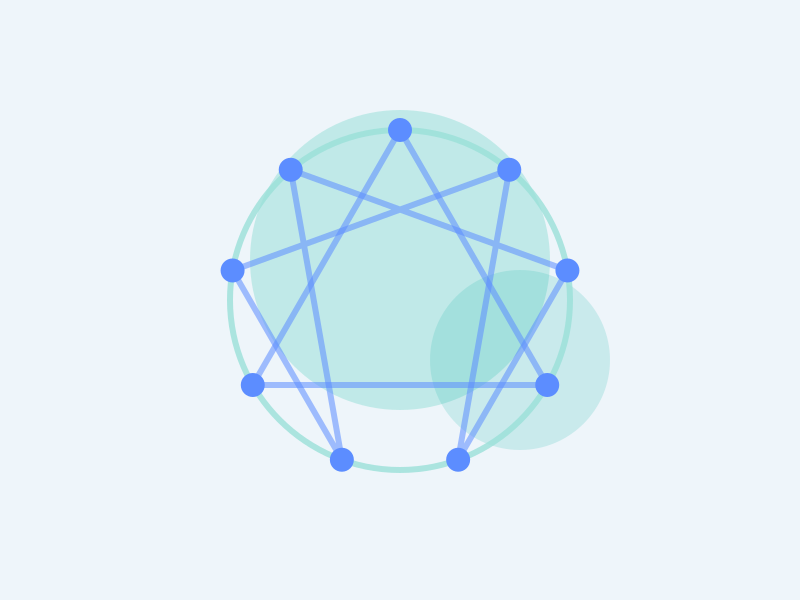
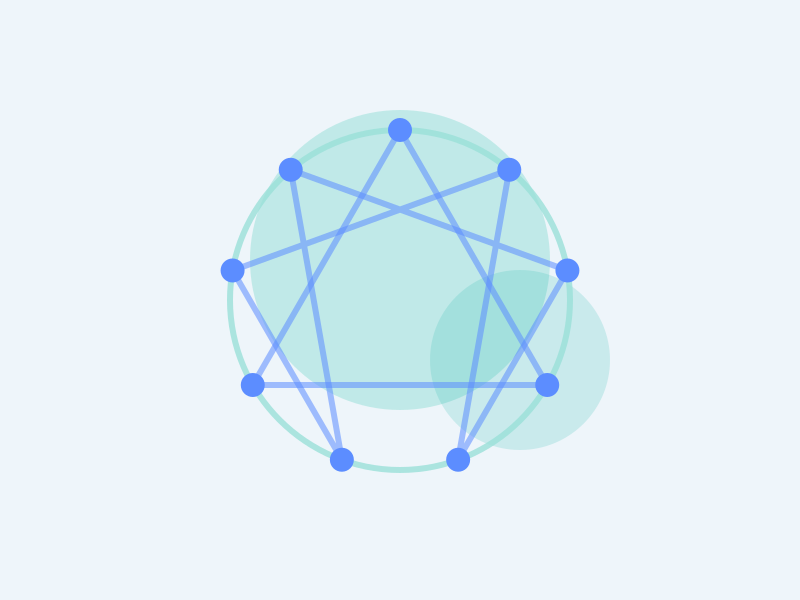
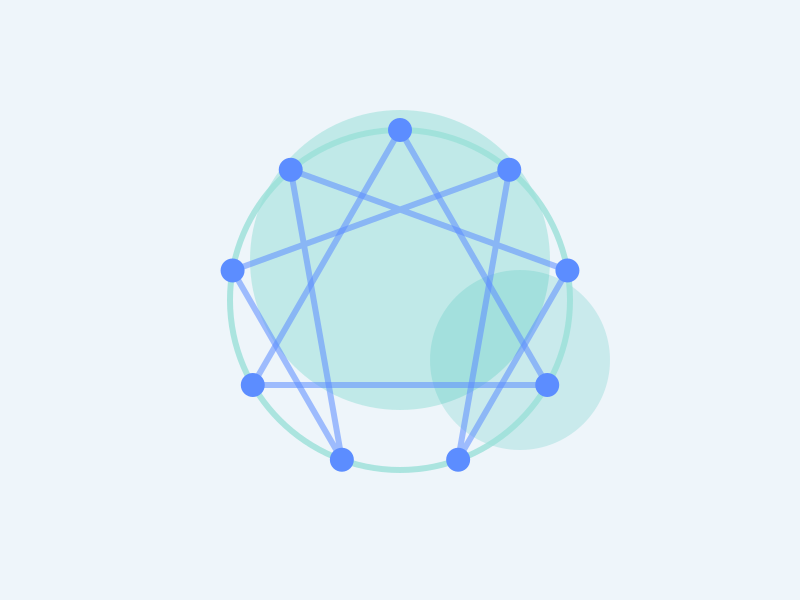
The nine enneagram types group into three intelligence centers, following the Riso-Hudson tradition: the instinctive center (types 8, 9, and 1), the emotional center (types 2, 3, and 4), and the mental center (types 5, 6, and 7). Each center reacts first from a different place: the body, the heart, or the head.
- Instinctive: you react first from the body, with an underlying current of anger or resistance.
- Emotional: you react first from feeling, with an underlying current of shame.
- Mental: you react first from thought, with an underlying current of anxiety.
15 questions, about 3-4 minutes. This test doesn't identify your specific enneagram type (that's what the quick enneagram test or the full enneagram test are for), but the broader center you react from automatically.
All possible results
The Instinctive Center (Body)
You react first from the body, not from thought. Your underlying emotion is anger, even if you don't always show it outwardly.
See the detail
“The instinctive center groups together enneagram types 8, 9, and 1: all three react first from the body, and share an underlying concern with autonomy and control over their own space.”
What this result means
Your most automatic reaction to what's happening around you doesn't start with thought or feeling, but with an almost immediate physical response: tension, an urge to act, resistance. According to Riso and Hudson, the underlying emotion shared by the three types in this center is anger, though each handles it differently: Type 8 expresses it outward, Type 9 numbs it to avoid conflict, and Type 1 turns it into self-control and high standards.
How it shows up day to day
- You feel the tension of a situation in your body before you can even put it into words.
- You're especially bothered by someone trying to control you or decide for you.
- You recover from a bad moment better through movement or physical activity than by talking it through.
An important clarification
This result is orientation-only and informational, inspired by the three-centers framework described by Don Richard Riso and Russ Hudson (1999) and by Claudio Naranjo (1994): it isn't a personality diagnosis and it doesn't replace a validated instrument like the RHETI.
The Emotional Center (Heart)
You react first from feeling, not from thought or the body. Your underlying emotion is shame, even if you hide it well.
See the detail
“The emotional center groups together enneagram types 2, 3, and 4: all three react first from feeling, and share an underlying concern with the image they project and how others see them.”
What this result means
Your most automatic reaction runs through feeling before analysis or physical impulse: how you feel, how the other person feels, what this says about who you are. According to Riso and Hudson, the underlying emotion shared by the three types in this center is shame, though each handles it differently: Type 2 compensates by making themselves indispensable to others, Type 3 covers it with achievement and recognition, and Type 4 turns it into a markedly distinct, personal identity.
How it shows up day to day
- Before deciding something, you ask yourself how it affects your relationship with the people involved.
- You remember how someone felt in more detail than you remember the actual facts of a conversation.
- Deep down, you worry about not being enough or not feeling loved just as you are.
An important clarification
This result is orientation-only and informational, inspired by the three-centers framework described by Don Richard Riso and Russ Hudson (1999) and by Claudio Naranjo (1994): it isn't a personality diagnosis and it doesn't replace a validated instrument like the RHETI.
The Mental Center (Head)
You react first from thought, not from feeling or the body. Your underlying emotion is anxiety, even if you resolve it by analyzing.
See the detail
“The mental center groups together enneagram types 5, 6, and 7: all three react first from thought, and share an underlying concern with security and anticipating what could go wrong.”
What this result means
Your most automatic reaction runs through analysis before feeling or physical impulse: you need to understand the situation, foresee scenarios, gain clarity before moving. According to Riso and Hudson, the underlying emotion shared by the three types in this center is anxiety or fear, though each handles it differently: Type 5 withdraws into their own space to process it, Type 6 projects it outward by seeking security and alliances, and Type 7 avoids it by filling the calendar with plans and new stimulation.
How it shows up day to day
- You need time and space alone to process what happened before talking about it.
- Deep down, you worry about not having the information or resources you need to feel secure.
- You tend to observe quite a bit before joining a new group, to properly get the dynamic first.
An important clarification
This result is orientation-only and informational, inspired by the three-centers framework described by Don Richard Riso and Russ Hudson (1999) and by Claudio Naranjo (1994): it isn't a personality diagnosis and it doesn't replace a validated instrument like the RHETI.
Indicative result. It describes tendencies based on what you answered today, not a fixed trait or a closed label. It is not a diagnosis.
How this test was built
Your dominant intelligence center (instinctive, emotional, or mental) among the three that group the nine enneagram types.
This result is not a clinical diagnosis or a validated psychometric test: the three-centers framework, like the rest of the enneagram, lacks the empirical backing of models such as the Big Five and does not appear in diagnostic manuals suc…
Of the personality models on this site, the enneagram has the weakest empirical foundation, and the three-centers framework inherits that same limitation.
See the full methodology
What it measures
Your dominant intelligence center (instinctive, emotional, or mental) among the three that group the nine enneagram types. It does not measure your individual enneagram type, only the broader level it belongs to.
What model it uses
The enneagram describes nine personality types (enneatypes), represented in a nine-pointed geometric symbol. Each enneatype is built around a basic fear and a basic desire that automatically shape how you think, feel, and act. According to Riso and Hudson, the nine enneatypes group into three intelligence centers:
- Instinctive center (body): types 8, 9, and 1, with anger as the underlying current.
- Emotional center (heart): types 2, 3, and 4, with shame as the underlying current.
- Mental center (head): types 5, 6, and 7, with anxiety as the underlying current.
Each center reacts first from a different place (the body, the feeling, or the thought) before conscious analysis kicks in.
Where that model comes from
The enneagram as a personality system did not originate in academic psychology, but in a philosophical and esoteric context. Its initial formulation is attributed to Óscar Ichazo, a Bolivian-Chilean thinker from the mid-20th century. Chilean psychiatrist Claudio Naranjo later developed it further and introduced it into California therapeutic circles in the 1970s, connecting it with humanistic psychology.
The most popular and widely used systematization today, including the three-centers framework, is that of Don Richard Riso and Russ Hudson, authors of the RHETI questionnaire, which this test draws on.
How the result is calculated
Each of the 15 questions adds points to one of the three centers: instinctive, emotional, or mental. The center with the most points at the end is your result.
This test does not distinguish between the three enneatypes within the same center; for that, there's the quick enneagram test and the full enneagram test.
What your result means
A dominant center indicates that your automatic reaction to a situation (before you fully analyze it) tends to activate first from the body, the feeling, or the thought, depending on which center dominates in your answers. It does not indicate which of the three enneatypes within that center is yours, only the most habitual emotional entry point.
What it does NOT mean
This result is not a clinical diagnosis or a validated psychometric test: the three-centers framework, like the rest of the enneagram, lacks the empirical backing of models such as the Big Five and does not appear in diagnostic manuals such as the DSM-5. It does not replace evaluation by a psychologist or psychiatrist, and should not be used to make clinical, professional, or legal decisions about yourself or other people.
Limitations
Of the personality models on this site, the enneagram has the weakest empirical foundation, and the three-centers framework inherits that same limitation. There is no scientific consensus or solid, replicated empirical validation confirming the nine enneatypes, nor the three centers that group them, as discrete psychological categories; nor is it recognized by mainstream academic psychology.
Its origin is philosophical and esoteric, not experimental, and its later development took place in therapeutic and personal-growth circles, not in peer-reviewed psychometric research. Its value lies in being a tool for self-knowledge and reflection, widely used in coaching and personal development, useful for thinking about your own patterns, but not as a clinical instrument.
Academic references
- Naranjo, C. (1994). Character and Neurosis: An Integrative View. Gateways/IDHHB.
- Riso, D. R., & Hudson, R. (1999). The Wisdom of the Enneagram. Bantam.
Frequently asked questions
How is this test different from the enneagram type tests?
This test identifies your intelligence center (instinctive, emotional, or mental), a broader level that groups three types each. To identify your specific type within that center, there's the quick enneagram test and the full enneagram test.
Can I score close on two centers?
Yes. Even though every enneagram type belongs to a single dominant center, it's common to identify to some degree with more than one: the result points to the strongest tendency based on your answers, not a mutually exclusive category.
Do all three centers have the same number of types?
Yes: each center groups exactly three types. Instinctive: 8, 9, and 1. Emotional: 2, 3, and 4. Mental: 5, 6, and 7.
Is this test reliable?
It's an orientation-only, informational approximation, not a validated psychometric instrument like Riso and Hudson's RHETI. For a deeper analysis, the recommended path is that academic questionnaire or guidance from a professional.
How long does the test take?
Between 3 and 4 minutes: 15 questions with three answer options each.
See all 6 questions
Is it free?
Yes, it's completely free: no sign-up or payment needed to take the test and see your result.