What Does 'Enneagram' Mean?

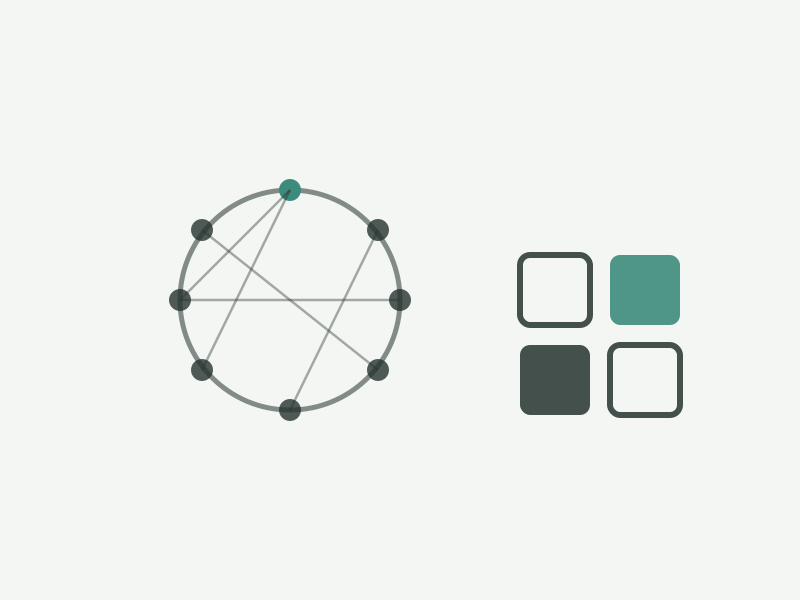
Enneagram is a word of Greek origin that names, first and foremost, a drawing: a circle with nine points and lines connecting them. A model of nine personality types was later built on top of that drawing, which we explain in what is the enneagram.
This article stays with the word and the symbol: where they come from, what each stroke represents, and how a figure traveled from an esoteric system into personality questionnaires.
The word: “figure of nine”
The term joins two Greek roots: ennea, “nine,” and gramma, meaning letter, stroke or drawn figure. It is the same root found in diagram, program or telegram.
Literally, enneagram means “figure of nine” or “drawing of nine.” English spells it with a double n, close to the Greek; Spanish, for instance, settled on a single one (eneagrama).
The symbol, piece by piece
The drawing has three elements, each with its own logic:
- The circle. Nine points spaced at equal distances, numbered clockwise, with 9 at the top. It represents the unity of the whole.
- The triangle. It joins points 9, 3 and 6. It is a closed figure, independent of the rest.
- The six-pointed figure (the “hexad”). It joins the remaining points in a fixed order: 1, 4, 2, 8, 5, 7 and back to 1.
That order is not arbitrary. Dividing 1 by 7 gives 0.142857142857…, a decimal that endlessly repeats the same six-digit sequence: exactly the route of the hexad. The numbers 3, 6 and 9, multiples of three, fall outside that sequence and form the triangle.
Where it comes from: Gurdjieff and the two “laws”
Sufi or ancient roots are often attributed to it, but no document earlier than the twentieth century shows it.
The first written source is P. D. Ouspensky’s book In Search of the Miraculous (1949). In it, Ouspensky reconstructs the teachings G. I. Gurdjieff gave his groups in Russia during the First World War, and presents the enneagram as a universal symbol bringing together two ideas from Gurdjieff’s system:
- The law of three: every process would result from the meeting of three forces (active, passive and reconciling). This is what the triangle represents.
- The law of seven, or law of the octave: every process would advance through seven stages, like the notes of a musical scale, with two points where it needs an outside push to stay on course. This is what the hexad and the path around the circle represent.
In Gurdjieff’s version, then, the enneagram did not describe people, but processes of any kind.
From symbol to personality
The move into psychology came later. The Bolivian Oscar Ichazo used the figure in the 1960s to arrange nine ego “fixations,” and in 1970 he led a long training program in Arica, Chile, attended by the Chilean psychiatrist Claudio Naranjo.
Naranjo brought the model to the United States, where he taught it in Berkeley and at the Esalen Institute, and connected it with categories from clinical psychology. From there it was developed by authors such as Don Riso and Russ Hudson, whose book The Wisdom of the Enneagram (1999) established much of the vocabulary used today.
In this personality enneagram, each number on the circle is a type and the lines take on a new meaning:
- The neighboring points on the circle are each type’s wings (a 4 would have wings 3 and 5).
- The two inner lines leaving each point are read as directions of change: according to Riso and Hudson, a 1 would move toward 4 under stress and toward 7 during periods of growth.
How these elements combine in each type is covered in what an enneagram type is and how many there are, and the full list is in the 9 enneagram personality types.
Essence and ego: the spiritual layer of the symbol
Spiritually oriented versions of the enneagram, such as Riso and Hudson’s, distinguish two layers in a person:
- Essence: what someone is before their defensive habits.
- Ego, or personality: the strategies learned for self-protection that over time get mistaken for oneself, like a suit of armor that was once useful and that, in adulthood, weighs more than it protects.
In this reading, each of the nine points on the circle would be a different way of building that armor. It is a proposal of the model, inherited from Gurdjieff’s tradition, not a finding of scientific psychology.
What the symbol does not guarantee
An elegant geometry says nothing about whether people really fall into nine types.
The systematic review by Joshua Hook and colleagues (2021) analyzed 104 samples and found mixed evidence: some scales relate to the Big Five in the expected ways, but statistical analyses usually find fewer than nine factors, and there are hardly any studies on wings and lines, precisely the elements the symbol draws most clearly.
As we read it, the enneagram works better as a vocabulary for thinking about one’s own motivations than as a proven classification. If you want to explore it firsthand, you can take our enneagram test.
Sources
- Hook, J. N., Hall, T. W., Davis, D. E., Van Tongeren, D. R., & Conner, M. (2021). The Enneagram: A systematic review of the literature and directions for future research. Journal of Clinical Psychology, 77(4), 865-883. https://doi.org/10.1002/jclp.23097
- Ouspensky, P. D. (1949). In Search of the Miraculous: Fragments of an Unknown Teaching. Harcourt, Brace.
- Riso, D. R., & Hudson, R. (1999). The Wisdom of the Enneagram. Bantam Books.
Want to know more about yourself?
Discover your result with one of our related tests.
Frequently asked questions
What language does the word 'enneagram' come from?
From Greek: 'ennea' (nine) and 'gramma' (letter, stroke, drawn figure), the same root as in 'diagram' or 'telegram'. Literally it means 'figure of nine', referring to the nine points spaced around a circle that make up the symbol.
What's the difference between essence and ego under this model?
In spiritually oriented versions of the enneagram, such as Riso and Hudson's, essence would be what a person is before their defensive habits, and the ego or personality, the set of learned strategies that over time get mistaken for oneself. This is a proposal of the model, not a finding of scientific psychology.
Is the enneagram symbol a recent invention?
Ancient roots are often attributed to it, but no documents prove them. The symbol first appears in the early twentieth century, in the teachings of G. I. Gurdjieff that P. D. Ouspensky published in 1949; its use to describe personality types came later, with Oscar Ichazo and Claudio Naranjo, from the 1960s and 1970s onward.
What do the inner lines of the enneagram mean?
In the personality enneagram, each type is joined by lines to two others, and authors such as Riso and Hudson read them as directions of change: where someone would tend to go under stress and where during periods of growth. The review by Hook and colleagues (2021) notes that this part of the theory has barely been researched.