Meticulous Stroke: what it means to draw slowly and small

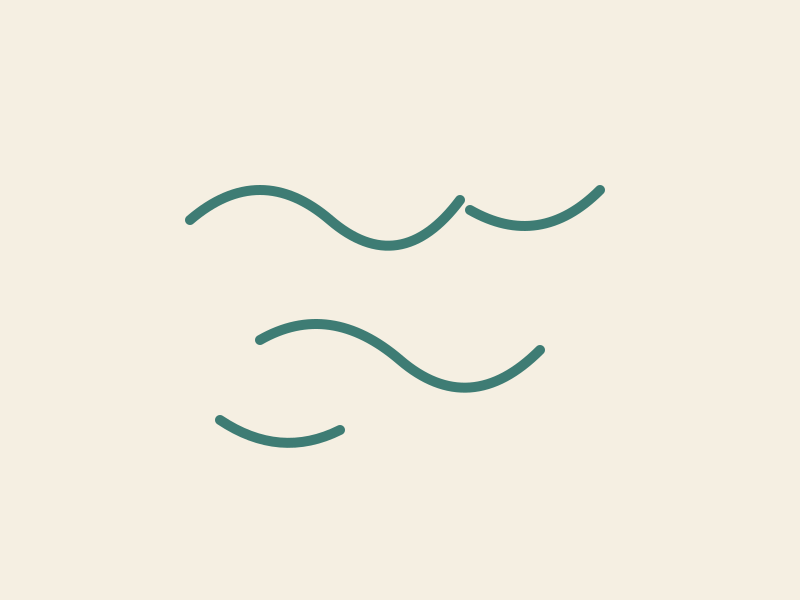
If the expressive style test gave you meticulous stroke as your result, your drawing combined two things: a low stroke speed (you moved slowly) and limited use of the canvas (you stayed within a relatively small area, instead of covering the whole available surface).
What this result actually measures
Without ever analyzing what you drew, the test calculates four numerical metrics from the path of your mouse, trackpad, or finger:
- the total distance the stroke travels divided by the time you spent actively drawing (speed),
- the size of the rectangle enclosing your whole drawing relative to the full canvas (space used),
- the number of separate strokes you made,
- and how similar the amount of ink is on the left and right of center (symmetry).
Only the first two decide the result. The canvas uses fixed coordinates of 600 × 400 points, whatever the size of your screen, and speed counts only the time your finger or mouse was actually drawing, not the pauses between strokes. Each metric is converted to a 0 to 100 scale with the cutoff at 50: pace falls below it when average speed stays under roughly 1.1 points per millisecond, and space falls below it when the rectangle enclosing the drawing covers less than about 31% of the canvas.
Meticulous stroke is the combination of the two lower halves: you drew calmly and without needing to fill the whole canvas. Those thresholds were tuned through manual testing. They don’t come from population data or any published norm, which is why a drawing that lands near the cutoff can switch boxes with very little.
Why this isn’t graphology
Let’s clear up a possible confusion from the start.
Graphology, the practice of analyzing the shape of handwritten letters to infer personality traits, has no serious scientific backing: decades of studies have found no reliable evidence that your handwriting predicts traits like honesty or extroversion, and much of the scientific community considers it a pseudoscience. The meta-analysis by Neter and Ben-Shakhar (1989) found that graphologists predicted no better than people with no training in graphology, and that when the texts had neutral content (no biographical clues), the validity of their inferences was practically zero.
This test works differently, and in a much more limited way.
It doesn’t analyze the shape of anything you drew, nor does it try to recognize whether you drew a face, a house, or a plain scribble.
It only measures how fast you moved and how much space you used, two objective numerical quantities. One important nuance: space can be measured with a ruler on the final image, but speed can’t, because the image doesn’t store time. The test calculates speed while you draw, using the timestamp of each point in the stroke; two identical drawings made at different paces would produce the same image and a different result.
There’s no symbolic interpretation of any kind, and it isn’t meant to be a personality assessment tool.
What’s reasonable to think about this result
Within those limits, there’s something real behind the underlying idea: the pace someone moves at while doing a task with no strict instructions (like this free drawing) can reflect, at least in that specific moment, how much of a hurry they were in, how much energy they felt, or how much they felt like tending to detail instead of finishing quickly.
It’s the same logic, much more informal, behind why someone walks slower on a Sunday morning than running to catch a train: the pace changes with context, it isn’t a fixed property of the person.
That’s why the test itself, right after giving you your result, includes an explicit note:
A snapshot of how you drew today, not a diagnosis.
If you repeat the exercise another day, in more or less of a hurry, it’s perfectly normal to get a different result, like direct stroke (fast but just as contained) or exploratory stroke (slow but far more expansive).
A real law from the science of movement, with caveats
There’s a legitimate field of study, unrelated to any projective test, that does investigate the relationship between speed and precision in human movement: Fitts’s law (1954), one of the most replicated findings in experimental psychology on motor control.
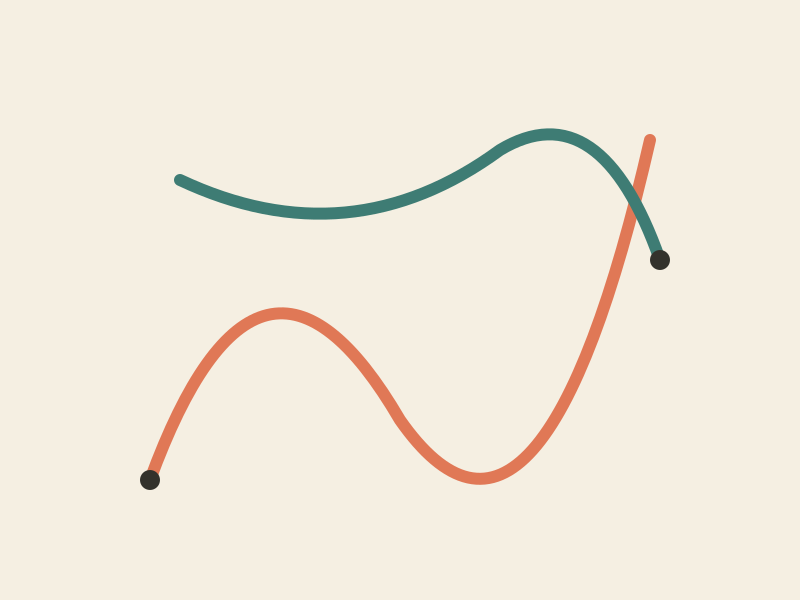
It describes something fairly intuitive once you say it out loud: the time a pointing movement takes grows with the distance to the target and with how small that target is. The more precision a gesture demands, the more slowly it is carried out.
It’s best not to stretch the analogy. Fitts’s law is studied with specific pointing tasks (touching a target on screen, for example), not with a free drawing with no defined goal, and we have no data showing that slow and contained go together in this test more often than any other combination.
What it does offer is a sober reminder: the speed of a stroke depends heavily on the task a person sets themselves in that moment (detailing something small, filling a gap, scribbling), and that explains a slow pace better than any personality reading.
The full map
The test places each result at the intersection of two axes, pace and space used, with four possible combinations.
Meticulous stroke sits in the corner of low pace and low space; at the opposite end is spontaneous stroke (fast and expansive), and in the other two corners, exploratory stroke (slow and expansive) and direct stroke (fast and contained).
No combination is better than another: they’re simply four different ways of having drawn 20 seconds of a free sketch.
Why this test exists, being this honest about its limits
It might seem strange to publish a test and, at the same time, spend much of the article explaining everything it doesn’t measure. We do this on purpose.
This test was never meant to imitate graphology or clinical projective tests with a veneer of rigor we don’t have: it’s simply a curious, honest way to pause for a moment on how you moved while drawing something with no specific instructions, with the same attitude you’d bring to noticing whether you’re walking faster or slower than usual today.
We’d rather be transparent about that modest origin than let you believe we’ve measured something we haven’t actually measured.
Sources
- Neter, E. and Ben-Shakhar, G. (1989). The predictive validity of graphological inferences: A meta-analytic approach. Personality and Individual Differences, 10(7), 737-745. https://doi.org/10.1016/0191-8869(89)90120-7
- Fitts, P. M. (1954). The information capacity of the human motor system in controlling the amplitude of movement. Journal of Experimental Psychology, 47(6), 381-391.
Want to know more about yourself?
Discover your result with one of our related tests.
Frequently asked questions
What does getting 'meticulous stroke' mean?
That in this specific drawing your average stroke speed was low and you used a small portion of the canvas, instead of covering all of it. It's a combination of two numerical metrics, not a judgment of the drawing's quality.
Does it mean I'm a detail-oriented or perfectionist person?
There's no basis for that claim. This result describes how you drew today, in a 20-second exercise, not a stable trait of your personality.
Is this the same as graphology?
No. Graphology analyzes the shape of handwritten letters to infer personality traits, and it lacks serious scientific backing. This test doesn't analyze the content or shape of what you draw, it only measures speed and space used.
Can I get a different result if I retake the test?
Yes, and it's fairly likely. The rhythm you draw with varies with your mood, how much of a hurry you're in, or simply the chance of that particular moment.