Spontaneous Stroke: What It Means to Draw Fast Across the Whole Canvas
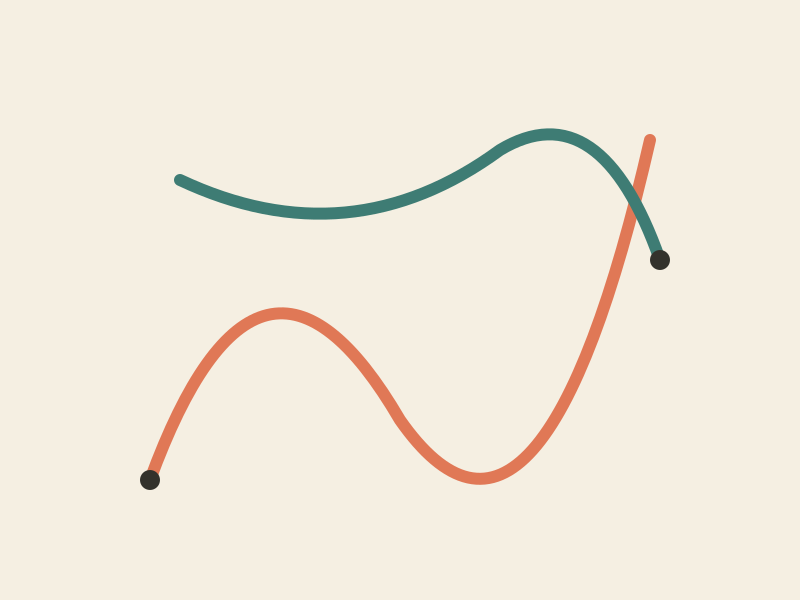
If the Expressive Style quiz gave you spontaneous stroke as your result, your drawing combined a high stroke speed with broad use of the canvas: you moved fast and what you drew spreads across a good part of the available surface.
It’s the result that lends itself most to grandiose readings (“energy,” “impulsiveness,” “overflowing creativity”). Here we explain what it actually measures and why those readings don’t hold up.
What it takes to land here
The test works on a logical canvas of 600 × 400 units and assigns the cell with two cutoffs, both at 50%:
- Fast rhythm: an average speed of at least about 1,100 units per second, counting only the time the pointer is down.
- Broad space: the rectangle enclosing all your strokes has to cover at least 31.25% of the canvas.
The key detail lies in that rectangle. The test doesn’t measure how much ink you put down, but how far the edges of your drawing reach. A single fast line from one corner to the opposite one produces a rectangle the size of the whole canvas, even if it leaves almost everything blank.
That’s why, contrary to what it might seem, this isn’t the most demanding cell. There’s no need to sustain a high rhythm for the full 20 seconds or to “fill” anything: two or three long, fast strokes crossing the canvas are enough. Pauses with the pointer lifted don’t penalize the rhythm either, because they aren’t counted.
The thresholds were tuned by hand with internal testing, not with user data, so landing here doesn’t mean being above anyone’s average.
Where it sits on the map
On the two-axis map, spontaneous stroke occupies the corner opposite meticulous stroke, which is slow and contained.
With the other two results it shares one axis each: speed with direct stroke, which stays within a small area, and breadth with exploratory stroke, which travels across the canvas calmly. It sits at the same distance from both.
No result is “more extreme” than another by definition. What does vary is your position within the cell: if your point landed close to where the axes cross, the test marks it as weakly defined, and a more unhurried or more compact attempt would move it to another cell.
Why this doesn’t measure impulsiveness
It’s tempting to read “fast and broad” as impulsiveness. In psychology, impulsiveness is a construct with several facets, and one of the most widely used instruments to measure it is the Barratt (Barratt Impulsiveness Scale, BIS-11), a 30-item questionnaire.
In their study of the scale’s structure, Patton, Stanford, and Barratt (1995) described three second-order factors: attentional, motor, and non-planning impulsiveness. Each is measured by asking about habitual behavior, like changing plans without thinking or acting without reflecting, across many situations.
A 20-second drawing touches none of those three facets. The speed of a gesture depends on the device, the shape of the lines, posture, or the rush of that moment. Turning it into a character trait would be exactly the overinterpretation this test deliberately avoids.
What Yerkes and Dodson actually studied
This result is often linked to the Yerkes-Dodson law, understood as a curve between arousal and performance. It’s worth being precise about what they actually studied.
Yerkes and Dodson (1908) worked with mice they trained to choose between two compartments, with electric shocks of varying intensity when they got it wrong. They observed that, when the discrimination was difficult, the fastest learning didn’t happen with the strongest shock, but with an intermediate one.
The famous “inverted U” between arousal and performance is a later reformulation. Teigen (1994) reconstructed how textbooks kept rewriting that experiment until it became a general law about arousal that the original study never proposed.
For this test, the conclusion is simple: neither the original experiment nor its popular version says anything about the speed of a free drawing, and there’s no performance criterion to measure.
Pollock and the broad gesture
On the test’s results page, this profile is illustrated with Jackson Pollock, whose drip paintings were made with movements of the arm and the whole body over canvases laid out on the floor.
The reference helps picture the gesture; it isn’t a retrospective diagnosis. What defines Pollock as a painter is a body of work built over years; what defines this result is the geometry of a 20-second drawing on a screen.
A cell that’s easy to leave
Precisely because a single long line can stretch the rectangle to the maximum, spontaneous stroke is a cell that’s easy to enter and leave. The same drawing, made with more pauses with the pointer down or contained within one half of the canvas, would get a different result.
That sensitivity is the best guide to reading it: it describes the shape of one specific gesture, and it lasts as long as that gesture does.
Sources
- Patton, J. H., Stanford, M. S., & Barratt, E. S. (1995). Factor structure of the Barratt Impulsiveness Scale. Journal of Clinical Psychology, 51(6), 768-774.
- Teigen, K. H. (1994). Yerkes-Dodson: A law for all seasons. Theory & Psychology, 4(4), 525-547. https://doi.org/10.1177/0959354394044004
- Yerkes, R. M., & Dodson, J. D. (1908). The relation of strength of stimulus to rapidity of habit-formation. Journal of Comparative Neurology and Psychology, 18(5), 459-482. https://doi.org/10.1002/cne.920180503
Want to know more about yourself?
Discover your result with one of our related tests.
Frequently asked questions
What does getting 'spontaneous stroke' mean?
That your average speed while the stroke was active exceeded the test's threshold and that the rectangle enclosing your whole drawing covered at least 31.25% of the canvas. It's the cell for high rhythm and broad space.
Does it mean I'm an impulsive person?
There's no scientific basis for that conclusion. This result describes how you drew one specific 20-second drawing. Impulsiveness is measured with validated questionnaires, like the Barratt scale, which ask about habitual behavior across very different situations.
Why aren't there famous people associated with this result, like in other tests on the site?
The test's results page does feature Jackson Pollock, but as a visual reference for a broad, fast style of gesture, not as someone who took this test. There's no way to know which cell a real person would land in without having them draw on this canvas, so the name illustrates an idea, not a data point.
Can I take the test as many times as I want?
Yes. Each attempt is independent, no history is saved, and it's normal (and likely) to get different results on different days.