Arno Stern, the Man Who Found the Same Drawing in Children Everywhere on Earth
Arno Stern turned 100 on June 23, 2024. He died a week later, on June 30, in France. He spent more than sixty of those years on one very specific idea: that asking a child “what did you draw?” is, in his view, almost always a mistake.
It isn’t a minor footnote in his work. According to the academic work that analyzes his thinking, it’s the starting point for everything else.
From a postwar orphanage to a complete theory
Stern was born in 1924 in Kassel, Germany. His family fled Nazism and settled in France in 1933, and during the war he himself went through a labor camp.
His first professional contact with children’s painting came in 1946, on the outskirts of Paris, when he took charge of a painting workshop in a home for war orphans. There he invited the children to paint with no instructions and no correction of any kind, and what he saw in those sessions shaped the rest of his work.
From there, without ever having worked inside the school system, Stern spent decades observing how people of every age paint in a space he designed himself: the Closlieu.
The Closlieu: a space built so no one watches you
The Closlieu isn’t a classroom or a conventional art studio. According to an academic paper on his semiology of expression, it’s a room of about 20 square meters, holding a maximum of fourteen people, designed to exclude any intrusion, request, or outside distraction.
The furniture includes a shared palette-table for mixing paint, brushes, paper, water, and a shelf of containers. Nothing in the space is there to evaluate the result.
In the Closlieu, whoever accompanies the session isn’t a teacher. Stern insisted on calling that person an assistant, a carefully chosen word: they don’t direct, evaluate, or correct the figure, the color, or the composition.
Their job is to hold the conditions so painting can happen with no power relationship involved.
The question he believed does more damage than any correction
The core of Stern’s critique isn’t obvious correction, but a question that sounds harmless: “What did you draw?”
An academic paper analyzing his book Del dibujo infantil a la semiología de la expresión records his argument this way, in Stern’s own words:
The adult doesn’t just say ‘Make me a nice drawing!’, they then ask the child to explain their drawing. And this completes the disaster, because it plants in the child’s mind the idea that drawing is meant to communicate. […] The adult also asks: ‘And there, what did you want to show?’ And the child reacts: ‘But can’t you see it? Then I wasn’t able to draw it properly!’
Arno Stern
For Stern, that sequence (praise, question, an implicit demand for recognition) is what installs in the child the idea that a drawing can be done “well” or “badly,” and that its job is to communicate something to an adult.
Hence his most controversial thesis: that a child painting freely isn’t making “art” for anyone, but responding to a need of their own to express themselves through forms.
The Formulation: the same stroke in deserts, savannas, and jungles
Between 1966 and 1972, Stern made numerous trips to deserts, savannas, and jungles to observe how children and adults painted with no contact with Western art education.
By his own account, he found the same figures and strokes in cultures that had no contact with each other, and went on to catalog some seventy forms.
He called that phenomenon the Formulation: a repertoire of figures (round, square, radial, spine-like, among others) that, according to his theory, represent nothing from the outside world. Keep in mind that this finding comes from his own observations, not from a comparative study with independent coding criteria.
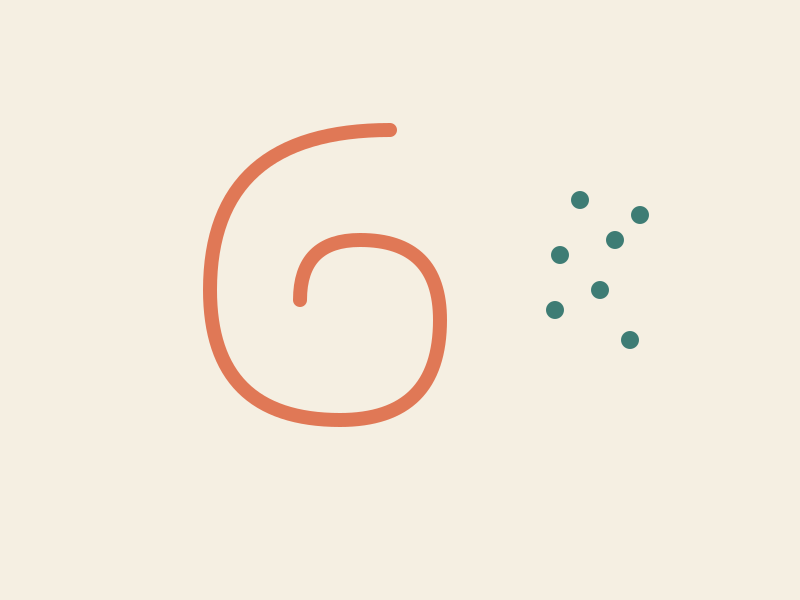
They arise, as an academic paper on the development of children’s drawing describes in detail, from two basic motor gestures: the Whirlwind (an impulsive spin whose ends, once joined, give rise to the Round figure) and Dotting (rapid, repeated tapping that produces the phenomenon of Multiplication).
The Formulation evolves, according to Stern, through three successive stages:
- Primary figures: unreasoned, representing nothing.
- Image-objects: reason steps in, and some primary figures start being used as parts of a house, a tree, or a boat, through resemblance to the surrounding world.
- Essential figures: these appear once a person, already an adult, gives themselves over completely to the Formulation with no need to represent anything, letting the strokes that naturalistic representation had eclipsed come back to life.
Stern held that this code is fed by what he called organic memory: a store from prenatal life and the earliest years that, according to his theory, would reveal itself indirectly in the figures of the Formulation.
Precision matters here: this is an idea of Stern’s own, not a finding with the kind of empirical backing that does exist, for instance, for other drawing techniques we cover on this site.
Two kinds of stroke: the one that communicates and the one that only expresses
A master’s thesis focused on sculpture and expressive drawing records another of Stern’s central distinctions: the difference between the communication-stroke and the expression-stroke.
The first is the stroke of the sketch, the preparatory study meant to fix in advance how a finished piece will look.
The second is the free construction of forms guided only by inner impulse and attention to the material, with no intention that the result resemble anything recognizable.
That same thesis quotes playwright Friedrich Schiller to describe the attitude the expression-stroke requires:
Reason is a troublesome witness during the poetic process.
A theory that collides head-on with reading content into a drawing
Let’s say it plainly: Stern’s position is incompatible with any system, including ones grounded in real research, that reads specific features of a drawing (a large eye, a house with no windows) as a signal about the personality of whoever drew it.
For Stern, that very question (“what does this represent?”) is the source of the problem, not a legitimate tool of analysis.
That tension is one more reason to treat his theory, precisely, as a theory: a complete and coherent perspective on graphic expression, built on decades of his own observation, but different in nature from a system like the one we review in what your drawing says, according to the Machover method, which has been put through decades of validity studies.
That said, there’s a curious point of contact: our own Expressive Style quiz doesn’t interpret what you draw, it only measures rhythm and use of space, without making any claim about content. It wasn’t designed based on Stern’s work, but it shares, at least on that one specific point, the same underlying caution: never turning a stroke into a message someone else has to decode.
Sources
- Stern, A. (2018). Del dibujo infantil a la semiología de la expresión: Iniciación a otra mirada sobre el trazo. Samaruc.
- Felipo Llopis, N. (2018). Desde otra perspectiva: Del dibujo infantil a la obra de arte (Bachelor’s Thesis). Facultat de Belles Arts de Sant Carles, Universitat Politècnica de València.
- García Sánchez, M. (2020). La forma emergente: Reflexiones acerca del dibujo expresivo como génesis del modelado cerámico (Master’s Thesis). Facultat de Belles Arts, Universitat Politècnica de València.
- Biographical details (dates, exile, the 1946 workshop, the 1966-1972 trips) checked against Arno Stern’s official site (arnostern.com) and the “Arno Stern” entry on French Wikipedia.
Want to know more about yourself?
Discover your result with one of our related tests.
Frequently asked questions
Who was Arno Stern?
An educator born in Kassel, Germany, in 1924, who died in France in 2024, and founder of the Institute for Research in the Semiology of Expression. He spent more than sixty years observing how children and adults paint, without intervening in what they create.
What is Arno Stern's Closlieu?
The workshop space Stern designed in Paris to practice what he called the Painting Game: a place free of intrusions or distractions, with fixed materials, room for a maximum of fourteen people, and an adult who acts as an 'assistant,' not a teacher, never evaluating or correcting what gets produced.
What is Arno Stern's 'Formulation'?
The name he gave to a set of figures (round, square, radial, spine-like, among others) that, according to his observations across different cultures, appear spontaneously in the strokes of children and adults with no connection to any outside instruction. For Stern, this repertoire isn't meant to represent anything.
Does Arno Stern's theory have the same kind of scientific backing as other drawing-analysis methods?
Not in the same way. His concepts, such as the 'organic memory' that in his view fed the Formulation, come from decades of his own observation and haven't been put through the kind of validity and reliability studies that do exist, for instance, for the Machover test. This article describes his theory the way academic work analyzing it presents it, not as an established scientific fact.