What the Wartegg Test Measures: All 8 Fields, With the Real Evidence
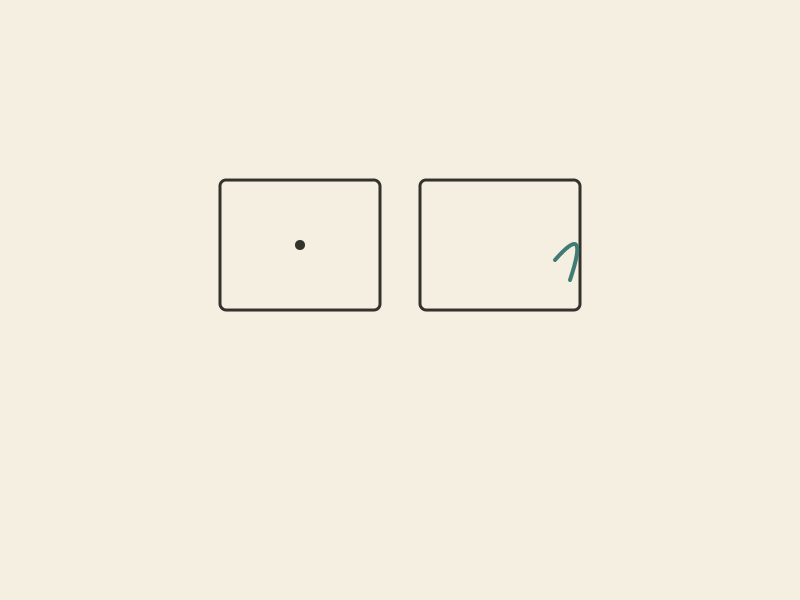
Eight small boxes, each with something already drawn inside: a dot, a wavy line, a curve. The task is to complete the drawings. That’s how one of the most widely used projective tests in personnel selection works in several Spanish- and Portuguese-speaking countries.
Who Wartegg was, and what he did differently
Ehrig Wartegg, a German psychologist, developed his technique starting in 1926 and published the 8-field version in 1939, in Gestaltung und Charakter. His distinctive idea was to offer neither a blank page nor a direct question, but a stimulus halfway between the two: ambiguous, but not empty. The hypothesis was that this starting point would lower conscious censorship and let more spontaneous associations show through.
The test reached the English-speaking world mainly through G. Marian Kinget, who in 1952 published The Drawing-Completion Test and proposed reading the drawings through four basic functions: emotion, imagination, intellect, and activity. Other coding systems followed, such as Biedma and D’Afonso’s (1973), which expanded the stimuli from 8 to 16 boxes, Freitas’s (1993), based on Kinget, and Crisi’s (2007), inspired by Rorschach coding.
That variety matters: when someone says “the Wartegg indicates such-and-such,” it’s fair to ask which system it was scored with.
The 8 stimuli and what is attributed to them
Each field combines a shape with a position inside the box, and the classic readings assign each one an area of personality:
- Field 1, a dot: the self, the starting point.
- Field 2, a small wavy line: the emotional world.
- Field 3, three ascending lines: one’s own goals.
- Field 4, a small black square: the relationship with control and norms.
- Field 5, two opposing straight lines: how conflict is handled.
- Field 6, two unconnected straight lines: rationality.
- Field 7, a small dotted semicircle: emotional sensitivity.
- Field 8, a large semicircle: the bond with one’s surroundings.
Geometry also plays a part in the design. The straight stimuli (fields 3, 4, 5, and 6) tend to suggest structured content, like objects or constructions, and the curved ones (fields 2, 7, and 8), organic content, like living creatures or landscapes. Field 1, a simple dot, is the most minimal stimulus of the eight.
That each shape “evokes” a specific area of personality is a hypothesis of the system itself, not an independent finding. What is well documented is that the shapes shape the kind of drawing people make, something anyone can confirm by completing all eight.
Reliability and validity, two different questions
Before looking at the data, it helps to separate two ideas that are often confused. Inter-rater reliability indicates whether two people score the same drawing similarly. Validity indicates whether that score relates to something real about the person drawing. A test can have the first without the second: always scoring the same way something that means nothing.
A 2012 meta-analysis: every study, together
Jarna Soilevuo Grønnerød and Cato Grønnerød pooled every available study on the Wartegg and analyzed them together in Psychological Assessment. Their two central numbers:
- Inter-rater reliability of 0.74 on average.
- Validity of 0.33 in the studies with clear hypotheses, expressed as a mean correlation.
The authors themselves describe both numbers as high. A correlation of 0.33 is a moderate effect in psychological assessment. Squared, it amounts to just over 10% of shared variance. It doesn’t turn the test into a diagnosis, but it isn’t zero either.
The conclusion they emphasize most is a different one. Despite those results, research on the Wartegg hasn’t managed to build accumulated knowledge, because its research traditions lived in isolation by country and language: lines of work in Germany, Italy, or Latin America that barely spoke to one another and that, in some cases, disappeared with their authors.
That isolation partly explains why the meta-analysis averages studies done with different scoring systems. The overall figure says that something holds up; it doesn’t say which specific system, or which reading of each field, is the one that works.
The Wartegg in personnel selection
In Brazil, one of the countries where it has been used most, the Federal Council of Psychology issued an unfavorable ruling on the test in 2005, as Pessotto and Primi (2018) recall. Since then, that same research group has published studies comparing Wartegg coding systems with the Rorschach in search of new validity evidence.
That trajectory sums up the test’s situation in hiring well: it’s still used, the evidence is scattered, and it depends heavily on the system used to score it. Part of its popularity is explained by reliability itself. A test that scores consistently looks objective, and it’s easy to mistake “it always scores the same way” for “it measures something true.” Our editorial reading is this: at most, a complement within a battery of tests, never the sole criterion for hiring or rejecting someone.
How our test works
Our Wartegg Test presents the 8 fields with their real stimulus already drawn in, but doesn’t interpret what you draw over it. Doing that properly requires recognizing content, like a boat, a face, or a landscape, and judging its formal quality with one of the published coding systems. That calls for the trained judgment of a professional looking at the actual drawing, and pretending a simple algorithm could replace it would be promising more than the test can deliver.
Instead, the report shows what each field is meant to assess according to the original method, along with the two numbers from the 2012 meta-analysis, so each person can decide how much weight to give it. It’s an exercise in how you complete ambiguous stimuli at a specific moment, not a fixed snapshot of who you are.
The same contrast between what the classic method claimed and what the evidence says today appears, applied to another drawing, in Koch’s Tree Drawing Test.
Sources
- Wartegg, E. (1939). Gestaltung und Charakter. J. A. Barth.
- Kinget, G. M. (1952). The Drawing-Completion Test: A Projective Technique for the Investigation of Personality. Grune & Stratton.
- Grønnerød, J. S., & Grønnerød, C. (2012). The Wartegg Zeichen Test: A literature overview and a meta-analysis of reliability and validity. Psychological Assessment, 24(2), 476-489. https://doi.org/10.1037/a0026100
- Pessotto, F., & Primi, R. (2018). A study of coding systems for the Wartegg Test and their relations with the Rorschach (R-PAS). Temas em Psicologia, 26(4), 1861-1873. https://doi.org/10.9788/TP2018.4-06En
Want to know more about yourself?
Discover your result with one of our related tests.
Frequently asked questions
Who was Ehrig Wartegg?
A German psychologist who created his technique in 1926 and published it in the form known today, with 8 stimulus fields, in 1939. It's known as the Wartegg Zeichentest (WZT), or the 8-field test.
Is the Wartegg test reliable?
It depends on what you mean by reliable. A 2012 meta-analysis pooling all available studies found that different raters score the same drawing fairly similarly (0.74 on average) and a validity of 0.33 in the studies with clear hypotheses, a moderate effect. The authors warn, however, that research is fragmented by country and scoring system and hasn't produced accumulated knowledge.
Is this test used in hiring processes?
Yes, it's one of its most frequent uses in several countries, especially across Latin America. In Brazil, the Federal Council of Psychology issued an unfavorable ruling on the test in 2005, and the available evidence depends heavily on the scoring system used, so it shouldn't be used as the sole criterion for a hiring decision.
Why doesn't our online test interpret what you drew?
Because a real Wartegg interpretation requires recognizing what you drew over each stimulus (an object, a scene, something abstract), a trained expert judgment call that can't honestly be automated. Instead of inventing an interpretation, we show what each field is meant to assess according to the original method.