Exploratory Stroke: What It Means to Draw Slowly Across the Whole Canvas
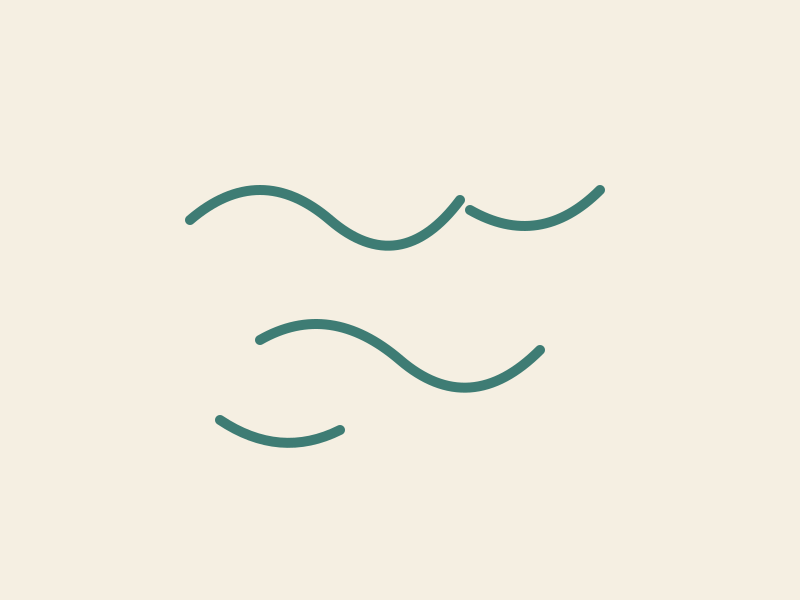
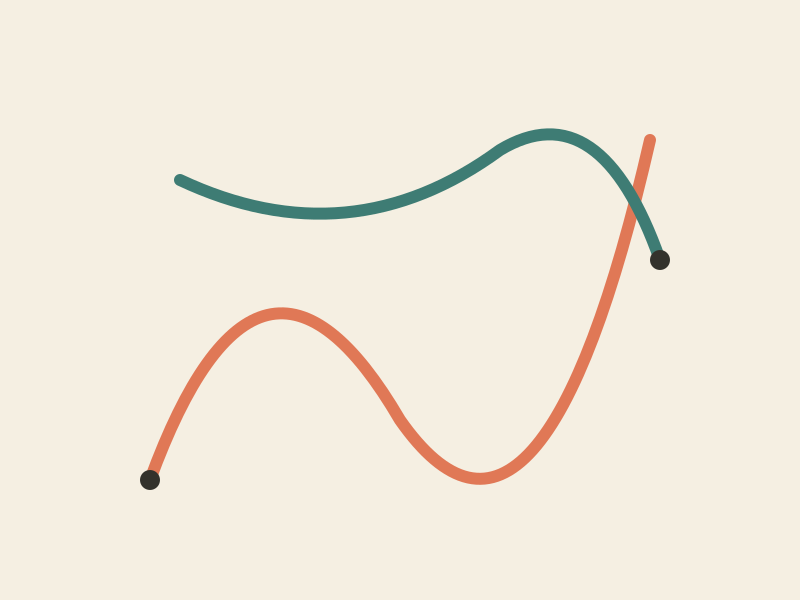
If the Expressive Style quiz gave you exploratory stroke as your result, your drawing combined a low stroke speed with broad use of the canvas: you moved calmly, but what you drew reaches areas far apart from each other.
It looks like a contradictory combination, and it isn’t. To see why, you have to look at how the test calculates each axis.
Two axes measured separately
The test works on a logical canvas of 600 × 400 units and calculates two independent figures, each with its cutoff at 50%.
Rhythm is the total length of your strokes divided by the time they were active. To land in the slow half, the average has to be below about 1,100 units per second with the pointer down. Pauses with the pointer lifted don’t count; pauses without lifting it do, and they lower the average.
Space doesn’t measure how much surface the ink covers, but the size of the rectangle that encloses the whole drawing. From 31.25% of the canvas upward, it counts as broad.
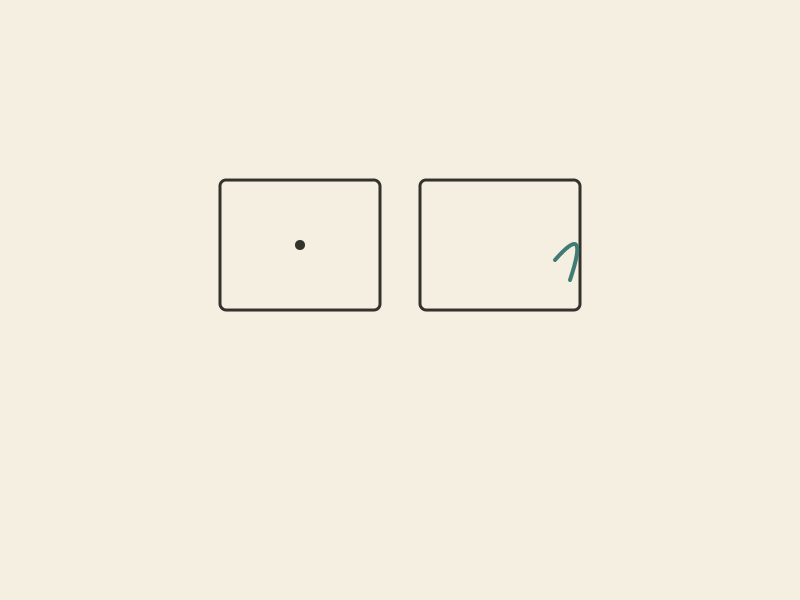
That’s the key to this result: two small, careful drawings in opposite corners produce a huge rectangle, even if there’s nothing between them. The same happens with a slow line crossing the canvas, or with a handful of loose motifs scattered across the surface.
The thresholds were set by hand with internal testing, not based on users’ results. Landing in this cell doesn’t put you above or below anyone.
Where the slowness comes from
A low rhythm can have very different origins, and the test doesn’t tell them apart:
- Unhurried movements, simply from drawing without rushing.
- Tight curves. When drawing by hand, speed naturally drops in tight turns and rises on straight stretches, a regularity described by Lacquaniti, Terzuolo, and Viviani in 1983 that we explain in direct stroke. A drawing full of loops tends to come out slow.
- Stops without lifting the pointer, for example while thinking about what to do next with your finger still on the screen.
That’s why the same result can come from a carefully drawn landscape, from several spirals scattered across the canvas, or from a hesitant scribble. The test sees geometry and the clock, not intention.
Explore versus exploit: where the name comes from
The name “exploratory” alludes to a classic distinction in decision science: exploring (trying new alternatives whose outcome is unknown) versus exploiting (sticking with a known option that already works).
In their review of the topic, Cohen, McClure, and Yu (2007) point out that many everyday decisions, from which ice cream to pick to which project to take on, require exploring before committing. They propose that the balance depends on factors such as how familiar the environment is, how quickly it changes, and the cost of reducing uncertainty, and they stress that there’s no general optimal solution to the problem.
That dilemma is studied with choices that have consequences, like laboratory tasks in which you win or lose depending on the option chosen. A free drawing has no rewards or costs, so the test measures none of this. We borrow the name because it describes the geometric pattern well: the stroke visits several areas of the canvas instead of staying in one.
What this result isn’t
As explained on the test’s category page, this isn’t a projective test. It doesn’t interpret the content of the drawing, as Karen Machover’s human figure drawing (1949) or Karl Koch’s tree test (1949) do, techniques that read the size or presence of elements and whose empirical backing is limited.
Here it doesn’t matter whether you drew a landscape, a spiral, or loose lines: the test calculates speed, space, number of strokes, and symmetry the same way for any drawing, and only the first two decide the result.
Nor does it describe your curiosity, the way you learn, or how you make decisions. That would take instruments that ask about habitual behavior, not 20 seconds of drawing.
A cell with two exits
On the map, exploratory stroke shares breadth with spontaneous stroke and slowness with meticulous stroke. That means it has two nearby exits: a somewhat faster attempt takes it to spontaneous, and an equally unhurried attempt concentrated in one area takes it to meticulous.
If your point landed close to where the axes cross, the test itself flags it with its definition label. In that case, the result says more about how close it came to another cell than about the cell itself, and it’s best read that way: as the description of one specific path across the canvas, not as a portrait.
Sources
- Cohen, J. D., McClure, S. M., & Yu, A. J. (2007). Should I stay or should I go? How the human brain manages the trade-off between exploitation and exploration. Philosophical Transactions of the Royal Society B: Biological Sciences, 362(1481), 933-942. https://doi.org/10.1098/rstb.2007.2098
- Lacquaniti, F., Terzuolo, C., & Viviani, P. (1983). The law relating the kinematic and figural aspects of drawing movements. Acta Psychologica, 54(1-3), 115-130. https://doi.org/10.1016/0001-6918(83)90027-6
- Machover, K. (1949). Personality Projection in the Drawing of the Human Figure. Charles C. Thomas.
- Koch, K. (1949). Der Baumtest: Der Baumzeichenversuch als psychodiagnostisches Hilfsmittel. Verlag Hans Huber.
Want to know more about yourself?
Discover your result with one of our related tests.
Frequently asked questions
What does getting 'exploratory stroke' mean?
That your average speed while the stroke was active fell below the test's threshold and that the rectangle enclosing your whole drawing covered at least 31.25% of the canvas. It combines an unhurried rhythm with a drawing that reaches far across the space.
Is this a better result than 'meticulous stroke'?
There's no hierarchy among the test's four possible results. Each one describes a different combination of two neutral metrics, rhythm and space, not a scale from better to worse.
Why can the same drawing take a long time and still cover a lot of space?
Because the two axes are calculated separately. Space depends only on how far the edges of the drawing reach, so two small figures in opposite corners already count as broad use. Rhythm depends on speed with the pointer down, and it drops with unhurried movements, tight curves, or stops without lifting the stroke.
Does the result change if I retake the test another day?
It's likely. Rhythm and use of space depend on the specific moment you draw, not on a fixed trait, so a different day in a different mood can produce a different result.