What Your House, Your Tree, and Your Person Say, According to Buck's H-T-P Method (and What the Real Evidence Says)
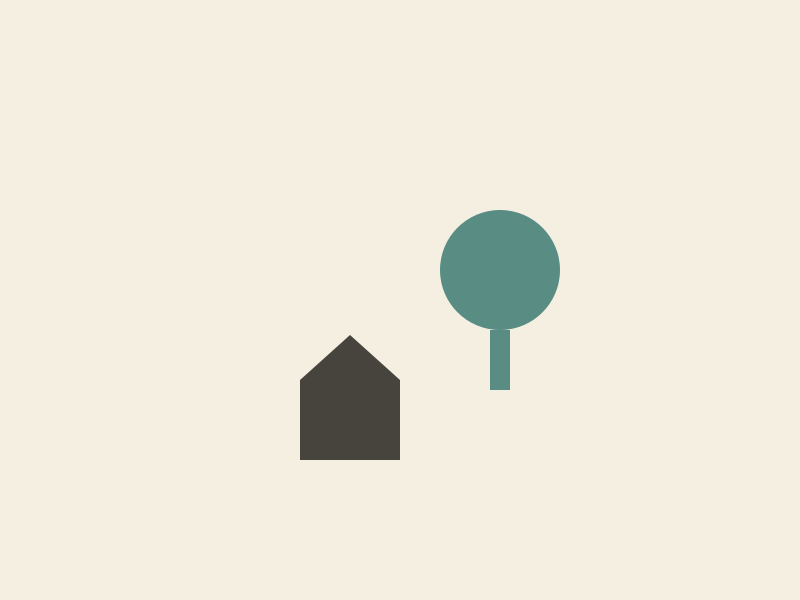
Three blank sheets of paper and a bare-minimum instruction: draw a house, a tree, and a person. That’s how one of the most widely used drawing tests in clinical psychology since 1948 begins.
Who created it, and why three drawings
John N. Buck, an American clinical psychologist, developed the method starting in 1946 and published it in 1948. His starting point was Florence Goodenough’s Draw-A-Man Test, already used to estimate children’s intelligence, and he asked a different question: whether a drawing could also reveal personality traits, and whether a single one was enough for that.
His answer was three objects, each with a different job:
- The house, which would evoke domestic and family life.
- The tree, understood as a deep, less conscious self-portrait.
- The person, a more direct self-portrait, closer to how you see yourself.
How it’s applied in clinical practice
The original protocol doesn’t end with the drawing. Each one is followed by a structured questionnaire, and for Buck that part wasn’t an extra but half the test.
About the house, for example, the questions ask what it’s made of, whether it’s the person’s own, whether it feels welcoming, or what the weather is like in the drawing. About the tree, how old it is, whether it’s alive and, if not, what happened to it. About the person, who they are, what they’re doing, and whether they’re happy.
The catalogue that made it popular: Jolles
Buck left a general framework. Isaac Jolles filled it with detail in 1964, with a catalogue that assigned, item by item, a meaning to every part of every drawing. Some examples from his system:
- Very small door: reticence, inadequacy, indecision.
- Missing door: inaccessibility, isolation.
- Chimney with excessive smoke: tension at home.
- Missing windows: isolation; numerous windows: exhibitionism.
- Omitted roots: insecurity.
- Arms pressed against the body: passivity; omitted arms: guilt or feelings of inadequacy.
Every detail, a meaning: that’s Jolles’s style, and most of the symbolic readings that circulate today about this test come from him.
Summary table: what this method claimed vs. what the evidence says today
| Drawn element | The method claimed | Evidence today |
|---|---|---|
| Very small door | Reticence, inadequacy | No specific support |
| Missing door | Inaccessibility, isolation | No specific support |
| Chimney with no smoke | Lack of affection at home | No specific support |
| Numerous windows | Exhibitionism | No studies isolating it |
| Omitted roots | Insecurity | No studies isolating it |
| Thick lines | Tension, anxiety, vigor | No specific support |
| Omitted facial features | Isolation | No specific support |
| Extended arms | Need for achievement | No specific support |
| Highly detailed clothing | Immaturity | No conclusive data |
With the roots there’s also an explanation simpler than any symbolic reading: many people draw the tree standing on a ground line, and on a real tree the roots can’t be seen.
What the evidence says
The broadest test is recent. In 2022, Lin, Zhang, Qu, Li, Liu, and Song published a two-part study in Acta Psychologica.
First they reviewed the diagnostic indicators proposed in earlier H-T-P studies and found no reliable relationship between them and the mental health problems studied. Then they gathered the drawings and depression scores of 4,196 Chinese children and adolescents and trained neural networks on the complete drawings, without limiting themselves to isolated signs.
The networks learned to recognize houses, trees, and people, but couldn’t tell the drawings of those who scored high on depression apart from everyone else’s. The authors conclude that the result casts doubt on the validity of the H-T-P for diagnosing mental health problems. The study focuses on depression and on children and adolescents, so it doesn’t settle every question, but it does settle the most common one.
It fits with the review by Motta, Little, and Tobin (1993) of human figure drawings, which concludes that they don’t reliably assess personality, behavior, or emotional state. And with Kahill’s (1984) review of the human figure drawing test, which uses the same kind of graphic signs: of 30 indices reviewed, only 2 had consistent support. Since the person in the H-T-P is drawn with the same logic, the critique applies to it directly.
Shading, a sign that can’t be wrong
Shading deserves its own mention. Handler and Reyher (1965), reviewing research on anxiety signs in drawings, pointed out that it has been used to explain both the presence of anxiety and the efforts to control it.
With that double reading, shading indicates anxiety and not shading can indicate that it’s being held in check. An interpretation that fits any result can’t be put to the test, and that’s why it doesn’t work as a scientific sign.
How our test works
Our House-Tree-Person Test collects 13 indicators from this tradition, spread across the three drawings:
- 5 are measured directly from your stroke: size of the house, size and placement of the person, pencil thickness, and deliberate use of shading.
- 8 depend on you telling us what you drew: door, chimney, windows, roots, fruit, facial features, arms, and clothing.
Each indicator appears alongside what the method claimed (Buck or Jolles) and what the evidence says today, hiding neither. A stroke made with a mouse doesn’t reproduce the pressure of a pencil on paper, so what gets recorded are magnitudes like size or position, not fine motor skill.
The person in the H-T-P is drawn with the same logic as a classic human figure drawing. To go deeper on just that drawing, the Machover method is the original reference.
Sources
- Buck, J. N. (1948). The H-T-P technique, a qualitative and quantitative scoring manual. Journal of Clinical Psychology, 4, 317-396.
- Jolles, I. (1964). A Catalogue for the Qualitative Interpretation of the House-Tree-Person (H-T-P). Western Psychological Services.
- Lin, Y., Zhang, N., Qu, Y., Li, T., Liu, J., & Song, Y. (2022). The House-Tree-Person test is not valid for the prediction of mental health: An empirical study using deep neural networks. Acta Psychologica, 230, 103734. https://doi.org/10.1016/j.actpsy.2022.103734
- Motta, R. W., Little, S. G., & Tobin, M. I. (1993). The use and abuse of human figure drawings. School Psychology Quarterly, 8(3), 162-169.
- Kahill, S. (1984). Human figure drawing in adults: An update of the empirical evidence, 1967-1982. Canadian Psychology, 25(4), 269-292. https://doi.org/10.1037/h0080846
- Handler, L., & Reyher, J. (1965). Figure drawing anxiety indexes: A review of the literature. Journal of Projective Techniques and Personality Assessment, 29(3), 305-313.
Want to know more about yourself?
Discover your result with one of our related tests.
Frequently asked questions
Who was John Buck?
An American clinical psychologist who developed the H-T-P (House-Tree-Person) test starting in 1946 and formally published it in 1948, inspired by Florence Goodenough's Draw-A-Man Test.
Why three drawings instead of just one?
Buck believed the house, the tree, and the person would work as three distinct projection screens: the house toward domestic life, the tree toward a deeper, more unconscious self-portrait, and the person toward a more conscious, direct self-portrait.
How many of its indicators have real scientific support?
None of the 13 our test measures currently has consistent, isolated empirical backing. A 2022 study of 4,196 children and adolescents reviewed the earlier literature without finding reliable indicators, and found that neural networks trained on the complete drawings couldn't tell apart those who scored high on depression.
Who was Isaac Jolles?
The author of an H-T-P interpretation catalogue published in 1964, far more detailed than Buck's original manual. Most of the specific symbolic readings that circulate today about this test (door, chimney, windows, roots...) come from his catalogue, not from Buck's original text.