Accommodating Negotiator: Prioritizing the Relationship Over the Outcome
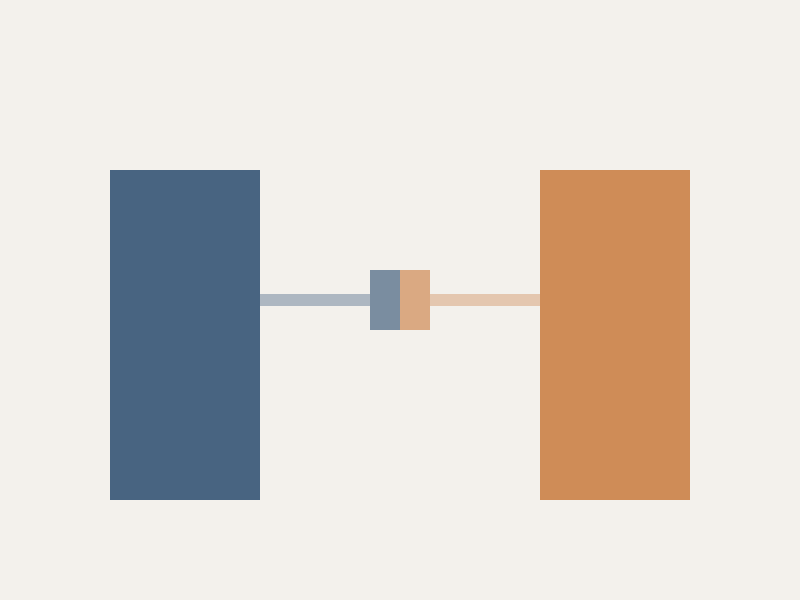
The accommodating negotiator style prioritizes the relationship over the outcome: it yields easily to keep the peace with the other party. The negotiation literature calls it yielding, and it is less a lack of judgment than a way of ordering priorities.
Low concern for self, high concern for the other
In dual concern theory (Pruitt and Rubin, 1986), the accommodating style is the mirror image of the competitive one: low concern for one’s own outcome, high concern for the other’s.
It isn’t weakness but a habitual priority to preserve the bond, even when that means giving ground on the substance of the matter. Often it is also a sensible decision: when the issue matters little and the relationship matters a lot, yielding is cheap and builds trust.
How it shows up in a negotiation
- Gives way early when sensing tension, even if the initial position made sense.
- Puts the other person’s satisfaction ahead of defending their own outcome.
- Sets a low minimum in advance “just in case,” so as not to risk ending up with no deal.
- Tends to be seen as easy to deal with, generous, and flexible.
A typical scene: three friends about to share an apartment are dividing up the bedrooms. The accommodating person takes the smallest one “because I don’t mind,” even though they are the one who works the most hours from home. Nobody asked for that sacrifice; they offered it so the split wouldn’t turn into an argument.
What research shows about giving in
This style has a precise name in a widely cited study. Emily Amanatullah, Michael Morris, and Jared Curhan (2008) examined a trait called unmitigated communion: concern for others combined with anxiety about the relationship. Their findings match the profile almost point by point:
- The trait predicted a tendency to accommodate in everyday conflicts, and it was distinct from simple agreeableness.
- In distributive negotiations, high scorers came in afraid of straining the relationship, set lower limits and planned large concessions, and therefore got worse economic results.
- When both parties in a multi-issue negotiation scored high, they achieved less joint gain but were more satisfied with the relationship.
The meta-analysis by De Dreu, Weingart, and Kwon (2000) adds the other half of the story. Concern for the other improves agreements, but only when it comes with a degree of resistance to yielding. A prosocial motive with little resistance leads to conceding early, and then nobody looks for the creative solution that would have benefited both sides.
Put another way: the problem isn’t concern for the other person, which is an asset, but separating it from the defense of one’s own interests.
When yielding is a strength and when it goes too far
Dale Carnegie, in How to Win Friends and Influence People (1936), champions a principle this style applies naturally: if you’re wrong, admit it quickly and plainly. It is a popular book, not research, but the distinction it allows is useful.
Acknowledging a real mistake disarms the other party and speeds up agreement. Giving in on something where you were right, just because holding your position creates tension, is something else, and it is exactly the pattern the studies above link to worse outcomes.
One question sums up that line well:
Do I really agree, or do I just want the discomfort to end?
On the map of styles
At the opposite end is the competitive negotiator, who puts the outcome ahead of the relationship.
The avoidant negotiator shares this style’s weak defense of self-interest, but by a different route: sidestepping the negotiation instead of yielding within it. And the collaborative negotiator keeps the same concern for the other person without giving up on their own.
If you recognize this pattern outside negotiations too, the people pleaser test explores the tendency to please in general.
Want to see your own style? Take the negotiation style quiz.
Sources
- Amanatullah, E. T., Morris, M. W., and Curhan, J. R. (2008). Negotiators who give too much: Unmitigated communion, relational anxieties, and economic costs in distributive and integrative bargaining. Journal of Personality and Social Psychology, 95(3), 723-738. doi:10.1037/a0012612
- Carnegie, D. (1936). How to Win Friends and Influence People. Simon & Schuster.
- De Dreu, C. K. W., Weingart, L. R., and Kwon, S. (2000). Influence of social motives on integrative negotiation: A meta-analytic review and test of two theories. Journal of Personality and Social Psychology, 78(5), 889-905. doi:10.1037/0022-3514.78.5.889
- Pruitt, D. G., and Rubin, J. Z. (1986). Social Conflict: Escalation, Stalemate, and Settlement. Random House.
Want to know more about yourself?
Discover your result with one of our related tests.
Frequently asked questions
Does being accommodating mean being submissive?
Not exactly: it's a choice of priority, the relationship over the immediate outcome, useful in many contexts, though it can become a problem if applied without exception.
When does this style work best?
When what's at stake matters little compared with the relationship, or when yielding now builds trust that pays off in the long run.
Does giving in a lot during a negotiation have a measurable cost?
According to Amanatullah, Morris, and Curhan (2008), yes: people with a high, anxious concern for the relationship set lower limits in advance, planned large concessions, and got worse economic results in distributive negotiations, although when both parties were like this they ended up more satisfied with the relationship.