The Ebbinghaus Forgetting Curve: Within a Day You Seem to Forget Nearly 70% of What You Learn, and That's a Good Thing
In 1885, a German psychologist published the results of more than two years spent memorizing lists of nonsense syllables. He wanted to measure something no one had measured before: how fast what we learn slips away. The answer was humbling. According to memory science, it is also good news.
That psychologist was Hermann Ebbinghaus, and his graph is now known as the Ebbinghaus forgetting curve.
William James featured it in The Principles of Psychology in 1890, calling it one of the first “exact measurements of memory.”
And alongside the numbers, he offered an idea that sounds remarkably current: forgetting is not a bug in the system.
What is the Ebbinghaus forgetting curve?
Ebbinghaus was both the researcher and the subject.
He used meaningless syllables so that no prior associations would help him remember.
James summarizes his first findings like this:
- After a single reading, he could recall no more than seven syllables.
- Remembering 12 took 16 readings.
- Remembering 24 took 44 readings.
- Remembering 36 took 55.
Then he measured forgetting. He learned a list, waited, and learned it again. In the passage from Ebbinghaus that James quotes:
- After one hour, more than half of the original work had to be done again.
- After eight hours, two thirds.
- After 24 hours, about a third of the original effect remained.
- After six days, a quarter.
- After a month, a fifth.
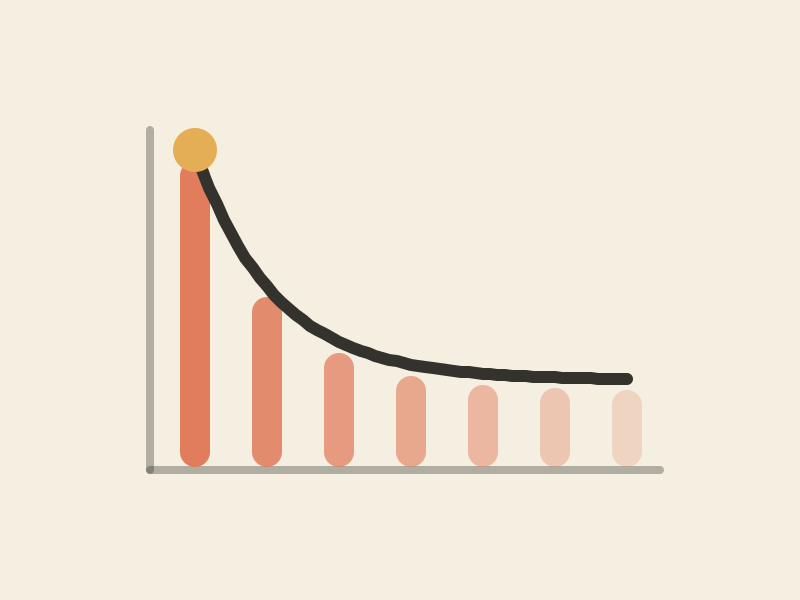
The shape is always the same: a steep drop at first, then a slope that keeps flattening, like a slide that levels out near the bottom.
Forgetting is not erasing: the “70%” trap
The “nearly 70% in a day” figure gets quoted a lot. It has a basis, but it needs careful reading.
Ebbinghaus never asked “how much do you remember?” He measured how much time he saved when relearning a list compared with the first time. This is known as the savings method.
That changes what the number means:
- Losing two thirds of the savings does not mean two thirds of the material vanished.
- A trace remains, which makes the second round of learning faster than the first.
- And the material was nonsense syllables, chosen precisely because they are hard to hold on to.
A good metaphor is a footpath across a field. Left alone, it fades into the grass, but the second time someone crosses, the trail reappears sooner.
Does it hold up more than a century later?
In 2015, Jaap Murre and Joeri Dros of the University of Amsterdam published a replication in PLOS ONE using the same method.
One participant spent 70 hours learning lists and relearning them after 20 minutes, 1 hour, 9 hours, 1 day, 2 days, or 31 days.
- The results were similar to Ebbinghaus’s.
- The curve was not perfectly smooth: it showed an upward jump starting at the 24-hour mark.
It is not the only possible explanation, but that bump fits a large body of sleep research.
According to a 2013 review by Björn Rasch and Jan Born in Physiological Reviews, sleep contributes to consolidating what was learned during the day.
Why do I forget things so easily?
This is where James makes the most interesting turn in the chapter.
William James writes that “in the practical use of our intellect, forgetting is as important a function as recollecting.”
His reasoning is almost mathematical. If we remembered everything in full detail, “it would take as long for us to recall a space of time as it took the original time to elapse.” In other words: “If we remembered everything, we should on most occasions be as ill off as if we remembered nothing.”
Selection, he says, “is the very keel on which our mental ship is built.”
He also quotes the French psychologist Théodule Ribot, for whom forgetting, except in certain cases, is “no malady of memory, but a condition of its health and its life.”
Modern neuroscience has landed somewhere very similar. In 2017, Blake Richards and Paul Frankland published a review in Neuron titled “The Persistence and Transience of Memory.” In their account, forgetting:
- Increases flexibility, by reducing the pull of outdated information on decisions.
- Prevents overfitting to specific past events, which helps the brain generalize.
- Is, in their words, as important to memory systems as persistence.
The goal of memory, they propose, is not to carry information through time for its own sake. It is to make better decisions.
James’s experiment on himself
James wanted to know whether memory could be trained like a muscle. In a footnote, he describes his own test:
- He learned 158 lines of Victor Hugo’s “Satyr” in 131 5/6 minutes over eight days.
- He then trained for twenty-odd minutes a day over 38 days, memorizing the first book of Milton’s Paradise Lost.
- The next 158 lines of Hugo took him 151 1/2 minutes. Slower, not faster.
He admitted he was worn out by other work at the time, an obvious confound.
Colleagues such as Burnham, Drown and Baldwin repeated the test and, taken together, found little or no gain.
His conclusion was blunt: “one’s native retentiveness is unchangeable.”
What improves, he argued, is method: thinking about facts and weaving them into other knowledge.
That is why he called cramming, the last-minute push before an exam, “such a bad mode of study.”
Material learned that way forms few associations and fades fast.
His favorite example was the journalist and politician Thurlow Weed. “My memory was a sieve. I could remember nothing,” Weed confessed.
For nearly fifty years, he told his wife Catherine every night about his day.
According to James, he did not strengthen his raw retention: he built a system of nightly review.
What modern research added
James’s intuition about method has since been studied in detail:
- The spacing effect: a meta-analysis by Nicholas Cepeda and colleagues (2006, Psychological Bulletin) pooled 839 assessments from 317 experiments. The gap between study sessions that produced the best retention grew as the retention interval grew.
- Retrieval practice: Henry Roediger and Jeffrey Karpicke (2006, Psychological Science) found that trying to recall a text led to better retention after two days and after a week than rereading it, even though rereading made students feel more confident.
Both findings fit neatly with what James wrote about associations.
Memory also responds to emotional state, as covered in why stress blocks memory.
What James got right, and where he went too far
- He was right to treat forgetting as a function, not a flaw, a view neuroscience now defends.
- He was right that cramming leaves fragile traces, in line with the spacing effect.
- He was right that method matters more than raw memory power.
- He went too far in declaring retention fixed on the basis of one tired person’s experiment with no controls.
The deep or surface learning quiz lets you see your own pattern.
And forgetting has a close cousin in false recognition, the subject of the article on what déjà vu is.
Sources
- Cepeda, N. J., Pashler, H., Vul, E., Wixted, J. T., & Rohrer, D. (2006). Distributed practice in verbal recall tasks: A review and quantitative synthesis. Psychological Bulletin, 132(3), 354-380. https://doi.org/10.1037/0033-2909.132.3.354
- Ebbinghaus, H. (1885). Über das Gedächtnis: Untersuchungen zur experimentellen Psychologie. Duncker & Humblot.
- James, W. (1890). The Principles of Psychology. Henry Holt and Company.
- Murre, J. M. J., & Dros, J. (2015). Replication and analysis of Ebbinghaus’ forgetting curve. PLOS ONE, 10(7), e0120644. https://doi.org/10.1371/journal.pone.0120644
- Rasch, B., & Born, J. (2013). About sleep’s role in memory. Physiological Reviews, 93(2), 681-766. https://doi.org/10.1152/physrev.00032.2012
- Richards, B. A., & Frankland, P. W. (2017). The persistence and transience of memory. Neuron, 94(6), 1071-1084. https://doi.org/10.1016/j.neuron.2017.04.037
- Roediger, H. L., & Karpicke, J. D. (2006). Test-enhanced learning: Taking memory tests improves long-term retention. Psychological Science, 17(3), 249-255. https://doi.org/10.1111/j.1467-9280.2006.01693.x
Want to know more about yourself?
Discover your result with one of our related tests.
Frequently asked questions
What is the Ebbinghaus forgetting curve?
It is a graph of how learned material fades over time, first measured by Hermann Ebbinghaus and published in 1885. Forgetting is very fast in the first hours and progressively slower afterwards: after one day roughly a third of the original learning remained, and after a month about a fifth.
Do we really forget 70% of what we learn within 24 hours?
Roughly, with an important caveat. Ebbinghaus did not measure how much was erased, but how much effort was saved when relearning a list. After 24 hours that saving was about one third, which means about two thirds of the work had to be redone. He also used meaningless syllables, which are much harder to retain than meaningful material.
Why do I forget things so easily?
Forgetting is not simply a failure. A 2017 review by Richards and Frankland in Neuron argues that it is an active process that clears out outdated information and helps the brain generalize instead of clinging to specific details. William James made a similar point in 1890, calling forgetting as important a function as recollecting.
Has the forgetting curve been replicated?
Yes. In 2015, Murre and Dros published a replication in PLOS ONE using the same savings method. One participant spent 70 hours learning and relearning lists, and the results closely matched Ebbinghaus's, with a small upward jump at the 24-hour point.
Does this article replace a professional assessment if I forget a lot?
No. It summarizes research on memory and forgetting for informational and educational purposes. If forgetfulness noticeably interferes with daily life or has changed in a striking way, the appropriate step is to talk to a healthcare or psychology professional.