Phubbing: Why Ignoring Someone for Your Phone Weighs More Than We Think
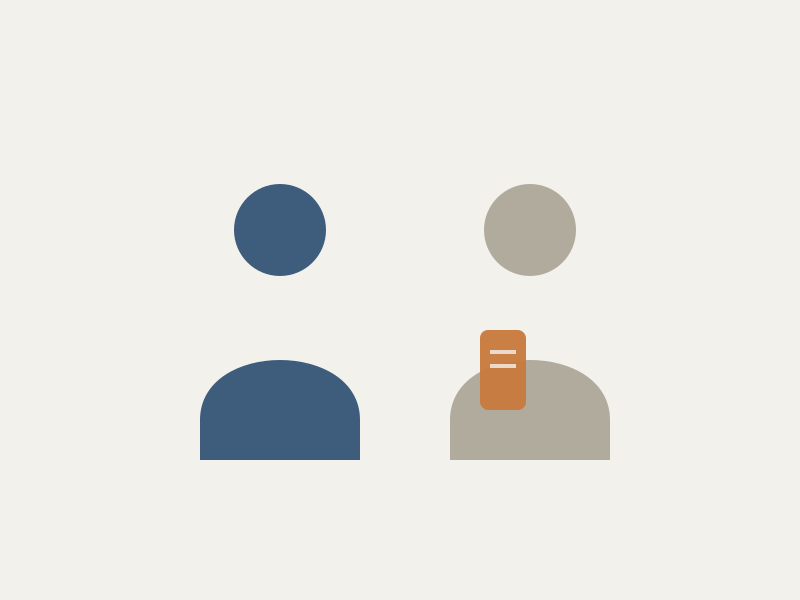
Being always connected and, at the same time, at a distance from the person right beside us: that’s the paradox the word “phubbing” names today. Zygmunt Bauman described it in Liquid Love (2003), almost a decade before that term existed, with the cell phones of the time and long before the smartphone.
Bauman starts with a detail of clothing: sportswear now comes with a pocket designed for the phone, and going for a run with that pocket empty would be, in his words, “like going out barefoot.” This isn’t rhetorical exaggeration but a description of a real habit: nobody leaves the house without their phone.
“Nowhere” has come to mean, literally, a place with no signal or a dead battery.
Connected inside, isolated outside
Bauman sums up the paradox in a single line:
One is always inside, but never locked in.
The phone guarantees a permanent connection to a network of contacts available at any moment. The price of that total availability is divided attention: whoever is looking at the screen pays less attention to whoever is in front of them. The mechanism breaks down into three pieces:
- Availability became total. Before, being available to someone had a physical limit: you could only attend to whoever was present. Today it extends, in theory, to anyone on your contact list, at any moment.
- Attention, on the other hand, is still limited. Every message read takes away, even if just for a second, attention from what’s happening right in front of your eyes.
- The result is a redistribution, not a sum. More availability to the network means less attention for whoever is physically present, because the total didn’t grow at the same pace as the demands placed on it.
The swarm, not the community
Bauman uses a specific image to describe the kind of grouping this constant connectivity produces: the swarm. Not a group with a leader, a flag or a shared purpose, but “an aggregate of self-propelled individuals” moving in the same direction without needing to coordinate. Every unit marches in step with the others, but never together.
The nuance matters: the phone didn’t create the swarm. It handed it the perfect tool for continuing to be exactly that.
The first-class passenger and the second-class teenager
Bauman notices something revealing on any given train. In first class, businessmen talk nonstop on the phone, busy looking efficient: connecting with as many people as possible is, in itself, a form of status. In second class, teenagers and young people let their families know which station they’ve just passed and which one they’re heading to.
Two different scenes, the same underlying behavior: using the phone not so much to sort out something urgent as to sustain the feeling of being available.
An ordinary dinner
Picture a familiar scene, not a real case but an illustration of the pattern. Two people are having dinner together. One of their phones buzzes: nothing urgent, just a notification from a group chat. Even so, they check it, reply with two words and return to the conversation thirty seconds later.
Neither of them would say they “weren’t together” during that dinner. But those thirty seconds, repeated several times an hour, build up into a vague feeling, hard to name in the moment, that the other person didn’t have their full attention available, even while sitting right across the table.
The advantage an unanswered message has
Bauman describes the contact list as “solid ground amid shifting sands.” An unanswered message doesn’t cause the same anxiety it used to, because there’s always another number to text: the total sum of those connections never runs out.
The person in front of us doesn’t work that way. They aren’t one more entry in an interchangeable list, but the only version of themselves available at that table, at that moment. Against an offer that seems to have no end, they compete at a disadvantage, not because they matter less, but because there’s only one of them.
Peter Sellers’s gardener and the remote control
Bauman turns to Being There (Hal Ashby, 1979) to show how far this logic goes. In the film, the gardener played by Peter Sellers, who has spent his life in front of the television, tries to “change the channel” with a remote control when a group of men confronts him on the street. In 1979 it was an absurd joke. Bauman’s point is that today pushing someone out of our field of attention is almost that easy: all it takes is looking at the phone.
Bauman quotes British sociologist John Urry, for whom relationships of co-presence always involve nearness and farness, and takes it a step further: physical proximity and spiritual closeness, which for centuries depended on each other, have split apart. Being next to someone no longer guarantees being close; being far away no longer stops you from feeling close to another person through a screen.
What research has measured since then
Bauman wrote as a sociologist, from observation. Since the word has existed, psychology has tried to measure the phenomenon, with results that partly confirm his intuition and partly qualify it.
- Why it spreads. In a survey of 251 people aged 18 to 66, Varoth Chotpitayasunondh and Karen Douglas (2016) linked phubbing to smartphone addiction, which was in turn associated with internet addiction, the fear of missing out and low self-control. Those who were phubbed most tended to see it as normal: phubbing spreads as a social norm. The fear of missing out has its own article on FOMO.
- Why it hurts. In a later experiment, the same authors (Chotpitayasunondh and Douglas, 2018) showed participants an animation of a conversation in which the other person ignored them for their phone a lot, a little or not at all. The more phubbing, the worse they rated the conversation and the less satisfying the relationship, and the main pathway was a threat to the sense of belonging. It’s the same mechanism, on a small scale, that research on ostracism describes.
- In couples. James Roberts and Meredith David (2016) created a 9-item “partner phubbing” scale. In a sample of 145 adults, more phubbing was associated with more conflict over phone use, and that conflict with lower relationship satisfaction. People with anxious attachment reported more conflict for that reason.
One much-cited finding calls for caution. Andrew Przybylski and Netta Weinstein (2013) found that the mere presence of a phone on the table, without anyone using it, lowered the quality of conversation between strangers. Claire Linares and Anne-Laure Sellier (2021) repeated the procedure with 356 participants and did not reproduce the effect. What research supports more solidly is using the phone during a conversation, not its simple presence.
Written before the smartphone
It’s worth placing the moment Bauman wrote this. In 2003 there was no social media as we know it today and no messaging apps with read receipts. Even so, he identified a central piece of the phenomenon: permanent availability to the network makes up, for whoever sustains it, for the lack of more solid and lasting bonds.
What came afterward, from social media to notifications, didn’t invent that mechanism. It made it faster and more constant.
The tension isn’t in the device
None of what Bauman describes amounts to saying that looking at your phone in someone else’s presence is, in itself, a gesture of contempt. The paradox he points to is subtler: the easier it becomes to stay connected with dozens of people at once, the easier it also becomes to stop being fully present with the one who is physically close.
The phone didn’t invent that tension; it only made it more visible and more frequent. The way each person handles it (what they prioritize, when, with whom) has a lot to do with how they understand and practice assertive communication: the kind that clearly names what you need from the other person, including their full attention.
If you’re not sure what your usual way of communicating is, the communication style quiz can help put a name to it.
Sources
- Bauman, Z. (2003). Liquid Love: On the Frailty of Human Bonds. Polity Press.
- Urry, J. (2002). Mobility and proximity. Sociology, 36(2), 255-274. doi:10.1177/0038038502036002002
- Chotpitayasunondh, V., and Douglas, K. M. (2016). How “phubbing” becomes the norm: The antecedents and consequences of snubbing via smartphone. Computers in Human Behavior, 63, 9-18. doi:10.1016/j.chb.2016.05.018
- Chotpitayasunondh, V., and Douglas, K. M. (2018). The effects of “phubbing” on social interaction. Journal of Applied Social Psychology, 48(6), 304-316. doi:10.1111/jasp.12506
- Roberts, J. A., and David, M. E. (2016). My life has become a major distraction from my cell phone: Partner phubbing and relationship satisfaction among romantic partners. Computers in Human Behavior, 54, 134-141. doi:10.1016/j.chb.2015.07.058
- Przybylski, A. K., and Weinstein, N. (2013). Can you connect with me now? How the presence of mobile communication technology influences face-to-face conversation quality. Journal of Social and Personal Relationships, 30(3), 237-246. doi:10.1177/0265407512453827
- Linares, C., and Sellier, A.-L. (2021). How bad is the mere presence of a phone? A replication of Przybylski and Weinstein (2013) and an extension to creativity. PLOS ONE, 16(6), e0251451. doi:10.1371/journal.pone.0251451
Want to know more about yourself?
Discover your result with one of our related tests.
Frequently asked questions
What is phubbing?
A term (a blend of 'phone' and 'snubbing') describing ignoring the person in front of you to pay attention to your phone. It was coined in May 2012 in a campaign by the McCann agency for Australia's Macquarie Dictionary. The word is recent, but Bauman described the same dynamic in 2003, without using that name.
Did Bauman ever use the word 'phubbing'?
No, the term was coined almost a decade after Liquid Love was published. What Bauman describes is the underlying phenomenon: the 'virtual proximity' to whoever is far away, sustained at the cost of distance from whoever is near.
Is the phone to blame for weaker relationships?
Bauman doesn't put it that simply. He describes it as a tool that amplifies an already-existing trend toward more flexible, revocable bonds, not as the original cause. Later research adds nuance too: the effects depend on how and how much the phone is used, and some striking findings haven't replicated.
Is there any way to measure the effect of phubbing on a relationship?
Yes. Roberts and David (2016) created a 9-item scale to measure partner phubbing and, in a sample of 145 adults, linked it to lower relationship satisfaction by way of conflict over phone use. These are correlational data: they show an association, not a single cause-and-effect relationship.
Why is it so annoying when someone looks at their phone while we're talking?
In an experiment by Chotpitayasunondh and Douglas (2018), being ignored for a phone lowered the perceived quality of the conversation and satisfaction with the relationship, mainly because it threatened the sense of belonging. It's a small-scale version of social exclusion.