Big Five vs. 16 Personalities: Which Test Should You Take First?
Big Five and 16 Personalities start from a different decision about how to describe a person: one uses continuous scales, the other uses closed categories. That design choice, more than the content of the questions, explains almost every practical difference you’ll notice when you take each test.
This article is a practical comparison of the two online tests: what they ask you, how the result is calculated and what you come away with. If you’re after the scientific debate between the two models, we cover it separately in MBTI or Big Five: which is better?
A note first: there are several “16 Personalities”
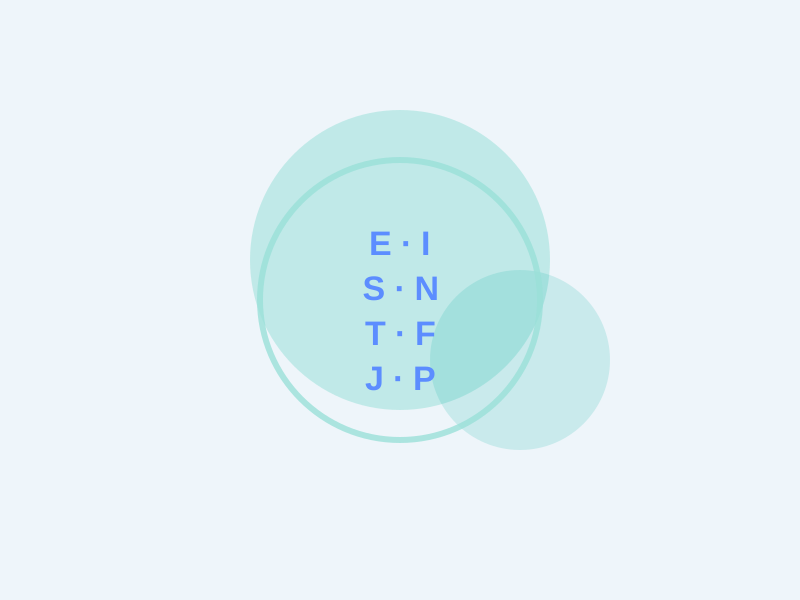
When someone says “16 Personalities,” they can mean three different things:
- The official MBTI (Myers-Briggs Type Indicator), a commercial instrument from The Myers-Briggs Company, based on Jung’s theory of types.
- 16personalities.com, a very popular website that uses its own model, NERIS. According to its own documentation, it doesn’t work with Jung’s cognitive functions but with a reworked version of the Big Five traits, and it adds a fifth scale (Assertive/Turbulent) that appears as an -A or -T suffix in the result (INFJ-T, for example).
- Tests inspired by the four dichotomies, such as ours, which are neither the official instrument nor a reproduction of its algorithm.
That’s why two people who say “I’m an INFJ” may have taken very different tests. And it’s why, curiously, the 16personalities.com result is closer to the Big Five than its four-letter format suggests.
What they ask and how the result is calculated
Both tests on this site use the same response format: statements about you, rated on a five-point agreement scale from “Strongly disagree” to “Strongly agree.” What changes is what happens to those answers.
| Big Five test | 16 Personalities test | |
|---|---|---|
| Versions | 10, 50 or 120 statements | 16, 40 or 80 statements |
| What each item scores | One of the five traits (in the 120 version, also one of its six facets) | One of the eight poles (E, I, S, N, T, F, J, P) |
| Reverse-worded items | Yes: half of them in the 120 version | No; the 80 version includes consistency-check questions |
| Calculation | Sum per trait, from low to high | Sum per pole, keeping the pole with more points on each axis |
| Result | Five continuous scores, with the most pronounced trait as the headline | A four-letter code out of 16 possible |
An example from the Big Five: “I keep my things organized and in their place” adds to conscientiousness; “My workspace tends to be messy” also measures it, but in reverse. An example from the 16 Personalities test: “I enjoy meeting new people in almost any situation” adds to the E pole, and the final result compares the E total with the I total.
What you come away with
The most visible difference is on the results screen.
With the 16 Personalities test you get a memorable label, such as INTJ or ESFP, with a full description of the type. It’s easy to remember, share and compare with someone else’s. The price is that two people with the same code can be far apart: someone who wins the E by one point and someone who wins it by forty get the same letter.
With the Big Five test you get a profile: five positions on five scales. It’s less eye-catching, but it keeps the nuances. You might see, for example, that you are moderately extraverted, very conscientious and low in openness to experience, a combination no four-letter code captures.
What happens if you retake the test
This is where the design shows the most:
- In typological tests, a sizable share of people get a different type when they retake it, especially on the letters where they landed close to the midpoint. In his reviews of the MBTI, Pittenger (1993; 2005) collected studies in which a considerable proportion of people, close to half in some of them, changed at least one letter when retaking the questionnaire a few weeks later.
- In the Big Five there’s no boundary to cross: if you retake the test, the usual outcome is a small shift within the same scale. The meta-analysis by Gnambs (2014) confirms that Big Five questionnaires have high short-term stability.
A changed letter doesn’t mean your personality has changed. It means you were close to the cutoff.
How the results of one relate to the other
The four MBTI dichotomies aren’t unrelated to the Big Five. McCrae and Costa (1989) compared the two instruments and found clear correlations, of roughly this order: introversion with extraversion, -0.74; intuition with openness to experience, 0.72; feeling with agreeableness, 0.44; perceiving with conscientiousness, -0.49.
In practice, if you take both tests, you can expect your code and your profile to tell a similar story on four of the five dimensions. Neuroticism is the exception: the MBTI doesn’t measure it (the -A/-T suffix of 16personalities.com is that site’s way of bringing it in).
So which should you take first?
- If you want a quick, memorable result that’s easy to share, start with 16 Personalities.
- If you’re looking for a more nuanced portrait that stays stable over time, or want to check your code against something more granular, go on to the Big Five.
They aren’t incompatible. The 16 Personalities result is best understood as a simplified snapshot of several of the spectrums the Big Five measures. If you want to know which questions await you in each one, you’ll find the details in how many questions the 16 Personalities test has and in what Big Five test questions look like.
Sources
- Gnambs, T. (2014). A meta-analysis of dependability coefficients (test-retest reliabilities) for measures of the Big Five. Journal of Research in Personality, 52, 20-28. https://doi.org/10.1016/j.jrp.2014.06.003
- McCrae, R. R., & Costa, P. T. (1989). Reinterpreting the Myers-Briggs Type Indicator from the perspective of the five-factor model of personality. Journal of Personality, 57(1), 17-40. https://doi.org/10.1111/j.1467-6494.1989.tb00759.x
- Pittenger, D. J. (1993). The utility of the Myers-Briggs Type Indicator. Review of Educational Research, 63(4), 467-488. https://doi.org/10.3102/00346543063004467
- Pittenger, D. J. (2005). Cautionary comments regarding the Myers-Briggs Type Indicator. Consulting Psychology Journal: Practice and Research, 57(3), 210-221. https://doi.org/10.1037/1065-9293.57.3.210
- NERIS Analytics. (n.d.). Our framework. 16Personalities. https://www.16personalities.com/articles/our-theory
Want to know more about yourself?
Discover your result with one of our related tests.
Frequently asked questions
Do Big Five and 16 Personalities measure the same thing with different labels?
No. Big Five places you on five continuous scales (more or less extraverted, for instance). 16 Personalities assigns you to one of 16 closed categories built from four binary preferences. They're different ways of organizing the same information about personality, not the same data under another name.
Which one is more reliable if I retake it months later?
Big Five tends to show stronger test-retest stability in the available research. In typological models like 16 Personalities, it's common for a share of people to land on a different type when they retake it, especially on dimensions where their score sat close to the midpoint.
Can I take both tests?
Yes, and they don't contradict each other: you can treat your 16 Personalities result as a memorable translation of a pattern that, underneath, still moves along continuous spectrums like the ones Big Five measures.
Is 16personalities.com the same as the MBTI?
No. 16personalities.com uses its own model, NERIS, which according to its documentation is based on a reworking of the Big Five traits and adds a fifth scale (Assertive/Turbulent, the -A or -T suffix). The official MBTI is a separate commercial instrument based on Jung's theory of types. Our 16 Personalities test is neither of the two: it is inspired by the four dichotomies.