Catharsis: why venting can fuel anger instead of putting it out
Hitting a punching bag while thinking about whoever drove you up the wall seems like the healthiest way to let rage out. In 2002, an American psychologist decided to test it in the lab. The bag put nothing out. It did exactly the opposite.
The idea that anger builds up like steam in a pressure cooker, and that you have to let it out before it explodes, is so widespread that almost nobody questions it. It has an old and prestigious name: catharsis. It also has a problem: when it has been tested with real anger, it does not behave the way it promised.
Catharsis meaning: where the word comes from
Catharsis comes from the Greek katharsis, meaning cleansing. It is usually translated as purification or as purging, in an almost medical sense: removing something the body has too much of.
Its first famous use is in Aristotle’s Poetics, in his definition of tragedy. Tragedy, he writes, imitates a serious and complete action and, through pity and fear, brings about the catharsis of those emotions. It is the only passage in the work where he uses the word in that sense, and he does not explain it. We have spent twenty-four centuries arguing about exactly what he meant.
From Greek tragedy to Freud’s consulting room
At the end of the nineteenth century, the word made the jump to psychology. Josef Breuer and Sigmund Freud called their treatment the cathartic method, which they described in Studies on Hysteria (1895). Under hypnosis, the patient recalled the experience that had marked her and released the emotion that, according to them, had become stuck. One of their patients, known as Anna O., named it “the talking cure”.
That is where the image we now use without thinking comes from: emotions as internal pressure that needs a release valve.
The punching bag experiment
Psychologist Brad Bushman set out to measure whether that valve worked for anger. He published the result in 2002 under a very telling title: “Does venting anger feed or extinguish the flame?”
First he made the participants angry: each one wrote a short essay and received an insulting comment on it. Then he split them into three groups:
- Rumination: they hit a punching bag while thinking about the person who had insulted them, whose photo was in front of them.
- Distraction: they hit the same bag, but while thinking about getting fit.
- Control: they did nothing.
At the end, everyone had the chance to punish the person who had insulted them with blasts of loud noise, at an intensity they chose themselves.
The group that hit the bag while thinking about their offender felt the angriest and was the most aggressive. The distraction group came next. Those who did nothing were the least aggressive. Bushman summed it up with an image that has been quoted widely ever since:
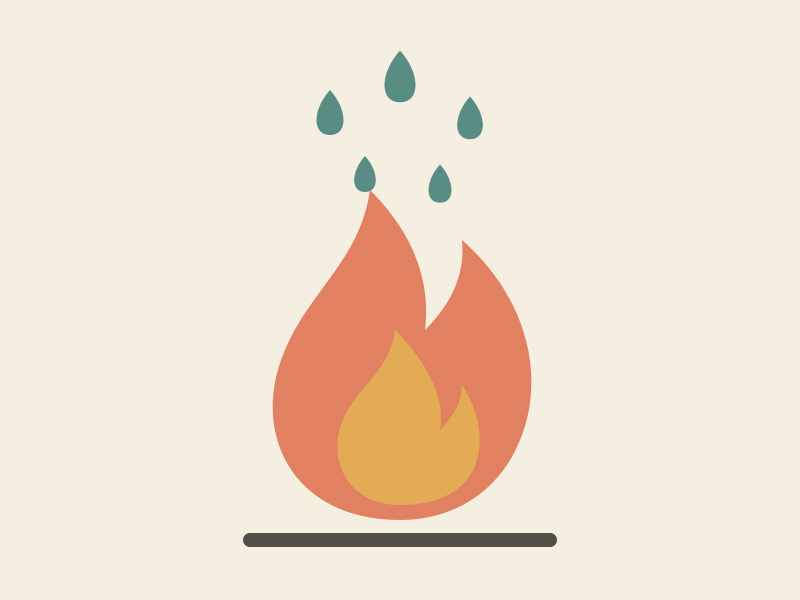
Venting to reduce anger is like using gasoline to put out a fire.
Venting at the person who made you angry: the case of John and Louise
Roger Fisher and Daniel Shapiro, of the Harvard Negotiation Project, reach a similar conclusion from a different place: the negotiating table. In Beyond Reason (2005) they tell the story of “John” and “Louise”, fictional names for a divorced couple with two children. She has them during the week and he has them at weekends.
Several weeks in a row, John is late bringing the children back.
- The first week, Louise says nothing. Better to get along, for the children’s sake.
- The second week, she still keeps quiet, biting her tongue.
- The third week, she decides to vent. She walks out of the house to his car and shouts: “Can’t you tell the time? You’re late. You’re always late. It’s so typical of you!”
John defends himself by attacking: “If you hadn’t brought them late, maybe they’d be on time. It’s just like you to try to control me like this.”
What the authors describe next is the exact mechanism by which venting makes things worse. For every attack, the other person builds a justification. Each one becomes more convinced they are right. As the anger grows, the situation looks black and white: I am right, my ex is not. And the more justified each one feels, the more entitled they believe they are to be furious.
The more often you justify your anger, to a colleague, to a friend or to the person who upset you, the more convinced you become. Instead of being vented, the anger grows.
The friend who agrees with you: a festival of self-justification
The episode has a second part that almost all of us have lived through. After dropping off the children, John goes to a bar and runs into a friend. “That Louise is out of control! It’s like she’s holding the kids hostage!” The friend nods: “Yeah, that’s ridiculous. She has no right!”
John leaves the bar more convinced than ever. Fisher and Shapiro have a very vivid name for this: a festival of self-justification. Venting to someone who is unconditionally on our side does not discharge the anger. It loads it with arguments.
So, is venting good or bad?
Neither Bushman nor the Harvard authors say emotions should be swallowed. What they question is one particular way of letting them out: the kind that goes over the offense, amplifies it and looks for allies. Fisher and Shapiro distinguish four reasons for expressing a strong emotion in a negotiation:
- to get it off your chest,
- to let the other person know the effect their behavior has had,
- to influence them,
- and to improve the relationship.
For the first, the most tempting one, they describe alternatives that look nothing like a punching bag:
- Talking to someone who moderates, not someone who cheers. A trusted friend who is told, literally: “I don’t think I’m seeing this clearly. Can you help me?”
- Venting as if you were the other person. Telling the story of the conflict from the point of view of whoever made you angry. It forces you to understand them and, along the way, lowers the temperature.
- Writing the letter and not sending it. At least not before letting a day pass and rereading it with a cool head.
- Not bringing up past grievances. Louise and John started out arguing about schedules and ended up with “you’re always late” and “it’s just like you”. That is where the conflict stopped being contained.
In their notes, the authors point to the research gathered by Eileen Kennedy-Moore and Jeanne Watson in Expressing Emotion (1999) and by Carol Tavris in Anger: The Misunderstood Emotion (1989), two classic references on the limits of venting.
The emotional catharsis that does seem to help: understanding the emotion’s message
The deeper proposal of Beyond Reason is to change the question. Instead of “how do I let this out?”, ask “what is this telling me?”. An emotion, they write, carries a message, and understanding it already brings some relief.
Louise replays the scene with that idea. Before John arrives, she takes a few minutes and works out what is really hurting her: that he changes the schedule without consulting her. That understanding, they write, takes some of the tension away. When John shows up, she does not shout that he is an irresponsible father. She tells him: “I’m upset. I understood we had agreed on a time to drop the children off. Am I wrong? I left a meeting early to be here.” And then she asks how he sees it.
It is not a magic sentence. It is a sentence that leaves room for active listening instead of shutting it out. It is much closer to emotional self-regulation than to repression, and very far from passive-aggressive communication, which is usually what is left when someone keeps quiet for three weeks.
What about rage rooms?
These days there are places where you pay to smash plates and televisions with a bat. We are not aware of conclusive studies on rage rooms specifically. What is known is that the condition in Bushman’s experiment that most resembles them (hitting something while thinking about what makes us angry) was the one that left people the most furious.
Breaking things may well be fun. What the research does not support is the idea that it puts anger out.
Why this matters in any negotiation
In a negotiation, vented anger has an extra effect: it is contagious. Every blow calls for another, and the conflict enters a spiral of retaliation that looks a lot like the one described by the eye for an eye principle. That is why the most experienced negotiators treat anger as a signal to read, not as pressure to release.
If you are curious about how often intense emotions carry you away, you can try our quiz Do I often suffer emotional hijackings?.
Sources
- Aristotle. Poetics, chapter 6 (1449b24-28).
- Breuer, J. and Freud, S. (1895). Studien über Hysterie (Studies on Hysteria). Deuticke.
- Bushman, B. J. (2002). Does venting anger feed or extinguish the flame? Catharsis, rumination, distraction, anger, and aggressive responding. Personality and Social Psychology Bulletin, 28(6), 724-731. https://doi.org/10.1177/0146167202289002
- Fisher, R. and Shapiro, D. (2005). Beyond Reason: Using Emotions as You Negotiate. Viking Penguin. Chapter 8, “On Strong Negative Emotions”, and “Works Consulted” notes.
- Kennedy-Moore, E. and Watson, J. C. (1999). Expressing Emotion: Myths, Realities, and Therapeutic Strategies. Guilford Press. (Cited by Fisher and Shapiro.)
- Tavris, C. (1989). Anger: The Misunderstood Emotion. Simon & Schuster. (Cited by Fisher and Shapiro.)
Want to know more about yourself?
Discover your result with one of our related tests.
Frequently asked questions
What does catharsis mean?
It comes from the Greek katharsis, meaning cleansing, and is usually translated as purification or purging. Aristotle used it in the Poetics to describe the effect of tragedy, which through pity and fear brings about the catharsis of those emotions. Today it is used to refer to an intense emotional release.
What is emotional catharsis?
It is the idea that expressing a pent-up emotion, especially anger or sadness, discharges it and makes it subside. Breuer and Freud called their late nineteenth-century treatment the 'cathartic method'. Later research on anger has heavily qualified that idea.
Is venting good for you?
It depends on how. In Brad Bushman's experiment (2002), people who hit a punching bag while thinking about the person who had offended them ended up angrier and more aggressive than those who did nothing. Fisher and Shapiro also point out that venting to someone who simply agrees with us tends to reinforce the anger.
Who first spoke of catharsis?
The earliest known use in this sense is in Aristotle's Poetics, in the fourth century BC, in his definition of tragedy. It is the only passage in that work where he uses the term this way, and he never explained it, so its exact meaning is still debated.
Do rage rooms work for releasing anger?
We are not aware of conclusive studies on rage rooms specifically. The closest thing that has been studied is Bushman's experiment, in which hitting something while thinking about the person who caused the anger was the condition that left the most anger and the most aggression.