What Is Ned Herrmann's Brain Dominance Model?
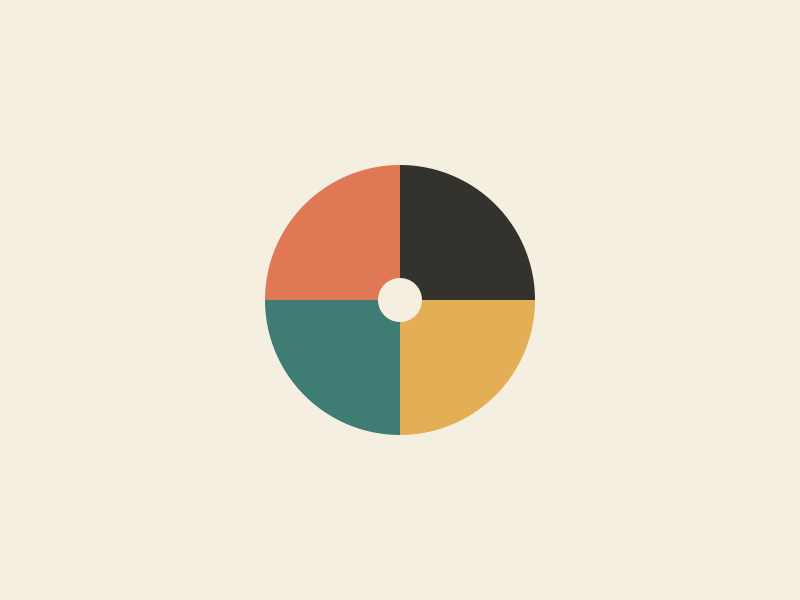
In the 1970s, consultant Ned Herrmann, who was then working in executive training at General Electric, asked an unusual question for the time: if the brain has specialized parts, why not design a tool that describes how each person thinks based on that specialization?
The result was a model that combines two ideas from neuroscience that already existed separately.
Two axes, four quadrants
The first idea is the hemispheric specialization described by Roger Sperry, in the popularized version circulating at the time: the left hemisphere, more tied to logic, language, and sequential thinking; the right, more given to the visuospatial, the intuitive, and the emotional.
The second is neuroscientist Paul MacLean’s triune brain, which distinguishes between more “cortical” processing (rational, abstract) and more “limbic” processing (emotional, tied to relationships).
Herrmann crossed both axes, left/right hemisphere and cortical/limbic, to get four quadrants, each with a different way of thinking, learning, and working:
- Left cortical (logical): analytical, fact-based, quantitative. Thinks in terms of data, logic, and cause and effect.
- Left limbic (organizer): sequential, planned, detail-oriented. Needs order, structure, and clear steps.
- Right limbic (interpersonal): feelings-based, expressive, sensitive to a situation’s emotional context.
- Right cortical (holistic): intuitive, integrative, comfortable with ambiguity and big ideas rather than detail.
One challenge, four ways to approach it
The model’s practical value shows up when you translate it into how each profile prefers to learn. Take an everyday task as an example: learning to use a new piece of software at work.
According to the model, the logical profile will want to understand how it works under the hood and why it was designed that way before touching anything. The organizer will look for a step-by-step manual with no loose ends, and will feel uneasy having to improvise.
The interpersonal profile will learn best if a colleague shows them in person and talks through questions along the way. And the holistic profile will prefer to dive straight in, work out the general logic through experience, and fit the pieces together afterward.
None of these routes is better than the others: they describe preferences, not abilities.
Hardly ever a single quadrant
Almost nobody fits neatly into a single quadrant. The instrument Herrmann developed, the HBDI, places each person at a point on the map, often with a marked preference for two quadrants and less for the other two, rather than in a single closed box.
It’s also common for the same person to lean on a different quadrant depending on the terrain: very organized at work and much more interpersonal and intuitive in their personal life, with no contradiction at all.
Where this model came from
Herrmann was looking for a tool that would help explain why the same training program worked very well with some employees and left others cold.
Over time, Herrmann Brain Dominance Technology spread far beyond the company where it was born, becoming one of the standard references, alongside Kolb’s model and Honey and Mumford’s, for explaining why the same content can be taught in very different ways depending on who it’s aimed at.
What neuroscience says today about its two pillars
The four quadrants are best read for what they are: a metaphor for thinking style, not an anatomical map. Herrmann’s own organization presents them that way, as a model for talking about ways of thinking without assigning them to a specific physical location.
Both of the model’s neuroscientific pillars have aged badly as literal descriptions of the brain:
- The triune brain has been superseded. MacLean’s idea of a brain built in evolutionary layers (reptilian, limbic, neocortex) doesn’t hold up in today’s comparative neurobiology: vertebrates didn’t keep adding new layers on top of an ancient core, they reorganized structures they already shared. Cesario, Johnson, and Eisthen (2020) sum it up in the title of their review: your brain is not an onion with a tiny reptile inside.
- There are no “left-brained” or “right-brained” people. Sperry’s findings on patients whose corpus callosum had been severed are solid, but the popular version that sorts people by their dominant hemisphere is not. Nielsen et al. (2013) analyzed the brain connectivity of 1,011 people aged 7 to 29 and concluded that lateralization is a local property of certain networks, not a global trait that sets some individuals apart from others.
Add to this what happens with learning styles in general: the hypothesis that people learn more when teaching matches each student’s preferred style has found no support in well-designed studies (Pashler et al., 2008). The HBDI can still be useful as a conversation about preferences within a team; what it lacks is any basis for classifying brains.
Why it connects with other models on this site
The left limbic quadrant, centered on order and sequence, shares ground with what people with a reading/writing style look for when organizing their knowledge in writing.
The right cortical quadrant, more intuitive and less tied to verbal detail, has things in common with people who learn better by doing than by reading step-by-step instructions.
Neither model measures exactly the same thing (one focuses on the input channel, the other on the processing style), but both share a limit: they describe preferences in processing information, and their value lies in self-knowledge, not in a final label.
Sources
- Herrmann, N. (1996). The Whole Brain Business Book. McGraw-Hill.
- Honey, P. & Mumford, A. (1986). The Manual of Learning Styles.
- Cesario, J., Johnson, D. J. & Eisthen, H. L. (2020). Your brain is not an onion with a tiny reptile inside. Current Directions in Psychological Science, 29(3), 255-260. doi:10.1177/0963721420917687
- Kolb, D. A. (1984). Experiential Learning: Experience as the Source of Learning and Development. Prentice-Hall.
- MacLean, P. D. (1990). The Triune Brain in Evolution: Role in Paleocerebral Functions. Plenum.
- Nielsen, J. A., Zielinski, B. A., Ferguson, M. A., Lainhart, J. E. & Anderson, J. S. (2013). An evaluation of the left-brain vs. right-brain hypothesis with resting state functional connectivity magnetic resonance imaging. PLoS ONE, 8(8), e71275. doi:10.1371/journal.pone.0071275
- Pashler, H., McDaniel, M., Rohrer, D. & Bjork, R. (2008). Learning styles: Concepts and evidence. Psychological Science in the Public Interest, 9(3), 105-119. doi:10.1111/j.1539-6053.2009.01038.x
- Sperry, R. W. (1982). Some effects of disconnecting the cerebral hemispheres. Science, 217(4566), 1223-1226.
Want to know more about yourself?
Discover your result with one of our related tests.
Frequently asked questions
How is Herrmann's model different from VARK?
VARK describes the sensory channel through which information best enters (seeing, hearing, reading, doing). Herrmann's model instead describes the thinking style used to process that information once received: analytical, organized, interpersonal, or holistic. They're different questions, not rival versions of the same thing.
What is MacLean's 'triune brain'?
A model proposed by neuroscientist Paul MacLean that distinguishes three brain structures by evolutionary age: the reptilian brain (basic survival functions), the limbic system (emotions), and the neocortex (abstract reasoning). Herrmann took from it the distinction between limbic and cortical processing for his own model.
How is Herrmann's model measured?
With the HBDI (Herrmann Brain Dominance Instrument), a questionnaire that places each person at a point on a four-quadrant map, usually with a preference for more than one, not in a single closed box.
Does this model have strong scientific backing?
It starts from neuroscience ideas of its time (Sperry's hemispheric specialization and MacLean's triune brain, the latter now discarded as a description of the brain), but, as with most learning-style models, its practical application in teaching has limited empirical support. Its main value is self-knowledge about how you prefer to think, not a closed diagnosis.