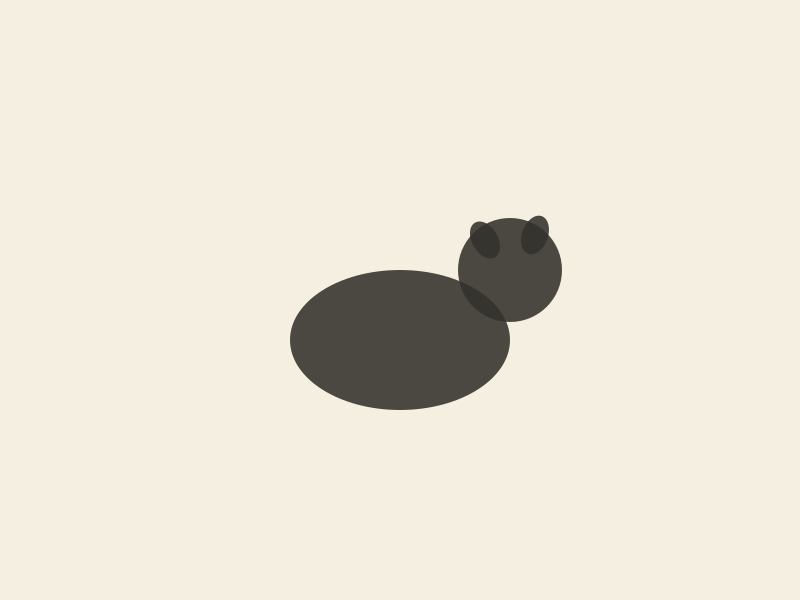
This test is built on the real method of Sidney Levy, the Levy Animal-Drawing-Story Technique (LADS), published in 1958. His original instruction: "Draw an animal. Any animal you like." The full protocol then asks you to invent a story, something we don't reproduce here given the brief nature of this test; we keep the graphic part.
The appeal of drawing an animal instead of a person: projecting yourself onto an animal would allow more emotional distance, making it easier to express content that would otherwise stay more guarded.
How the report works
It uses 9 indicators: 4 are measured directly on your canvas (size, placement, thickness, shading) and 5 depend on you telling us what you drew (type of animal, aggressiveness, disparaging tone, whether you erased anything, perspective). Unlike other tests on this site, there is a real study with data from 149 children (Ballús, Barbosa, Sales, & Gómez, 2020) comparing adopted children, non-adopted children, and children in psychological treatment: some indicators showed real differences between groups, and others didn't.
A canvas drawn with a mouse will never capture the nuance of a real pencil stroke, but it does capture magnitudes (size, position, thickness), which is exactly what we measure. We're not claiming diagnostic precision, and neither does the original test.
Sources
- Ballús, E., Barbosa, P., Sales, A., & Gómez, A. (2020). Adoption and projective techniques: a comparative study using the animal drawing test (LADS). Psicopatología y Salud Mental del Niño y del Adolescente, 35, 69-81.
- Levy, S., & Levy, R. B. (1958). Normative data, frequencies, and symbolism in the drawing of an animal, based on a sample of 7,346 drawings, cited in Ballús et al. (2020).
- Hammer, E. F. (1958). The Clinical Application of Projective Drawings. Charles C Thomas.
- Maganto Mateo, C. (1990). Test Gráfico del Dibujo de un Animal. TEA Ediciones.
- Motta, R. W., Little, S. G., & Tobin, M. I. (1993). The use and abuse of human figure drawings. School Psychology Quarterly, 8(3), 162-169.
All possible results
Your Animal Drawing Report
Nine real indicators from Levy's method, each one connected to what you drew: what he and later researchers claimed about that specific value, and what the scientific evidence says today, including a study with real data from 149 children.
See the detail
Sidney Levy published his technique in 1958. A 2020 Spanish study, with children across three groups (adopted, non-adopted, and in psychological treatment), tested several of its indicators against real data (Ballús et al., 2020): the result is more nuanced than for other techniques on this site, with some indicators showing real differences and others showing none. This report exists to show the real method, with the same rigor used to study it today, not to diagnose anything about you or evaluate any child.
Indicative result, not a diagnosis. Drawing tests have no recognised diagnostic validity: research does not support most of their interpretations. This describes what you drew today, not your personality or your psychological state.
How this test was built
A report with 9 indicators : 4 are measured directly on your drawing (size, placement, line thickness, shading) and 5 depend on your answer about what you drew (type of animal, aggressiveness, derogatory tone, perspective, smudges).
This is not a psychological diagnosis or a validated personality test, and it does not replace a professional's evaluation.
Unlike other techniques on this site, this one does have a real study with data (Ballús et al., 2020, with 149 children across three groups): small size and shading showed real differences between a group in psychological treatment and unt…
See the full methodology
What it measures
A report with 9 indicators: 4 are measured directly on your drawing (size, placement, line thickness, shading) and 5 depend on your answer about what you drew (type of animal, aggressiveness, derogatory tone, perspective, smudges).
What model it uses
Levy's idea: projecting yourself onto an animal, instead of a person, would allow more emotional distance and let out content that would otherwise stay more protected.
- Type and aggressiveness of the animal: would express your own tendencies (passive or aggressive).
- Line and placement: would follow the same logic as other drawing techniques of the era.
Where that model comes from
Sidney Levy published the Animal Drawing and Story Technique (LADS) in 1958.
How the result is calculated
You draw an animal on a single canvas. The size, placement, line thickness, and shading are measured directly; the other 5 indicators depend on 5 short questions about what you drew, because they require recognizing content (what animal, whether it's aggressive, how you'd describe it).
What your result means
Each indicator connects your specific value to the reading Levy and those who continued his work gave that exact value, and to what the evidence says today, including a study with real data from 149 children.
What it does NOT mean
This is not a psychological diagnosis or a validated personality test, and it does not replace a professional's evaluation. It's a symbolic reading from clinical tradition, meant for curiosity and reflection, not a tool that reliably reveals your traits.
Limitations
Unlike other techniques on this site, this one does have a real study with data (Ballús et al., 2020, with 149 children across three groups): small size and shading showed real differences between a group in psychological treatment and untreated groups, but the type of animal, its aggressiveness, the perspective, and the smudges didn't distinguish between groups, and in the case of smudges, the difference found ran in the opposite direction from what was expected. It's a more nuanced result than for other techniques, but it's still a single study, not a consolidated review. In the broadest review of this type of drawing, Motta, Little, and Tobin (1993) conclude that they don't reliably assess personality, behavior, or emotional state.
Academic references
- Levy, S. (1958). Figure drawing as a projective test. En Projective Techniques in Personality Assessment. Springer.
- Motta, R. W., Little, S. G., y Tobin, M. I. (1993). The use and abuse of human figure drawings. School Psychology Quarterly, 8(3), 162-169.
Frequently asked questions
Is this test a psychological diagnosis?
No, not under any circumstances. Even the original LADS test, applied by a trained clinician, isn't considered a reliable standalone diagnostic tool today. This report is informational: it shows the real method alongside the real scientific evidence about its validity.
Why does it ask you to draw an animal instead of a person directly?
Within this tradition, it's been argued that projecting yourself onto an animal allows more emotional distance than projecting directly onto a human figure, making it easier to express content that would otherwise stay more guarded.
Is it true there's a real study with data backing some indicators?
Yes, and it's unusual for this site: a 2020 study of 149 children found statistically real differences between a group in psychological treatment and groups without treatment in small drawing size and in shading. The type of animal, its aggressiveness, and the drawing's perspective, on the other hand, showed no real difference.
Can I retake the test?
Yes, as many times as you want. We don't save your drawing or your previous answers.
Is it free?
Yes, it's completely free: no sign-up or payment needed to take the test and see your result.
See all 6 questions
How long does the test take? How many questions does it have?
You draw an animal, then answer 5 short questions about your drawing. About 3-4 minutes in total.