What Is Brain Integration, According to Daniel Siegel?

Psychiatrist Daniel J. Siegel and psychotherapist Tina Payne Bryson, in their book The Whole-Brain Child (2011), take as their starting point the hemispheric specialization Roger Sperry studied: the brain’s two hemispheres don’t do exactly the same things.
But their contribution goes a step further by asking a very practical question: what happens when those two hemispheres aren’t coordinating well, and what can be done to help them work together?
A logical brain and a brain of sensations
Siegel and Bryson describe the left hemisphere as the side that wants and enjoys order: it’s logical, literal, and linear, and organizes information into sequences that make sense.
The right hemisphere, on the other hand, is holistic and nonverbal: it sends and receives signals like facial expressions, tone of voice, and gestures, and deals mainly with the overall impression of an experience (its meaning and its feel), specializing in images, emotions, and personal memories.
They sum it up in an easy-to-remember formula: the left brain cares about the letter of the law; the right, about its spirit.
A useful simplification, not an exact map
This division is a teaching device. Current neuroscience describes lateralization as a matter of degree: in most people language relies mainly on left-hemisphere networks, but the right hemisphere contributes to intonation and the meaning of speech, and both take part in emotion. A study of 1,011 people found no individuals who were globally “left-brained” or “right-brained”: lateralization is a local property of certain networks (Nielsen et al., 2013). Siegel and Bryson’s metaphor works as a guide to parenting, not as an anatomical description.
Why it dominates in childhood
Developmentally, in very young children, especially during the first three years, the right hemisphere dominates: they don’t yet have the logic and language needed to put what they feel into words, and they live much more intensely in the immediate present.
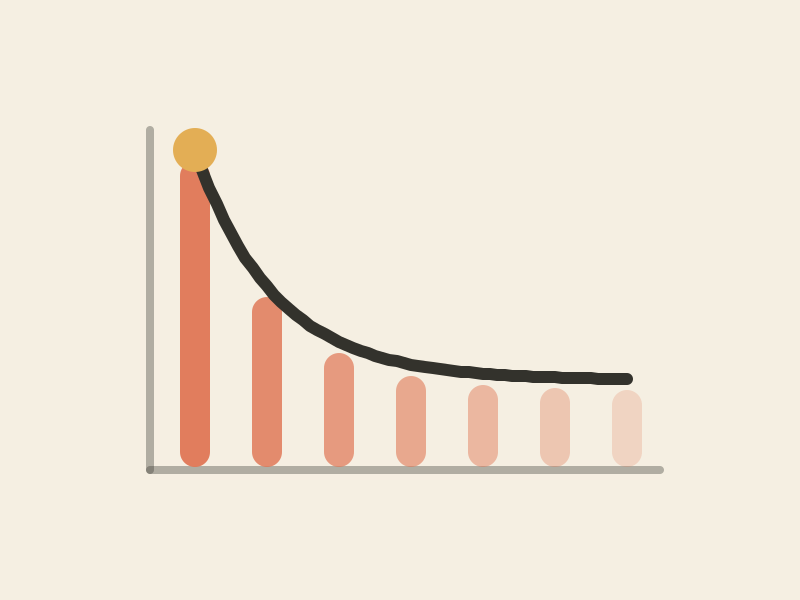
This part has concrete empirical support. Chiron et al. (1997) measured resting cerebral blood flow in children and found that between ages one and three, flow in the right hemisphere predominates; from age three onward the asymmetry shifts toward the left, just as language abilities take off.
The capacity for the left hemisphere’s logical, sequential thinking develops progressively, something you can notice in practice when, for example, a small child starts insistently asking “why?”
Two shores: the emotional flood and the emotional desert
The corpus callosum, the same structure Sperry studied by surgically severing it in his experiments, is what allows both hemispheres to work as a team in a healthy brain.
Siegel and Bryson compare trying to live using only one hemisphere to swimming with only one arm: it’s possible, but far less effective than using both at once, and the result tends to be going in circles instead of moving forward.
Two problematic extremes
When that coordination fails, Siegel and Bryson describe two equally problematic extremes.
If the right hemisphere dominates excessively, a person can feel overwhelmed by an emotional flood: images, bodily sensations, and intense emotions with no logical order to contain them.
If, on the other hand, the left dominates excessively, an emotional desert appears: excessive literalness and distance, where real emotions get denied or minimized in the name of a cold logic.
The river of well-being
The goal, according to the authors, isn’t for either hemisphere to win, but horizontal integration: the logic and order of the left side working alongside the emotional and experiential richness of the right, instead of one overriding the other.
Siegel and Bryson use an image to describe this balance: a river of well-being, with chaos on one bank and excessive rigidity on the other.
Mental health, in this metaphor, isn’t reaching a fixed point, but moving continuously down the center of that river, without running aground on either bank.
The other integration: upstairs brain and downstairs brain
The book doesn’t stop at the two hemispheres. Siegel and Bryson also describe vertical integration, between what they call the “downstairs brain” (deeper structures involved in quick reactions, intense emotions, and alarm) and the “upstairs brain” (the cortex, involved in planning, regulating emotions, and taking someone else’s perspective).
Their observation is that the upstairs brain is the last to mature, which is why a tantrum isn’t solved by asking a three-year-old for a self-regulation their cortex can’t yet sustain.
Connect before you reason
The authors describe a practical strategy for helping someone (a child, but really anyone) who’s caught in a right-hemisphere emotional flood: connect before you redirect.
Before trying to reason, explain, or correct, they suggest first validating what the other person feels, through gestures, tone of voice, and presence, the same nonverbal language the right hemisphere runs on.
Only afterward, once the person feels understood and their emotional activation has come down, does it make sense to bring in logic, explanation, or correction, appealing at that point to the left hemisphere.
In their reading, trying to reason before connecting tends to fail because you’re speaking to the wrong hemisphere at the wrong moment.
The strategy that completes this idea in the book is “name it to tame it”: helping someone put into words what happened, so that the left hemisphere’s orderly account gives shape to what the right experienced as sensation. We cover it separately in naming what you feel.
Why this idea fits with Herrmann’s model
This same distinction between more logical-sequential processing and more emotional-holistic processing is the idea on which consultant Ned Herrmann had built, decades earlier, his brain dominance model, which describes thinking and learning styles based on the same hemispheric specialization (also as a metaphor, not a map).
Where Herrmann translates that specialization into four thinking styles applied to work and learning, Siegel and Bryson stay at a more basic, everyday level: not so much which style dominates in each person, but whether both sides are, at any given moment, collaborating or working in isolation.
Siegel and Bryson develop this mostly with parenting in mind, but the underlying idea, that learning and functioning well requires coordinating both sides of the brain instead of letting one dominate, isn’t exclusive to childhood: it stays relevant for understanding how we learn and how we manage what we feel in adulthood, ground we cover in more detail in our piece on emotional self-awareness.
If you’d also like to explore your own predominant learning channel, we have a learning style quiz for that.
Sources
- Chiron, C. et al. (1997). The right brain hemisphere is dominant in human infants. Brain, 120(6), 1057-1065. doi:10.1093/brain/120.6.1057
- Herrmann, N. (1996). The Whole Brain Business Book. McGraw-Hill.
- Nielsen, J. A., Zielinski, B. A., Ferguson, M. A., Lainhart, J. E. & Anderson, J. S. (2013). An evaluation of the left-brain vs. right-brain hypothesis with resting state functional connectivity magnetic resonance imaging. PLoS ONE, 8(8), e71275. doi:10.1371/journal.pone.0071275
- Siegel, D. J. & Bryson, T. P. (2011). The Whole-Brain Child: 12 Revolutionary Strategies to Nurture Your Child’s Developing Mind. Delacorte Press.
- Sperry, R. W. (1982). Some effects of disconnecting the cerebral hemispheres. Science, 217(4566), 1223-1226.
Want to know more about yourself?
Discover your result with one of our related tests.
Frequently asked questions
What is horizontal brain integration?
The term psychiatrist Daniel Siegel uses to describe the coordination between the left hemisphere (logical, verbal, sequential) and the right (emotional, nonverbal, tied to experience), so that both work together instead of one dominating the other.
Why does the right hemisphere dominate in young children?
Because they don't yet have a strong grip on using logic and language to express their feelings, and they live much more anchored in the present and in immediate experience, functions typically associated with the right hemisphere.
What happens when one hemisphere dominates too much?
If the right dominates excessively, a person can feel overwhelmed by emotions and images with no logical order (what Siegel calls an 'emotional flood'). If the left dominates excessively, it can lead to excessive literalness and emotional distance (an 'emotional desert'), denying or minimizing what they feel.
Does this only apply to childhood?
Siegel develops the idea mostly in the context of parenting, but the underlying mechanism (coordinating logical and emotional processing so you don't get stuck at either extreme) describes a balance that stays relevant in adulthood too.